CRM Best Practices for Building Better Customer Relationships
Customer Relationship Management (CRM) can become much more valuable when it is supported by clear processes, accurate customer data, consistent communication, and thoughtful use of technology. Simply having a CRM system does not automatically improve customer relationships. The real benefit comes from how an organization collects information, manages interactions, supports employees, and uses customer context to make better decisions.
CRM best practices are therefore less about using every available feature and more about creating a practical system that fits the way an organization actually works. Businesses can improve CRM effectiveness by keeping customer records organized, defining clear processes, maintaining data quality, coordinating teams, using automation carefully, and regularly reviewing whether the system is helping employees create better customer experiences.
Start With the Customer, Not the CRM System
One of the most important CRM best practices is to start with customer needs rather than software features. Organizations sometimes begin CRM planning by comparing dashboards, automation tools, reports, or other technical capabilities before defining what they actually need to improve.
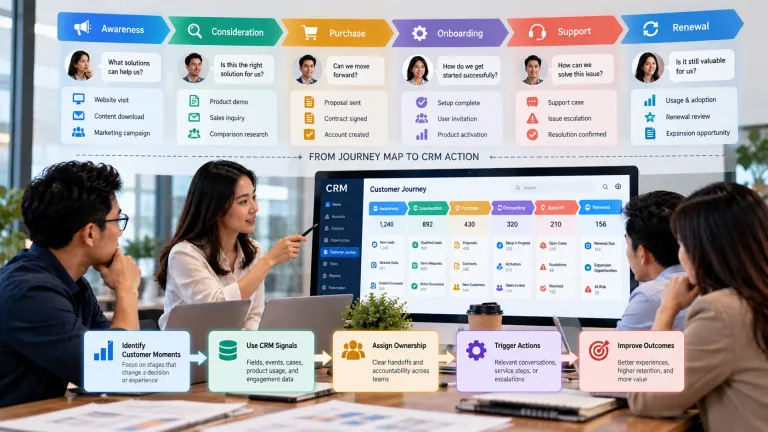
A stronger approach begins by examining the customer journey. What questions do customers commonly ask? Where do communication problems occur? Which parts of the experience require customers to repeat information? Where are follow-ups being missed? Which teams need better access to customer history?
These questions help connect CRM design to real customer problems. This is consistent with the broader purpose of CRM explained in this beginner’s guide to CRM: customer relationship management is most useful when information and interactions are organized around meaningful customer relationships.
Keep Customer Data Accurate and Consistent
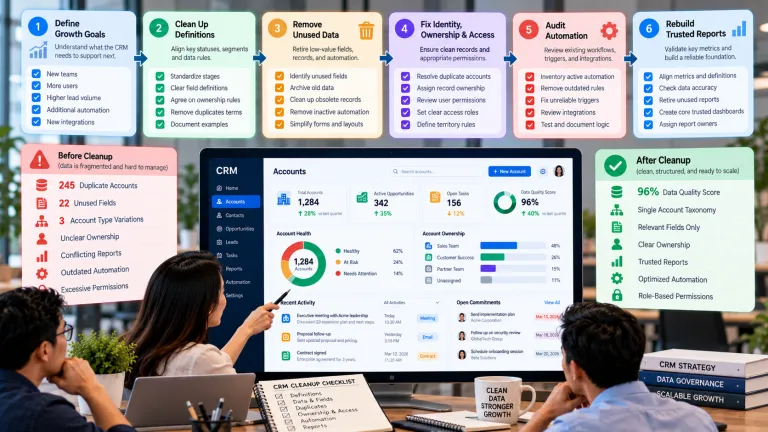
Good customer relationships depend on reliable information. If customer records are incomplete, duplicated, outdated, or inconsistent, employees may make decisions based on incorrect context. Even a well-designed CRM system can become difficult to use when data quality is poor.
Organizations should therefore establish clear rules for creating, updating, and maintaining customer records. Important fields should have consistent definitions, duplicate records should be identified, and outdated information should be reviewed regularly.
It is also important to avoid collecting information simply because the CRM allows it. The best customer data is not necessarily the largest amount of data. Information should have a clear purpose and provide value to the customer relationship or business process.
Create a Clear Customer Record Structure
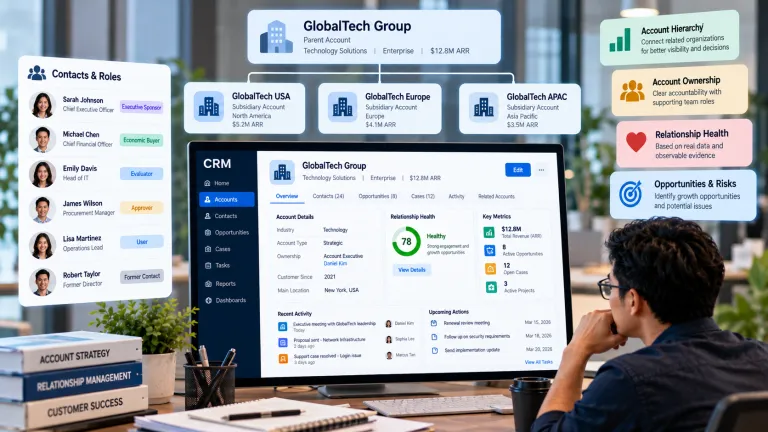
A CRM record should make it easy for employees to understand the customer relationship. At a minimum, relevant information should be organized in a way that connects customer identity with interactions, activities, service history, and other meaningful context.
Different organizations may require different structures, but consistency matters. If one employee records important information in one field while another uses a completely different location, the CRM becomes harder to interpret.
Understanding the key components of a CRM system can help organizations design this structure more effectively. Contact management, communication history, service cases, analytics, automation, and integrations should work as connected parts of the broader customer relationship.
Define Simple and Practical Workflows
CRM workflows should reflect how employees actually work. A complicated workflow can create unnecessary administrative effort, while an overly simple workflow may fail to capture important customer information or activities.
Organizations should define what happens at each important stage of the customer journey. For example, a new inquiry may require qualification, follow-up, and assignment. A support case may require investigation, communication, resolution, and documentation.
The workflow should make the next action clear without creating unnecessary steps. Employees are more likely to use CRM consistently when the system makes their work easier rather than adding layers of administration.
Make Customer Interaction History Useful
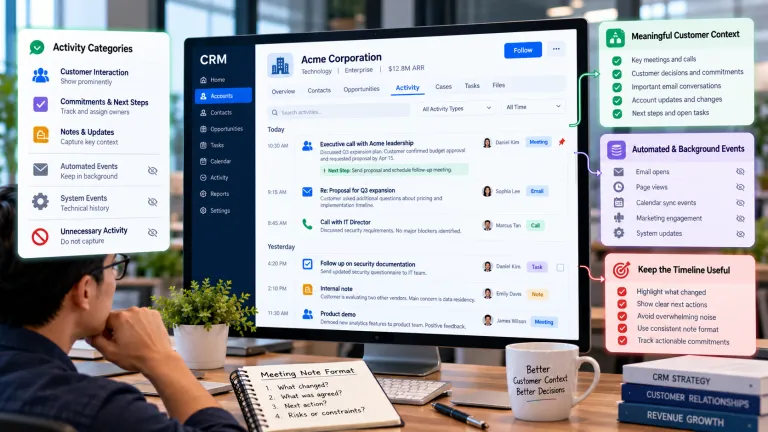
Customer interaction history is one of the most valuable parts of CRM, but only when it is captured and presented in a useful way. Emails, calls, meetings, support cases, and other activities can provide context that helps employees understand what has already happened.
Employees should not have to search through multiple disconnected systems just to understand a customer’s situation. Where appropriate, relevant interactions should be connected to the customer record so the relationship can be viewed as a continuous history.
This is especially important when customers move between employees or departments. A connected history can reduce repetition and help the next employee continue the conversation with greater context.
Use CRM to Improve Communication, Not Just Record It
A common mistake is treating CRM as a passive storage system. Customer information becomes more valuable when it helps employees communicate more effectively.
Before contacting a customer, employees should be able to review relevant history, understand previous concerns, and identify current activities. This can make communication more relevant and reduce unnecessary questions.
Consistency is also important. Customers should receive information that reflects the current state of their relationship rather than disconnected messages from different departments. CRM can provide the shared context needed to support that consistency.
Use Automation Where It Removes Repetition
Automation can be one of the most useful CRM capabilities when it is applied carefully. Repetitive activities such as reminders, notifications, record updates, task creation, or basic follow-up actions can often be structured so employees do not have to perform every step manually.
The key is to automate processes that are predictable and genuinely repetitive. Not every customer interaction should be automated. Situations involving complaints, unusual circumstances, sensitive information, or important relationship decisions may require human judgment.
AI can extend this capability further. As explained in AI automation in customer service, artificial intelligence can help classify requests, summarize conversations, support response generation, and assist with customer service workflows.
Personalize Without Becoming Intrusive
CRM can support more personalized customer experiences because it provides information about previous interactions, preferences, and behavior. However, personalization should be based on relevance rather than the assumption that more personalization is always better.
A customer may appreciate receiving information related to a known interest, but excessive or poorly timed personalization can feel intrusive. Organizations should therefore consider whether the information being used actually helps the customer.
AI can help identify patterns that support more relevant communication. Our article on AI-powered personalization in customer relationships explores how AI can combine customer behavior and context to support more adaptive experiences.
Coordinate CRM Across Teams
CRM works best when customer information remains useful across departments. Sales, marketing, customer service, account management, and other teams may each interact with the same customer at different points in the relationship.
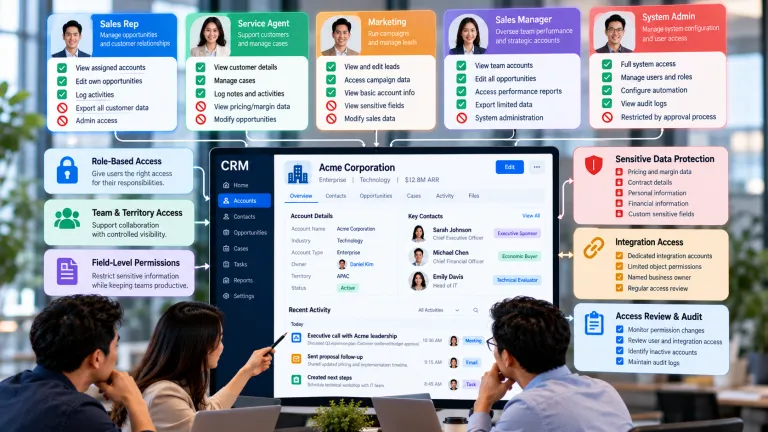
Organizations should therefore establish clear rules around ownership, access, updates, and information sharing. Employees need to know which information they are responsible for recording and which information other teams rely on.
This is particularly important for collaborative CRM. As discussed in the three main types of CRM, collaborative CRM focuses on making relevant customer information available across teams and communication channels.
Use Analytics to Learn, Not Just Report
CRM reports should help organizations understand what is happening rather than simply display large amounts of information. Useful reporting begins with clear questions: Which customer issues are increasing? Where are opportunities slowing down? Which interactions need attention? What changes are appearing in customer engagement?
Organizations should choose metrics that connect directly to meaningful business or customer outcomes. A dashboard can contain many numbers while still providing very little insight if those numbers do not support an actual decision.
More advanced analytics can also identify patterns that may not be obvious through standard reporting. Predictive analytics in CRM can help organizations explore possible future outcomes using historical and current customer information.
Protect Customer Data and Respect Privacy
Customer relationship management involves information that may be personal, sensitive, or commercially important. Good CRM practices therefore include appropriate access controls, security procedures, data retention practices, and clear policies for how customer information should be used.
Employees should only have access to information that is appropriate for their role. Organizations should also review which data is necessary for particular workflows rather than making every customer detail available to every system or employee.
Responsible CRM is not just a technical issue. It is part of maintaining customer trust. Customers are more likely to have confidence in an organization when information is handled carefully and used for clear purposes.
Train Employees and Encourage Consistent Adoption
A CRM system only becomes useful when employees actually use it consistently. If important interactions are recorded in personal notes or separate spreadsheets instead of the CRM, the shared customer history quickly becomes incomplete.
Training should focus not only on where to click but also on why certain information matters. Employees need to understand how accurate CRM records help their own work and how those records support colleagues and customers.
It is also important to listen to employees after implementation. If people repeatedly avoid a workflow, the problem may be with the design rather than employee discipline. CRM processes should be reviewed when they create unnecessary effort or do not reflect real work.
Review and Improve the CRM Over Time
CRM should not be treated as a one-time implementation project. Customer expectations, business processes, communication channels, and technology continue to change, which means CRM workflows may also need to evolve.
Organizations should periodically review whether customer records are still useful, whether workflows remain relevant, whether automation is producing the intended results, and whether employees are encountering unnecessary friction.
This continuous improvement mindset is important because CRM effectiveness depends on alignment between technology and the organization. As explained in how CRM works step by step, CRM creates value through a connected process of collecting information, managing interactions, organizing workflows, and using customer context to guide action.
Combine CRM With AI Thoughtfully
AI can expand what CRM systems are capable of, but it should be introduced on top of a strong operational foundation. Organizations that have inaccurate data or poorly designed workflows may gain limited value from advanced AI features.
Once the fundamentals are working well, AI can support tasks such as customer data analysis, summarization, personalization, automation, and decision support. The role of AI in customer data and decision-making explains how AI can help transform customer information into more useful context for employees.
The goal should not be to automate every customer interaction. AI should be used where it can reduce unnecessary effort, improve access to information, or help employees make better decisions while keeping appropriate human oversight.
Measure CRM Success From the Customer’s Perspective
CRM performance should not be evaluated only through internal productivity measures. Organizations should also consider whether the system is improving the customer experience.
Are customers receiving more consistent communication? Are employees able to resolve issues with better context? Are customers repeating information less often? Are follow-ups more reliable? Are personalized interactions genuinely more useful?
These questions help shift attention from CRM as an internal technology project toward CRM as a tool for improving customer relationships. The most meaningful results are often seen in the quality and consistency of customer experiences rather than in the number of features activated.
Conclusion
CRM best practices are ultimately about creating a reliable connection between customer information, business processes, employees, and customer experiences. Accurate data, clear workflows, useful interaction history, thoughtful automation, team coordination, analytics, privacy, and employee adoption all contribute to a stronger CRM environment.
The best CRM approach is not necessarily the most complicated one. It is the approach that helps employees understand customers, communicate consistently, respond efficiently, and make better decisions without creating unnecessary administrative work.
As AI continues to become part of CRM, these fundamentals become even more important. A strong CRM foundation gives organizations a better environment in which automation, analytics, personalization, and AI can create genuine value while human judgment remains central to meaningful customer relationships.