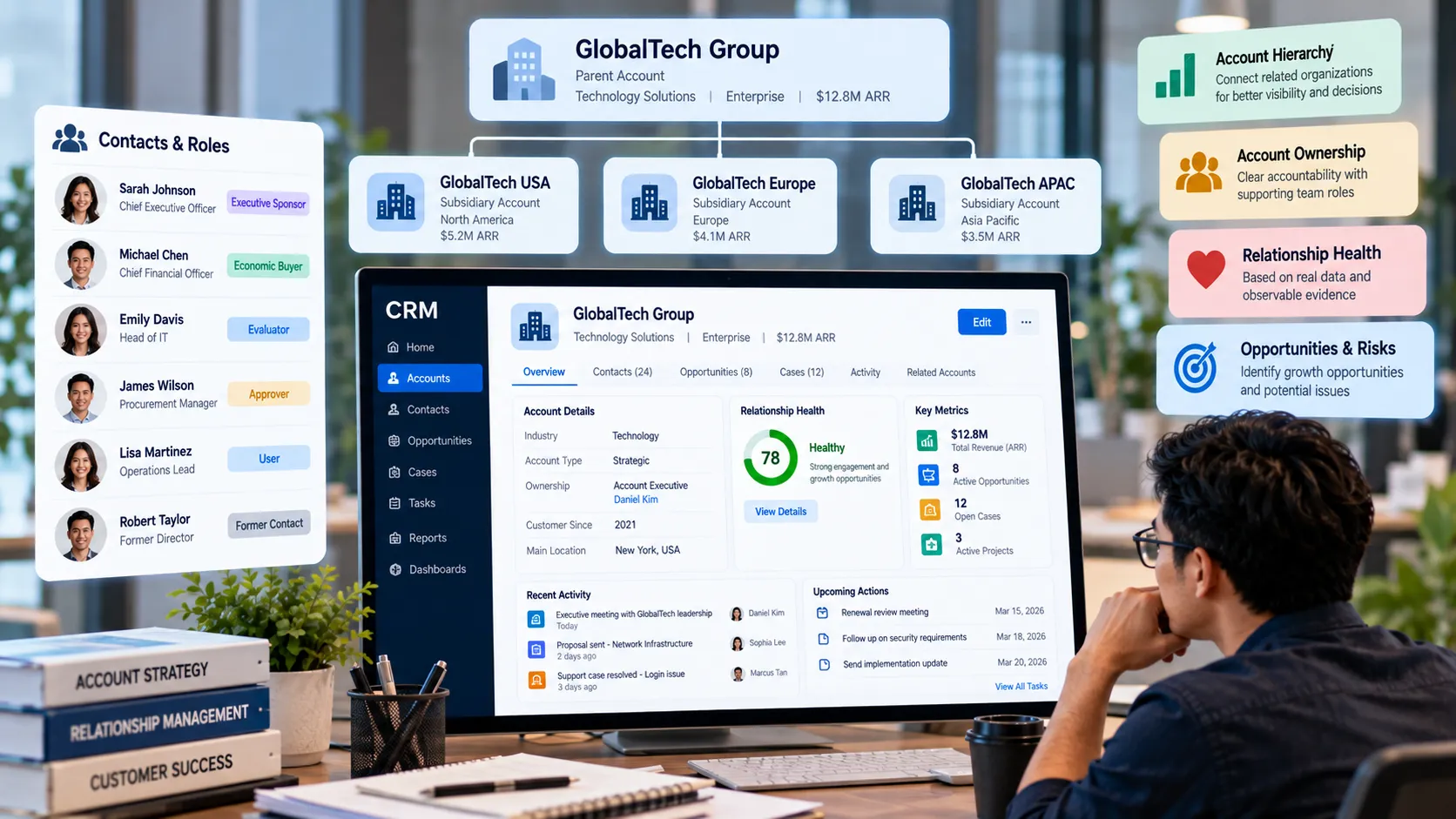
CRM Account Management: How to Organize Relationships Beyond Individual Contacts
A contact record tells you who a person is. It does not automatically tell you how that person fits into a customer relationship. In B2B and other relationship-heavy environments, the same organization may contain buyers, users, executives, blockers, partners, subsidiaries, and former contacts. Treating each person as an isolated record makes the CRM look complete while the real relationship remains fragmented.
CRM account management creates the structure that connects people and commercial activity to the organization they represent. The challenge is to model enough context for useful decisions without constructing a complex hierarchy that users cannot maintain.
Key Takeaways
Account structure should reflect how the business sells, serves, owns, and reports on relationships.
Contacts need roles and relationship context, not only job titles.
Parent-child hierarchies are useful when they change ownership, risk, purchasing, or reporting decisions.
Account ownership should distinguish commercial accountability from every person who contributes to the relationship.
Relationship health should be based on observable evidence rather than a single subjective label.
Decide What an Account Represents
An account might represent a legal entity, a purchasing organization, a physical location, a household, or another relationship unit. The correct definition depends on how contracts, ownership, service, credit, and reporting work. If the definition is unclear, duplicates and conflicting hierarchies appear quickly.
Document the account-creation rule and important exceptions. For example, a global company may require separate local operating accounts connected to one parent because contracts and sales ownership are local while executive reporting is global.
Connect Contacts to Roles, Not Just Accounts
A person’s title does not reliably explain their role in a specific buying or service relationship. A finance director may be an approver in one opportunity and only an informed stakeholder in another. Capture relationship roles where they influence action.
Avoid excessive role taxonomies. A small set such as economic buyer, champion, evaluator, user, approver, partner, and blocker may be enough if definitions are clear. When roles are opportunity-specific, store them at that relationship level rather than assuming one permanent role for the contact.
Use Hierarchies Only When They Support Decisions
Parent-child account structures can help with territory planning, enterprise agreements, risk visibility, and cross-sell coordination. They can also become difficult to maintain when legal and commercial structures differ or change frequently.
Ask what decision the hierarchy will support. If nobody uses the parent relationship for ownership, pricing, service, risk, or reporting, a complex hierarchy may not deserve operational maintenance. Preserve only the structure that employees can keep current and that changes how the business acts.
Clarify Account Ownership and Team Roles
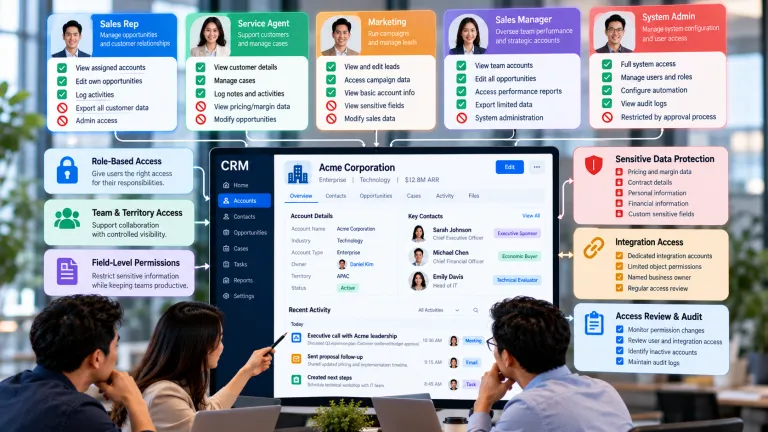
One account may involve an account executive, customer success manager, service owner, specialist, partner manager, and executive sponsor. If all of them are treated as the account owner, responsibility becomes unclear. Define one accountable role for the relevant commercial or service outcome and model contributors separately.
Ownership rules should also address absence, territory changes, mergers, and inactive employees. A CRM should make it difficult for important accounts to remain without an accountable owner simply because organizational changes occurred.
Build a Useful Account View
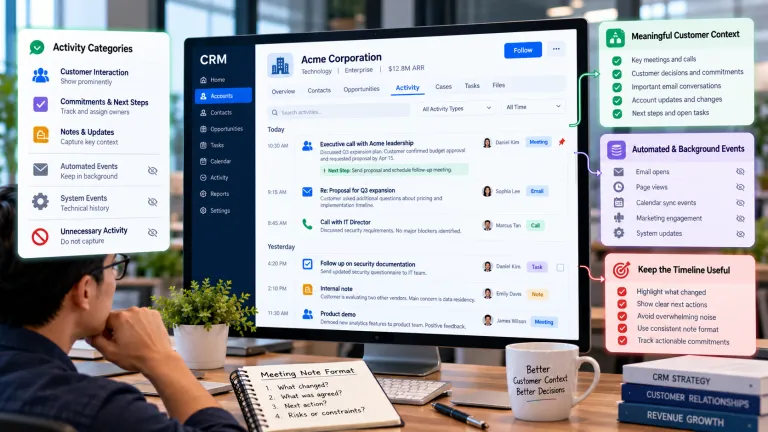
The account page should answer practical questions quickly: Who is this customer? What are the active commercial and service relationships? Who matters? What has happened recently? What commitments are open? What risks or opportunities require attention?
That does not require showing every available field. Use role-based layouts and summaries so the highest-value context is visible first, while detailed historical or administrative information remains accessible when needed.
Measure Relationship Quality With Evidence
A single red-yellow-green health field is easy to understand but can hide the reason behind the judgment. When relationship health matters, combine indicators such as unresolved critical cases, product adoption, payment issues, engagement with key stakeholders, renewal timing, open commitments, and recent executive interactions.
Not every signal should be combined into one score. Sometimes the most useful account view is a small set of distinct signals that help the owner understand what needs attention and why.
A Practical Account-Management Example
A consulting company sells to organizations with several regional offices. Its CRM stores each office as a separate account, so teams do not realize that three regions belong to the same parent group. One region has a strong relationship while another has an unresolved service issue, and the account executive preparing an executive meeting cannot see the full picture.
The company adds a lightweight parent-account structure and a relationship role for the group executive sponsor. Local ownership remains separate, but the parent view summarizes active projects, revenue, critical cases, and key contacts across regions. The hierarchy is intentionally limited to two levels because deeper legal structures would add maintenance without changing decisions.
What Belongs in an Account Model?
Information Useful When Avoid When
Parent-child hierarchy Group structure affects ownership, pricing, risk, or reporting. It is maintained only for completeness.
Contact role The role changes how a team communicates or decides. It duplicates a job title without added meaning.
Account owner One person is accountable for a defined relationship outcome. Ownership is used as a list of everyone involved.
Relationship health Signals lead to a clear review or action. A subjective color is updated inconsistently.
Strategic classification The category changes service, planning, or resource decisions. The label is prestigious but has no operational consequence.
Common Mistakes to Avoid
Creating hierarchies that mirror every legal entity
Legal structure is not always the structure teams need for customer decisions. Model the relationships that influence ownership, service, contracts, or reporting.
Treating job title as buying role
Roles are contextual. Capture the person’s role in the relationship or opportunity when that information matters.
Showing every field on the account page
A complete database does not require a crowded interface. Prioritize the context users need for the next decision and keep secondary details accessible without dominating the view.
What to Do Next
Define what an account represents in your business and document exceptions.
Review duplicate and fragmented accounts that may indicate inconsistent account-creation rules.
Identify the small number of contact roles that change communication or decision-making.
Clarify the difference between accountable account ownership and supporting team participation.
Add hierarchy only where it supports a real cross-account decision.
Design the account view around current risks, opportunities, relationships, and commitments.
Continue Reading on Clientira
Related Clientira guides provide additional context:
CRM Duplicate Records: Why They Happen and How to Prevent Them
CRM Field Design: How to Capture Useful Data Without Creating Clutter
Frequently Asked Questions
What is an account in a CRM?
An account is the organizational or relationship entity used to group contacts, activities, opportunities, service history, and other information. Its exact meaning should reflect how the business owns and manages customer relationships.
Should every company location have its own account?
Only when locations need separate ownership, contracts, service, reporting, or other operational treatment. Otherwise, separate location records may create unnecessary fragmentation.
What is the difference between account owner and account team?
The owner is accountable for a defined relationship outcome, while the account team includes other people who contribute specialist, service, success, partner, or executive support.
How should account health be measured?
Use a small number of observable signals connected to customer outcomes and risk. A summary rating can be useful, but it should be explainable through underlying evidence.
Final Thoughts
CRM account management is about organizing relationship context so people can act with a shared understanding. The model should connect organizations, people, roles, ownership, activity, and risk without trying to reproduce every detail of the customer’s corporate structure.
The right level of structure is the level your teams can maintain and use. If a hierarchy, role, or health measure does not change a decision, simplify it. Clear relationship context is more valuable than a complex model that looks impressive but quickly becomes stale.