CRM Duplicate Records: Why They Happen and How to Prevent Them
Two records for the same customer can look like a small housekeeping issue. In practice, duplicates fragment relationship history, split ownership, distort reports, trigger repeated outreach, and make automation less reliable. The problem becomes especially visible when sales, marketing, service, and integrations each create records using slightly different information.
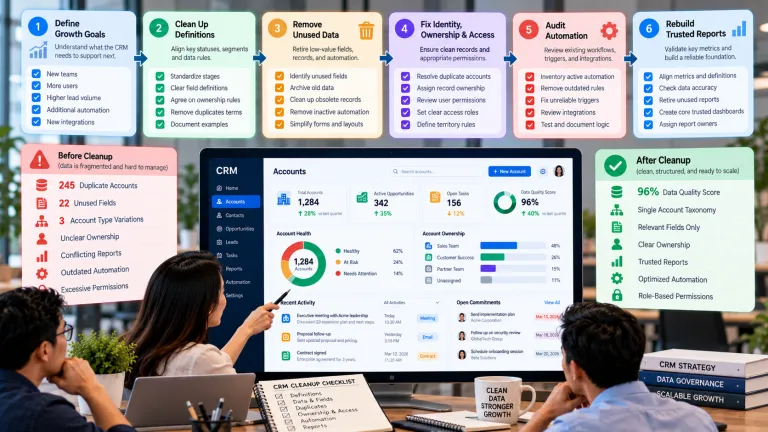
Deduplication tools are useful, but lasting improvement requires understanding why duplicate records enter the CRM in the first place. Prevention depends on identity rules, data-entry design, matching logic, integration behavior, and clear ownership. Cleaning records without fixing those causes simply resets the clock until the next cleanup.
Key Takeaways
Duplicates are an identity-management problem as much as a data-cleaning problem.
Prevention should happen at manual entry, imports, forms, integrations, and synchronization points.
Matching rules should use multiple signals because names and email addresses can legitimately change or repeat.
Merge decisions need rules for ownership, field precedence, activity history, and related records.
Track duplicate creation rate, not only the number of records cleaned.
Why Duplicate Records Appear
Duplicates often enter through several legitimate business processes. A representative creates a contact without searching first. A web form creates a new lead even though the person is already a customer. An integration identifies accounts using a different key. A list import contains variations in punctuation, company suffixes, phone formats, or email addresses.
The underlying issue is that the CRM must answer an identity question: when should two pieces of information be treated as the same person or organization? If each source answers differently, duplicates are inevitable.
Define Identity Before Writing Matching Rules
For an individual, email may be a useful signal but is not always a permanent identity key. People change employers, share addresses, use aliases, or provide personal and business emails. For companies, names are even less reliable because of abbreviations, legal entities, branches, and rebranding.
Create a hierarchy of identity signals. Strong identifiers may include an authoritative customer ID or verified account number. Supporting signals can include normalized email, phone number, website domain, address, legal name, or combinations of attributes. Matching should reflect the cost of a false merge as well as the cost of a missed duplicate.
Prevent Duplicates at Every Entry Point
A duplicate-prevention policy that applies only to manual CRM entry will miss forms, APIs, event tools, enrichment services, imports, and integrations. Inventory every source capable of creating or updating customer records and document its identity behavior.
At manual entry, provide search and duplicate warnings. For forms, attempt matching before creating a new person. For imports, run a pre-import comparison and require an owner to review uncertain matches. For integrations, use stable external IDs where possible and define whether the source may create records, update records, or both.
Design Safe Merge Rules
Merging is not simply deleting one record. The team must preserve activities, relationships, consent information, cases, opportunities, ownership, and other connected data. It also needs a rule for conflicting field values. The newest value is not always the most trustworthy value; a verified billing address may deserve priority over a recently imported marketing address.
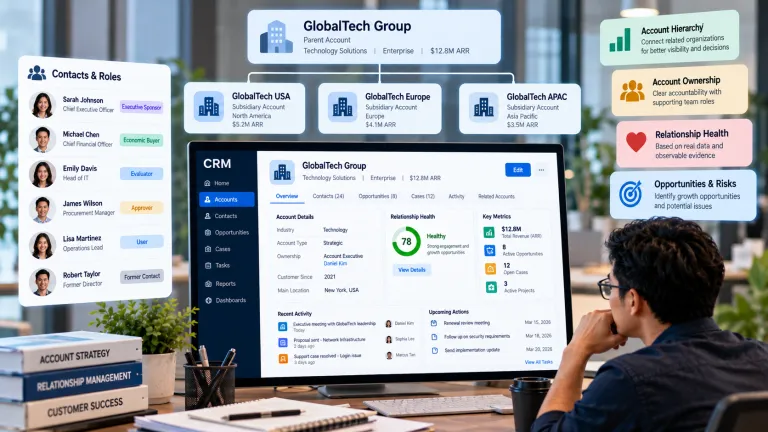
Use source trust, verification status, recency, and business purpose to define field precedence. High-risk merges should require review, especially when separate legal entities, households, branches, or similarly named contacts may legitimately coexist.
Measure the Process, Not Just the Backlog
A one-time cleanup can make a database look healthy while the underlying duplicate-creation rate remains unchanged. Track new suspected duplicates per period and, where possible, identify their source. If most new duplicates come from one web form or integration, prevention there will create more value than repeatedly running broad cleanup jobs.
Also monitor merge reversals or complaints. Aggressive matching can be as damaging as weak matching if distinct customers are incorrectly combined. Data quality should reduce ambiguity without erasing legitimate differences.
A Practical Duplicate-Prevention Scenario
A software company finds that one customer can appear as a lead from a webinar, a contact created by sales, and a user synchronized from the product database. Marketing reports three people, sales sees one buyer, and support conversations are attached to only one of the records.
The company introduces a verified customer ID for product users, normalizes email and domain values, and changes the webinar integration to search before creating. Potential matches with different employers are sent to review rather than automatically merged. During cleanup, activity history and consent status are preserved. Within several weeks, the duplicate backlog falls, but the more important result is that the rate of new duplicates from the webinar source drops sharply.
Choosing a Duplicate-Matching Response
Match Confidence Example Recommended Action
Very high Same verified customer ID. Update or merge automatically according to tested rules.
High Same normalized email plus matching name and organization. Warn or auto-match when the business risk is low.
Medium Same name and phone, but different email. Queue for review or ask the user to confirm.
Low Similar company names with different domains and addresses. Keep separate unless additional evidence appears.
Conflict Strong identifiers point to different entities. Stop automation and investigate before changing records.
Common Mistakes to Avoid
Using one field as universal identity
A single identifier such as email or company name may work often but can still produce false matches. Combine strong and supporting signals according to the business context.
Running cleanup without source analysis
If the team does not identify which processes create duplicates, the database will deteriorate again after the cleanup.
Merging without preservation rules
A merge can destroy ownership, consent, activity, or relationship information if the surviving record and field precedence are not defined in advance.
What to Do Next
List every manual and automated path that can create customer or account records.
Define authoritative identifiers and supporting matching signals for people and organizations.
Normalize common values such as email, phone, domain, and company suffixes before comparison.
Create separate policies for high-confidence matches, uncertain matches, and risky conflicts.
Document which values survive a merge and how related records are preserved.
Measure new duplicate creation by source so prevention efforts target the real cause.
Continue Reading on Clientira
Related Clientira guides provide additional context:
CRM Field Design: How to Capture Useful Data Without Creating Clutter
CRM Requirements Gathering: How to Define What Your Business Actually Needs
Frequently Asked Questions
What causes duplicate records in a CRM?
Common causes include inconsistent manual entry, web forms that always create new records, list imports, multiple integrations, weak matching rules, and the lack of a stable identity key across systems.
Should CRM duplicates be merged automatically?
Only when match confidence is high and the cost of a false merge is low. Ambiguous cases should be reviewed, especially for accounts, households, legal entities, or records with conflicting identifiers.
Is email a reliable duplicate key?
Email is useful but not universal. People can change jobs, use multiple addresses, share addresses, or enter aliases. Combine email with additional signals and use verified system identifiers where available.
How often should duplicates be reviewed?
Continuous prevention is preferable to occasional cleanup. Review duplicate-creation metrics regularly and run targeted cleanup when the backlog or source behavior indicates a problem.
Final Thoughts
Duplicate records are visible symptoms of a deeper identity problem. A clean database depends on consistent rules for recognizing customers across manual entry, forms, imports, and integrations.
The strongest program combines prevention with cautious matching and safe merging. When identity is managed deliberately, the CRM becomes more useful not only for reporting but also for the customer experience: employees can see one coherent relationship instead of several incomplete versions of it.