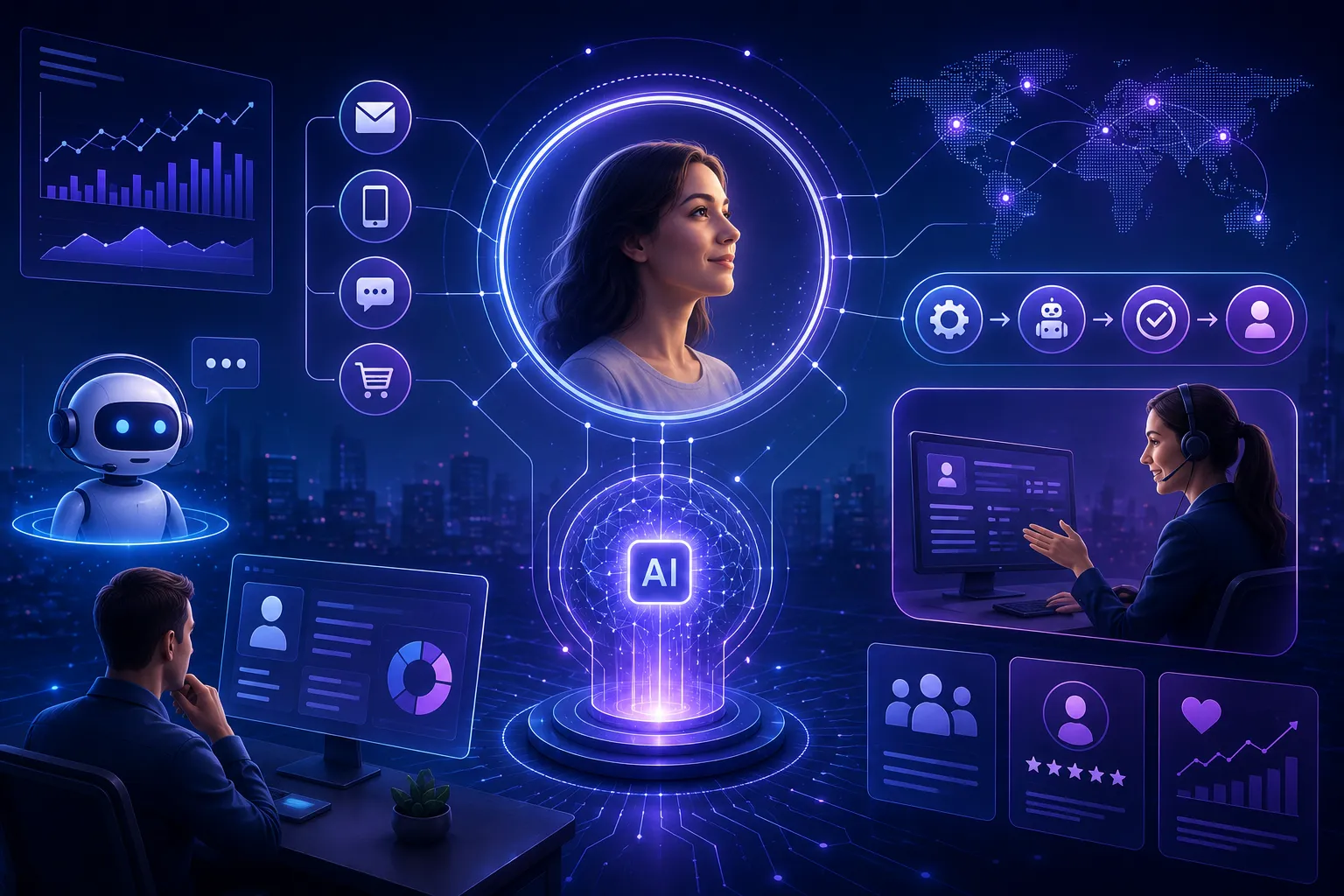
The Future of AI and CRM: What Will Customer Relationships Look Like?
The future of Customer Relationship Management (CRM) will likely be shaped by the growing relationship between artificial intelligence, customer data, automation, and human decision-making. CRM systems have traditionally helped organizations store customer information, track interactions, manage sales activities, and support customer service. As AI becomes more capable of interpreting information and assisting with actions, CRM is gradually moving toward a more intelligent and context-aware role.
This does not necessarily mean that customer relationships will become completely automated. A more realistic direction is a combination of AI-supported processes and human judgment, where technology handles repetitive analysis and routine activities while people remain responsible for empathy, accountability, creativity, and complex decisions. Current CRM developments already point toward deeper AI integration, including AI agents, real-time insights, automated workflows, and more context-aware customer service. :contentReference[oaicite:0]{index=0}
From CRM as a Database to CRM as an Intelligent System
One of the biggest changes in CRM is the shift from simply storing information toward helping employees understand and use that information. A traditional CRM record might contain contact details, interaction history, service cases, and sales activity. The information is useful, but employees still need to interpret it and decide what to do next.
AI can add another layer by analyzing customer information, summarizing long histories, identifying relevant patterns, and surfacing context at the moment it is needed. This can reduce the amount of manual searching required before an employee makes a decision or responds to a customer.
This evolution builds on the fundamentals of CRM. Understanding what CRM is remains important because AI does not replace the underlying relationship data. Instead, AI increasingly acts as an intelligence layer on top of that foundation.
AI Agents May Become Part of Everyday CRM Work
One of the most significant developments in AI and CRM is the rise of AI agents. Unlike a simple chatbot that waits for a question and generates a response, an AI agent can be designed to perform a sequence of tasks within a defined workflow. In customer service, for example, agents can assist with understanding customer intent, retrieving information, summarizing cases, and carrying out selected actions.
Current CRM and customer service platforms are already moving in this direction. Microsoft’s 2026 customer service roadmap describes expanded AI agents, autonomous workflows, next-best-action capabilities, and AI-assisted case handling as part of its ongoing development. :contentReference[oaicite:1]{index=1}
This suggests that future CRM environments may become more action-oriented. Instead of simply telling an employee what happened, the system may increasingly help determine what should happen next and prepare or execute appropriate steps within defined boundaries.
Customer Relationships May Become More Proactive
Traditional CRM is often reactive. A customer sends a message, creates a support case, requests information, or enters a sales process, and the organization responds. AI can help shift some of these activities toward a more proactive model by identifying patterns and changes in customer behavior before a customer explicitly asks for assistance.
For example, a sudden reduction in engagement combined with repeated service issues may indicate that a customer relationship deserves attention. AI can help identify these signals and surface them for employees rather than requiring teams to manually inspect every customer record.
This development is closely connected to predictive analytics in CRM. The purpose is not to predict customer behavior with certainty, but to use available information to identify signals that may support earlier and better decisions.
Personalization May Become More Contextual
Personalization is also likely to become more dynamic as AI gains access to richer customer context. Traditional personalization often relies on predefined segments, such as location, industry, or previous purchases. AI can potentially combine more signals, including recent interactions, content engagement, service history, preferences, and changes in behavior.
This could make customer experiences more adaptive. A customer who is researching a particular topic may receive related information, while another customer with an unresolved service issue may be directed toward support rather than promotional content. The important difference is that personalization becomes more closely connected with the current context of the relationship.
As explored in AI-powered personalization in customer relationships, the goal should not be to personalize every possible interaction. Personalization should remain useful, relevant, and respectful of customer expectations.
Customer Service May Become a Hybrid AI-Human Environment
Customer service is likely to be one of the clearest areas where AI and humans will work together. AI can handle routine questions, summarize conversations, classify cases, retrieve information, and assist employees during customer interactions. Human representatives can then focus more attention on complex situations that require judgment, empathy, negotiation, or problem-solving.
This creates a hybrid model rather than a completely automated one. A customer might begin with an AI chatbot, move through automated information gathering, and then be transferred to a human when the problem becomes more complicated. Ideally, the human representative receives the relevant context rather than asking the customer to repeat the entire conversation.
That direction is already visible in current customer service platforms. Microsoft describes AI agents that can converse with customers, handle routine issues, collect context, and hand conversations to human representatives with the available history. :contentReference[oaicite:2]{index=2}
Our article on AI chatbots and CRM explores this relationship between conversational AI, CRM context, and human customer service in more detail.
CRM Decision-Making May Become More Assisted
Another likely development is a shift from dashboards that simply display information toward systems that help people interpret that information. Managers may increasingly interact with CRM data through natural language questions rather than manually opening multiple reports and filtering records.
For example, a manager might ask which customer segments have shown declining engagement, which service issues are becoming more frequent, or which opportunities need attention. AI can potentially summarize relevant information and point the manager toward patterns that deserve investigation.
This builds directly on the role of AI in customer data and decision-making. AI can help turn customer data into useful context, but human decision-makers still need to evaluate the information and consider factors that may not be represented in the data.
CRM Will Need Better Data and Stronger Governance
As AI becomes more deeply embedded in CRM, data quality will become even more important. AI systems depend on the information they can access, which means inaccurate customer records, outdated information, inconsistent labels, and incomplete histories can create weak or misleading outputs.
This means organizations may need to pay greater attention to data governance, access controls, privacy, security, and the processes used to maintain customer information. The more actions an AI system is allowed to take, the more important it becomes to define which information it can access and what decisions require human approval.
The future of AI and CRM is therefore not only a technology question. It is also a governance question. Organizations will need clear rules for responsible data use, human oversight, and escalation when AI confidence is low or the situation is sensitive.
CRM May Become More Connected Across Channels
Customers rarely stay within one communication channel. A relationship might begin on a website, continue through email, move into chat, and later involve a phone conversation or service case. Future CRM systems are likely to place greater emphasis on connecting these interactions into one continuous customer context.
This could reduce one of the most common frustrations in customer service: repeating the same information to different employees. When customer history follows the relationship across channels, employees can start conversations with more context and customers can experience a more connected journey.
This is closely related to collaborative CRM, where information sharing across departments and communication channels is a central part of the customer relationship strategy.
Automation Will Become More Flexible
Traditional CRM automation generally follows predefined rules. If something happens, the system performs a predefined action. This remains useful for many routine workflows, but AI can make automation more flexible by helping interpret information and determine which action may be appropriate.
For example, a workflow might not simply send a standard message after a customer interaction. An AI-supported system could summarize the conversation, identify the customer’s intent, determine whether the issue appears urgent, and recommend whether it should be escalated or followed up later.
This is one reason AI automation in customer service is becoming increasingly important. The future of automation is likely to involve more interpretation and coordination, not simply more predefined triggers.
Human Trust Will Remain Essential
As AI becomes more capable, trust may become one of the most important factors shaping customer relationships. Customers need to understand when they are interacting with AI, what information is being used, and when a human can become involved. Organizations also need employees who understand the limitations of automated recommendations.
AI can generate useful responses and identify patterns, but it can still misunderstand context or produce incorrect information. Human oversight therefore remains important, particularly when decisions have significant consequences for customers.
The future relationship between people and AI is likely to be strongest when AI is treated as an assistant rather than an unquestionable authority. Technology can provide speed and analytical scale, while humans provide judgment, empathy, accountability, and the ability to understand unusual circumstances.
What Will Customer Relationships Look Like?
Customer relationships in the future may become more continuous, predictive, and context-aware. Customers may interact with organizations through multiple channels while AI quietly connects the information behind those interactions. Employees may receive relevant context automatically instead of searching through long histories, and many routine activities may happen in the background.
At the same time, the best customer relationships are unlikely to become completely machine-driven. The value of CRM will continue to depend on trust, communication, service quality, and the human understanding of customer needs.
The most meaningful change may therefore be that technology becomes less visible while customer context becomes more useful. Instead of customers thinking about the CRM system itself, they may simply experience faster answers, more relevant communication, smoother handoffs, and fewer repeated explanations.
Conclusion
The future of AI and CRM is moving toward more intelligent, proactive, and connected customer relationship management. AI agents, predictive insights, personalization, automated workflows, conversational interfaces, and decision-support tools are changing what CRM systems can do.
However, the future will not be defined by automation alone. Organizations will need reliable data, strong governance, responsible AI practices, and human oversight to ensure that technology improves customer relationships rather than making them feel impersonal.
Ultimately, the future of CRM is likely to be less about replacing people and more about helping people understand customers better. When AI provides the right information at the right moment and humans remain responsible for meaningful decisions, CRM can evolve from a system that records customer relationships into a system that actively helps organizations build them.