AI Customer Churn Prediction: Turning Risk Scores Into Useful Retention Actions
Churn prediction is appealing because it promises advance warning. Instead of learning that a customer has left, the CRM can highlight accounts showing patterns associated with cancellation or non-renewal. The difficult part is not producing a risk score. It is turning that score into an intervention that is timely, appropriate, and actually capable of changing the outcome.
Some churn is unavoidable or even healthy. Some signals appear only after the customer has effectively decided to leave. Some interventions cost more than the relationship is worth. A practical churn program therefore connects model design to customer context, actionability, and measurement of whether the intervention creates incremental retention.
Key Takeaways
Define churn precisely before training or evaluating a model.
Distinguish predictive signals from information that appears after the churn decision is already made.
Risk scores should lead to different actions based on cause, value, and customer context.
Measure whether interventions change outcomes, not only whether the model predicts churn accurately.
Human review is useful when the appropriate response depends on relationship nuance or missing context.
Define the Churn Event
Churn can mean contract cancellation, non-renewal, prolonged inactivity, product abandonment, or a substantial reduction in spend. These events have different causes and timelines. A model trained on a vague label may mix preventable and non-preventable outcomes.
Define the event, prediction window, and point at which the business still has time to act. A 90-day warning may be useful for a complex enterprise renewal, while a consumer subscription may require a much shorter window.
Choose Signals That Exist Before the Decision
Common signals include declining usage, unresolved service issues, payment changes, reduced engagement, stakeholder turnover, failed onboarding milestones, or repeated negative feedback. The important test is whether the signal is available early enough to influence action.
Watch for leakage: information that directly or indirectly reveals the future outcome, such as a cancellation-reason field populated after the customer gives notice. Leakage can make a model look accurate in testing while providing little real-world warning.
Connect Risk to Likely Cause
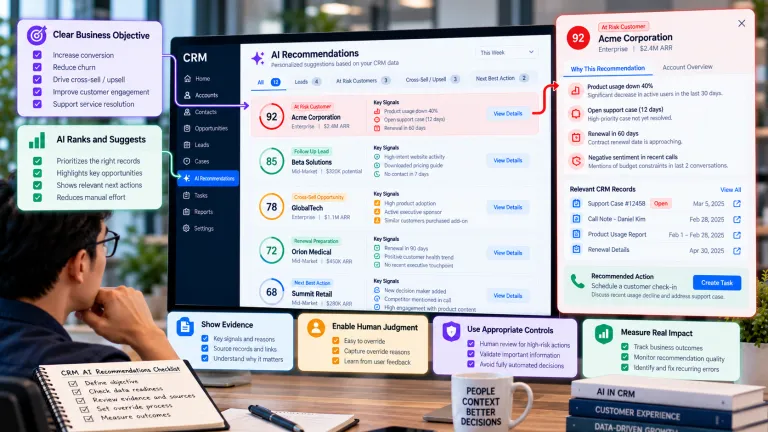
A single probability does not tell a customer success manager what to do. If risk is driven by low adoption, education or workflow support may help. If the account has a critical unresolved incident, service recovery is more appropriate. If the customer is consolidating vendors for strategic reasons, a discount email may be irrelevant.
Use interpretable signals or reason categories to shape the retention playbook. The objective is not to create one automated response for every high-risk customer.
Prioritize Actionable Risk
High probability does not always mean high priority. An account predicted to churn with 95 percent probability may already be lost, while an account at 55 percent risk may be responsive to a small intervention. Customer value, relationship potential, cause, intervention cost, and likelihood of influence all matter.
A useful queue can combine risk with actionability rather than simply sorting by probability.
Test Whether Interventions Work
A churn model can be accurate while the retention program has no effect. To understand value, compare outcomes for similar customers who receive different interventions or no intervention where ethically and commercially appropriate. This helps distinguish prediction from causal impact.
Track unintended effects as well. Aggressive retention offers can train customers to threaten cancellation for discounts or reduce margin without improving long-term relationships.
Monitor Drift and Changing Customer Behavior
Products, prices, onboarding, competitors, and customer behavior change. Signals that predicted churn last year may become weaker or reverse. Monitor performance by cohort and time period, and review whether interventions themselves are changing the data.
Keep a feedback loop between customer-facing teams and the model owner. Frontline observations can reveal new reasons for churn before they are obvious in aggregate metrics.
A Practical Churn-Prediction Example
A subscription company ranks accounts by churn probability and asks customer success managers to contact the highest-risk customers. Managers find that many top-ranked accounts have already submitted cancellation requests, so the score is accurate but not useful. The model also overweights reduced usage caused by seasonal business cycles.
The team redefines the target as churn within the next 60 days among accounts that have not yet given formal notice. It adds seasonality context and surfaces the leading risk signals. Managers select interventions based on cause, and the company compares retention outcomes with similar accounts outside the intervention group. The program shifts from predicting departure to finding situations where action can still matter.
From Churn Risk to Retention Decision
Question Why It Matters Example
Is the risk early enough? Action cannot help after the decision is effectively final. Flag adoption decline before renewal notice.
What is driving the risk? Different causes need different responses. Service failure versus low product usage.
Can the business influence it? Some churn is structural or intentional. Customer acquisition or merger may be uncontrollable.
Is intervention worthwhile? Retention has cost and opportunity trade-offs. High support cost may change priority.
Did the action change the outcome? Prediction alone does not prove business value. Compare intervention with a relevant baseline.
Common Mistakes to Avoid
Celebrating model accuracy without actionability
A model can predict churn after the customer has already decided to leave. Evaluate lead time and whether the signal changes an available decision.
Sending the same offer to every high-risk customer
Risk causes differ. Match intervention to evidence and customer context rather than automating a universal discount or email.
Ignoring customers the model scores as low risk
False negatives matter. Sample lower-risk accounts and review unexpected churn so the team learns which signals are missing.
What to Do Next
Define the churn event and the time window in which intervention can still matter.
Audit historical fields for leakage and inconsistent outcome labels.
Identify signals that can explain likely causes, not just correlation with churn.
Create a small set of cause-based retention actions with clear owners.
Prioritize using actionability and customer context as well as model probability.
Measure incremental retention, cost, and customer effects against a baseline.
Continue Reading on Clientira
Related Clientira guides provide additional context:
AI Data Readiness for CRM: How to Know Whether Your Customer Data Is Ready
AI Recommendation Systems in CRM: When Suggestions Help and When Humans Should Override Them
Frequently Asked Questions
What data is useful for churn prediction?
Depending on the business, useful data may include product usage, service history, engagement, payment behavior, onboarding milestones, contract timing, relationship changes, and customer feedback. The data should be available before the churn event.
What is a good churn model accuracy?
No single metric or threshold is universally sufficient. Evaluate precision, recall, calibration, lead time, performance by segment, and whether the resulting interventions create value.
Should churn outreach be automated?
Routine low-risk actions may be automated, but high-value, sensitive, or ambiguous accounts often benefit from human review of the underlying signals and relationship context.
How often should a churn model be retrained?
Retraining cadence depends on how quickly behavior changes and how much new labeled data is available. Monitor performance and drift continuously enough to retrain when evidence shows deterioration rather than following a fixed calendar blindly.
Final Thoughts
Churn prediction becomes valuable only when it creates earlier and better retention decisions. A risk score should help teams understand where attention is needed, why the risk may exist, and which response is worth trying.
Design the program around actionability and incremental impact. When prediction, customer context, and intervention learning are connected, CRM AI can move beyond forecasting churn and contribute to a more disciplined retention strategy.