AI Recommendation Systems in CRM: When Suggestions Help and When Humans Should Override Them
CRM recommendation systems can suggest which lead to contact, which customer needs attention, what product may be relevant, or what action should happen next. That can reduce cognitive load when employees face more records and signals than they can review manually. It can also create false confidence when a recommendation is presented as the ‘right’ answer without context.
The design challenge is to make recommendations useful while preserving human judgment where context, customer nuance, or consequences matter. That involves more than model accuracy. Teams need to consider ranking objectives, evidence, timing, feedback, override behavior, and what the business learns when employees disagree with the system.
Key Takeaways
Recommendations should optimize a clearly defined business and customer objective, not an abstract model score.
Users need enough context to understand why a suggestion deserves attention.
Human override is valuable data when reasons are captured and reviewed.
Do not evaluate recommendation quality only by click or acceptance rate.
High-impact recommendations require stronger validation and often human approval.
Define What the Recommendation Is Trying to Improve
A next-best-action system needs an objective. Maximizing immediate conversion can produce different suggestions from maximizing retention, lifetime value, service resolution, or customer trust. If the objective is not explicit, teams may celebrate a higher model score without knowing whether the behavior improves the relationship.
Write the decision in operational terms: for this type of customer at this point in the journey, what choice is the system helping a person make, and which outcome matters?
Separate Ranking From Decision Authority
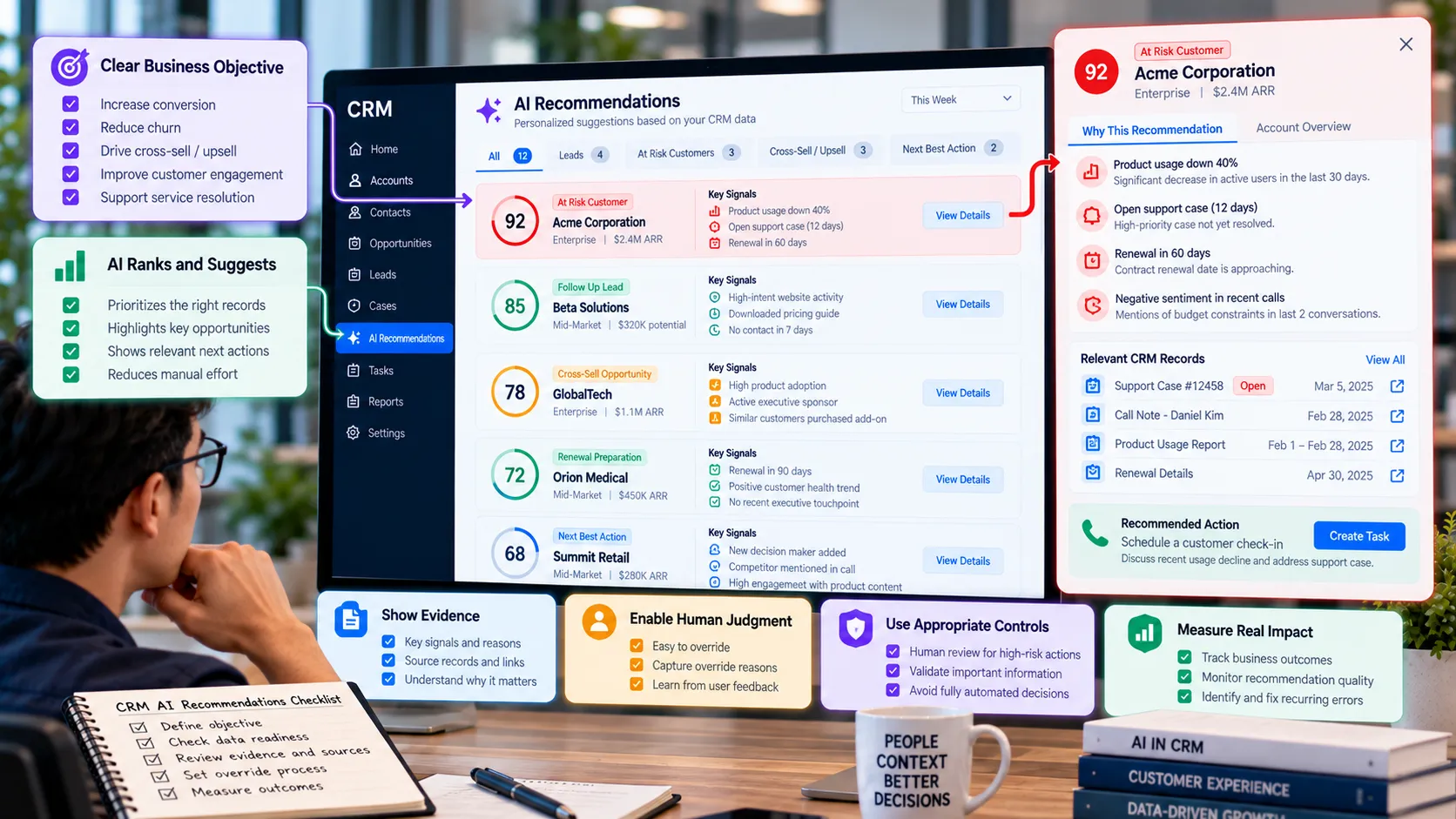
Recommendation models are particularly useful for ranking attention. They can sort hundreds of accounts by likely urgency or relevance, allowing humans to investigate the highest-priority items first. Ranking is different from automatically deciding what happens to the customer.
This separation is a practical way to introduce AI. The model narrows the search space while the employee applies context that may not exist in the data: a sensitive negotiation, a recent offline conversation, a strategic relationship, or a customer preference.
Show Evidence, Not Just Scores
A score of 82 provides little guidance by itself. Users need to know which signals contributed: renewal is approaching, usage fell, a key contact changed, a complaint remains open, or a high-intent product event occurred. Evidence helps employees decide whether the recommendation makes sense.
Explanations should be concise and action-oriented. Exposing every model feature can overwhelm users, while a few relevant signals can make the recommendation easier to verify.
Design Override as a Normal Workflow
If users can technically override a recommendation but are punished for doing so, the system does not truly support judgment. Make override available and capture a small set of reasons such as missing context, incorrect data, customer request, strategic exception, or recommendation not relevant.
Those reasons provide a valuable feedback loop. Repeated overrides may expose data problems, model drift, poorly defined business rules, or legitimate segments where different strategies are needed.
Beware of Feedback Loops
A recommendation system can influence the data that later trains it. If the model sends attention to one group of customers, that group receives more opportunities to respond, which can reinforce the model’s belief that the group is more promising. Meanwhile, under-served groups generate less evidence.
Evaluation should therefore look beyond historical conversion. Use controlled tests where appropriate, monitor coverage and exposure, and ask whether the system is narrowing attention in ways that become self-reinforcing.
Measure Business Value and Customer Consequences
Acceptance rate tells you whether users follow recommendations, not whether recommendations are good. Compare outcomes with a baseline and examine downstream effects: conversion quality, retention, service resolution, customer complaints, time saved, and distribution of recommendations across relevant groups.
A model that employees accept frequently may simply mirror what they already do. The goal is useful improvement, not obedience.
A Practical Recommendation-System Example
A customer success team receives an AI-generated list of accounts most likely to churn. At first, the CRM simply shows a risk score and automatically creates outreach tasks. Managers notice that teams are contacting some customers who recently discussed temporary seasonal usage changes, while accounts with serious service problems are not always ranked highly.
The company changes the design. The model now ranks accounts but shows three leading risk signals. Customer success managers confirm or override the recommended action, choosing among outreach, service escalation, observation, or no action. Override reasons are reviewed monthly. The model still saves time by focusing attention, but people retain responsibility for how the signal is interpreted.
When Should Humans Override an AI Recommendation?
Situation Human Role Why
Low-risk prioritization Review top-ranked items and act efficiently. AI can reduce search effort with limited downside.
Important missing context Override and record the reason. The model cannot use information it does not have.
High-value or sensitive customer situation Apply additional review or approval. Relationship consequences can exceed the model objective.
Recommendation conflicts with policy Follow policy and flag the issue. AI suggestions should not supersede required controls.
Repeated poor recommendations for a segment Escalate for model and data review. Patterned errors suggest a system problem rather than individual judgment.
Common Mistakes to Avoid
Using acceptance rate as the main success metric
High acceptance can reflect pressure, convenience, or recommendations that merely reproduce existing behavior. Evaluate downstream outcomes and quality.
Hiding the reason behind a recommendation
Opaque scores make it difficult for users to verify context and difficult for managers to diagnose why the system failed.
Treating overrides as user resistance
A thoughtful override can be evidence of important context. Capture and analyze override reasons instead of optimizing them away automatically.
What to Do Next
Define the customer and business objective behind each recommendation use case.
Decide whether AI is ranking attention, suggesting an action, or taking the action automatically.
Show a small set of evidence signals alongside meaningful recommendations.
Create an easy override path with structured reasons for important cases.
Measure outcomes against a baseline and monitor exposure across relevant customer segments.
Review clusters of overrides and poor outcomes as potential data, model, or process issues.
Continue Reading on Clientira
Related Clientira guides provide additional context:
AI Data Readiness for CRM: How to Know Whether Your Customer Data Is Ready
AI Hallucinations in CRM: Where Generated Answers Can Create Business Risk
Frequently Asked Questions
What is a CRM recommendation system?
It is a model or rules-based capability that suggests or ranks customer-related actions, opportunities, products, risks, or priorities using available data.
Should employees always follow AI recommendations?
No. Recommendations are probabilistic aids and may lack important context. The appropriate level of human judgment depends on the consequence of the decision and the reliability of the system.
What makes an AI recommendation explainable enough?
Users should understand the main evidence or signals that made the recommendation relevant to the current decision. The explanation does not need to expose every mathematical detail to be operationally useful.
How should overrides be used?
Allow users to override when context or policy requires it, capture a concise reason, and analyze recurring patterns to improve data, rules, models, or process design.
Final Thoughts
The best CRM recommendation systems reduce the cost of finding relevant context without pretending that customer decisions are fully predictable. They help people focus, compare evidence, and act more consistently.
Human override is not a defect in that design. It is part of a mature system in which AI contributes scale and pattern recognition while employees remain responsible for context, exceptions, and consequences the model cannot fully understand.