How AI Automation Is Changing Customer Service
Artificial Intelligence (AI) automation is changing how customer service teams handle questions, requests, and routine interactions. Traditional customer service often depends heavily on employees to read incoming messages, identify customer needs, search for information, and prepare responses. As the number of customer interactions grows, these tasks can consume significant time. AI automation introduces technologies that can assist with repetitive activities while helping service teams work with customer information more efficiently.
The impact of AI automation is not limited to faster responses. It can also change how customer service processes are organized, how customer information is understood, and how employees prioritize their work. AI can help classify incoming requests, summarize conversations, suggest responses, identify relevant information, and support customers through automated channels. At the same time, human involvement remains important for situations that require judgment, empathy, or a deeper understanding of context.
What Is AI Automation in Customer Service?
AI automation in customer service refers to the use of artificial intelligence to perform, assist with, or improve tasks that traditionally require manual employee involvement. Unlike basic automation, which generally follows fixed rules, AI-supported automation can interpret information, identify patterns, understand language, and generate responses based on available context.
For example, a traditional workflow might automatically send a confirmation message whenever a customer submits a request. An AI-supported workflow can go further by analyzing the content of that request, identifying its likely purpose, summarizing the issue, and helping route it to the appropriate person or process. This allows automation to become more context-aware rather than relying entirely on predefined conditions.
Why Customer Service Is a Natural Area for AI Automation
Customer service involves a large number of repetitive but important activities. Employees may receive similar questions every day, review previous conversations, categorize requests, search internal documentation, and prepare follow-up messages. While each interaction is important to the customer, many of the administrative steps surrounding the interaction can be repetitive.
AI automation is particularly useful in this environment because customer service generates structured and unstructured information at the same time. Structured information may include customer records, case categories, timestamps, or interaction status, while unstructured information may include emails, chat messages, call transcripts, and written descriptions of problems. AI can help interpret both types of information and connect them to the broader customer relationship.
How AI Automation Changes Customer Service Workflows
Automated Request Classification
One common use of AI automation is identifying what a customer is asking for. Instead of requiring an employee to manually categorize every incoming request, AI can analyze the message and determine whether it relates to billing, technical support, product information, account access, or another category. The request can then be routed according to the organization’s workflow.
This can reduce repetitive administrative work and help employees focus on cases that require more attention. Classification can also support consistency because similar requests can be organized using the same general logic. However, organizations should still review how classifications are handled because customers may describe the same problem in very different ways.
Conversation Summaries
Customer service conversations can become lengthy, especially when an issue requires multiple interactions. Employees who receive an escalated or transferred case may need to read an entire conversation history before understanding what has happened. AI can help by generating concise summaries that highlight the main issue, previous actions, important customer statements, and potential next steps.
Summaries can make handoffs more efficient and reduce the amount of time employees spend reviewing repetitive information. They can also help teams maintain continuity when different employees become involved in the same customer case. The summary should still be treated as an aid rather than a perfect representation of the conversation, because important details may require human verification.
AI-Assisted Response Generation
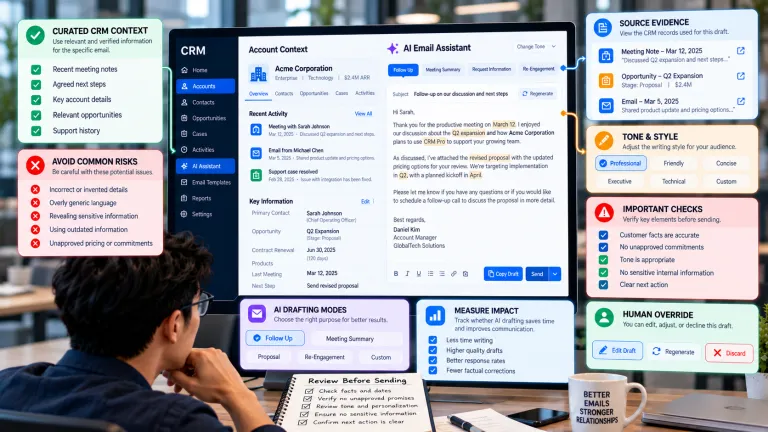
Generative AI can assist customer service employees by creating draft responses based on the customer’s message and available context. Instead of writing every response from the beginning, an employee can review a suggested draft, correct inaccuracies, adjust the tone, and decide whether the message is appropriate.
This approach can be useful for common requests that follow recognizable patterns. It may also help employees work more efficiently during periods of high demand. However, generated responses should not be treated as automatically correct. Customer communication often involves details that require human judgment, particularly when complaints, sensitive issues, or unusual circumstances are involved.
AI Chatbots and Self-Service
AI chatbots are another visible application of automation in customer service. Unlike older rule-based chatbots that depend heavily on fixed menus and predefined responses, modern conversational systems can interpret natural language and handle a wider range of questions. They can help customers find information, understand basic processes, or complete routine requests without waiting for an employee.
Self-service can be valuable when customers need quick answers to simple questions. It can also help customer service teams manage routine demand by allowing employees to spend more time on cases that require human involvement. The key is to recognize where automation is appropriate. A chatbot that handles simple informational requests may be useful, while a complicated complaint may require direct interaction with a person.
Personalization Through Customer Context
AI automation can become more useful when it is connected to relevant customer information. Instead of treating every customer interaction as identical, an AI-supported system can use available context to help determine what information may be relevant to the conversation. This may include previous interactions, customer preferences, service history, or the stage of an ongoing case.
Context can make automated interactions more useful because the system has more information about the customer’s situation. However, personalization should be handled carefully. More data does not automatically create a better experience, and organizations need to consider privacy, relevance, accuracy, and the expectations of customers when using personal information in automated workflows.
How AI Automation Supports Customer Service Employees
One of the most important aspects of AI automation is that it does not necessarily mean removing people from customer service. In many situations, the more practical role of AI is to support employees by reducing repetitive work and making relevant information easier to access.
An employee may spend less time searching through records, reading long conversations, categorizing requests, or preparing routine drafts. That time can instead be used for problem-solving, relationship management, difficult conversations, and cases where empathy or judgment is important. In this sense, AI automation can change the role of customer service employees rather than simply replace them.
Benefits of AI Automation in Customer Service
When implemented appropriately, AI automation can provide several potential benefits. Faster handling of routine requests can improve operational responsiveness, while automated classification and summaries can reduce administrative effort. AI-assisted workflows can also help organizations process large volumes of customer information more consistently.
Another potential benefit is scalability. A customer service team may face sudden increases in demand that are difficult to handle with manual processes alone. Automated systems can assist with routine interactions and information retrieval while employees focus on more complex cases. This does not eliminate the need for people, but it can help distribute their attention more effectively.
Challenges and Risks of AI Automation
AI automation also introduces challenges that organizations need to consider. One important issue is accuracy. AI systems can misunderstand customer requests, produce incorrect information, or generate responses that sound convincing but do not reflect the actual situation. These risks become more serious when automated systems operate without sufficient human oversight.
Data quality is another important factor. AI automation depends on the information available to the system, so incomplete or outdated customer records can lead to weak results. Privacy and security also matter because customer service processes may involve sensitive information. Organizations need appropriate controls to determine what information can be processed, who can access it, and how automated decisions are reviewed.
There is also a human experience challenge. Customers may become frustrated when they cannot reach a person for an issue that requires explanation or empathy. Effective automation therefore requires clear boundaries between tasks that are suitable for AI and situations that should be transferred to human employees.
The Future of AI Automation in Customer Service
AI automation is likely to become increasingly integrated into customer service workflows as organizations gain better access to customer data, conversational AI, analytics, and automated processes. Instead of operating as a separate chatbot or isolated tool, AI may become part of a broader customer service environment where information, workflows, and employee assistance are connected.
The future of customer service is therefore unlikely to be defined by automation alone. The more important question is how organizations combine automation with human judgment. AI can help process information, identify patterns, and handle repetitive activities, while people remain responsible for decisions that require empathy, accountability, and a deeper understanding of customer needs.
Conclusion
AI automation is changing customer service by helping organizations classify requests, summarize conversations, generate response drafts, support self-service, and organize customer information more efficiently. These capabilities can reduce repetitive work and help employees focus on interactions that require more attention and judgment.
However, effective AI automation is not simply about automating as many tasks as possible. The strongest customer service processes are likely to be those that use AI where it adds value while maintaining human involvement where context, empathy, and responsibility matter most. Understanding this balance is essential as organizations continue to explore how AI can improve customer relationships without making customer experiences feel impersonal.