AI Data Readiness for CRM: How to Know Whether Your Customer Data Is Ready
Organizations often ask whether their CRM contains enough data for AI. The more useful question is whether the available data can support a specific decision safely and consistently. A database may contain millions of records and still be a poor foundation for lead scoring, churn prediction, summarization, or next-best-action recommendations if definitions are inconsistent or important outcomes are missing.
AI data readiness is therefore use-case specific. The same CRM can be ready for one application and unready for another. A team may have clean interaction history for summarization but weak outcome labels for prediction. This guide provides a practical way to evaluate readiness before a company spends time building models or enabling AI features.
Key Takeaways
AI readiness starts with a defined decision or task, not a general ambition to use AI.
Reliable labels and outcomes can matter more than sheer data volume.
Missingness, bias, duplication, drift, and inconsistent definitions should be evaluated in the context of the use case.
Permissions, consent, retention, and sensitive-data rules are part of data readiness.
A small, well-governed dataset may be more useful than a large but poorly understood customer database.
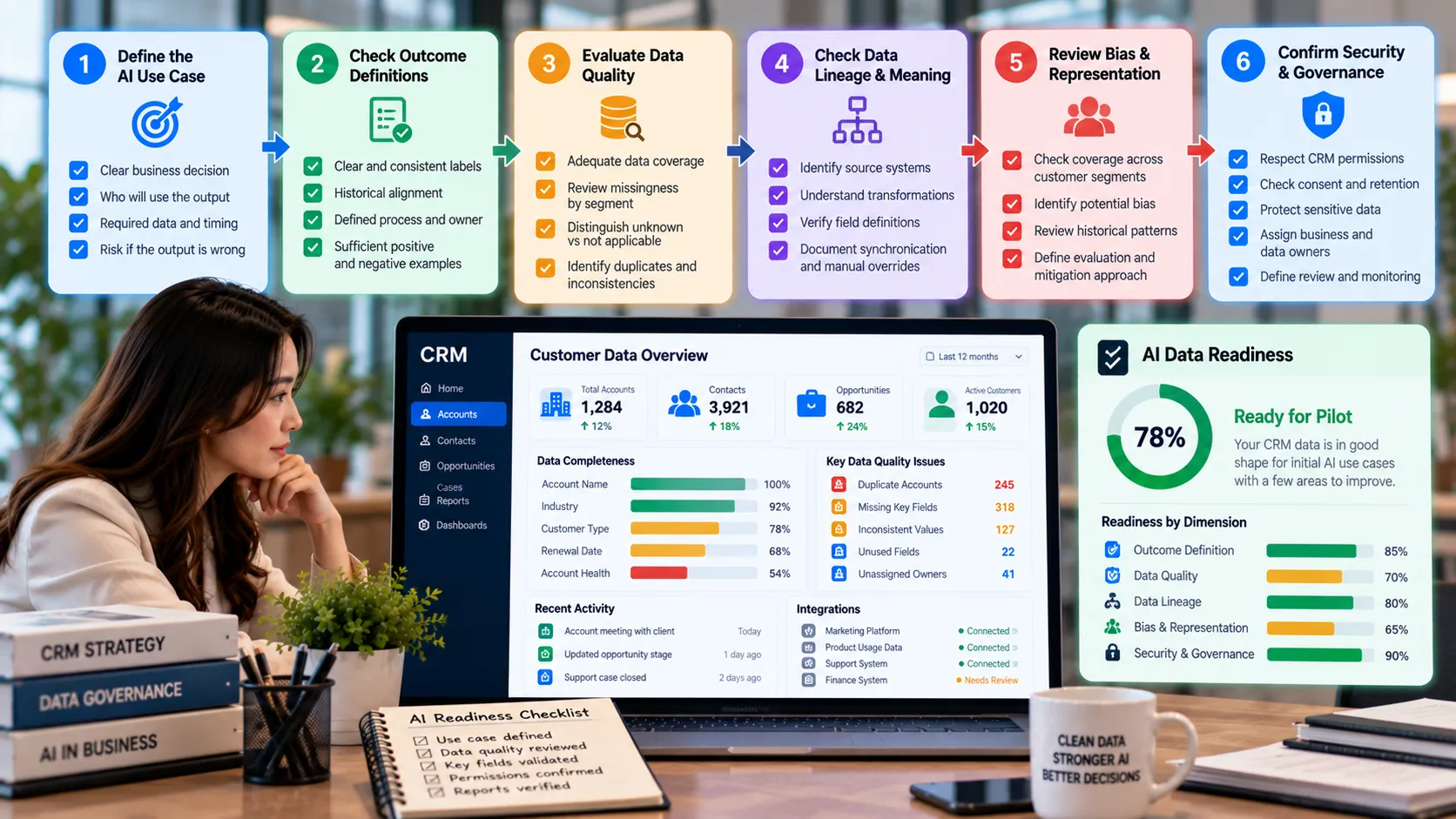
Define the AI Use Case Before Auditing the Data
Data can only be judged against the task it is expected to support. A generative assistant that summarizes recent account activity needs accessible, relevant text and trustworthy relationship context. A churn model needs historical signals plus a credible definition of churn and enough examples of customers who did and did not churn.
Write the intended decision in plain language: who will use the output, what action it may influence, how quickly the result is needed, and what happens if the output is wrong. This frames which data matters and how much reliability is necessary.
Check Whether the Outcome Is Defined
Predictive AI depends heavily on labels or outcomes. If sales teams disagree about what ‘qualified’ means, an opportunity-scoring model can learn inconsistent behavior rather than real buying evidence. If customer success closes accounts for several different reasons under one generic churn status, the model may struggle to identify meaningful patterns.
Before modeling, audit outcome definitions, historical consistency, and the process that created those labels. Sometimes the most valuable AI preparation is improving how the business records outcomes for several months before training anything.
Evaluate Coverage and Missingness
A dataset can look complete overall while important fields are missing for particular regions, teams, customer types, or time periods. That matters because an AI system may perform differently where the inputs are sparse. Review completeness by relevant segment rather than only as one company-wide percentage.
Also distinguish between unknown and not applicable. A blank renewal date may mean the value was never entered, or that the customer does not have a renewal-based contract. Those meanings should not be treated as identical.
Trace Data Lineage and Meaning
AI outputs are easier to trust when teams know where the inputs came from and what they mean. Identify source systems, transformations, synchronization timing, manual overrides, and field definitions. A field named ‘customer value’ may represent contract value in one system and lifetime revenue in another.
Lineage is especially important when AI features combine CRM data with product, support, marketing, or external information. If teams cannot explain the input, they will struggle to explain unexpected output.
Review Bias and Representation
Historical CRM data reflects past business choices: which customers were targeted, which leads received attention, which cases were escalated, and which outcomes were recorded. AI can learn those patterns, including undesirable ones. Readiness therefore includes examining whether important groups or situations are underrepresented and whether historical labels contain systematic differences.
The objective is not to prove that data is perfectly neutral. It is to identify where the data-generating process could distort an AI-supported decision and design evaluation, human review, or scope limits accordingly.
Include Security and Governance in the Readiness Test
An AI feature may make information easier to retrieve, combine, or infer. Confirm that the proposed use respects CRM permissions, data minimization, retention, and any applicable consent or contractual requirements. Sensitive notes that are appropriately restricted in the CRM should not become broadly visible because an assistant can summarize them.
Assign a business owner for the use case and a data owner for critical inputs. Readiness is stronger when someone can answer who approves changes, who investigates errors, and when the system should be paused.
A Practical AI-Readiness Example
A company wants to predict which customers are likely to cancel. It has five years of CRM history, so leadership assumes the data is sufficient. An audit shows that cancellation reasons were captured only during the last year, account health was entered inconsistently, and product usage is available for only one product line.
Instead of training a broad churn model immediately, the team narrows the first use case to the product line with reliable usage data, standardizes cancellation outcomes, and establishes a monthly review of missing inputs. It uses the model as a risk signal for customer success rather than an automatic intervention. The project moves more slowly at first, but the data foundation and evaluation are far clearer.
An AI Data Readiness Scorecard
Dimension Ready Enough When Warning Sign
Purpose The AI output supports a named decision or task. The goal is simply to “use AI.”
Definitions Critical fields and outcomes have stable meanings. Labels vary by team or period.
Coverage Important segments have sufficient, understood data. Missingness is concentrated in key groups.
Lineage Sources and transformations can be traced. Nobody can explain where key inputs originate.
Governance Owners, access rules, monitoring, and escalation are defined. The project assumes the vendor feature will manage these automatically.
Common Mistakes to Avoid
Equating volume with readiness
Large datasets can still contain weak labels, biased coverage, duplicates, and conflicting definitions. Quality should be assessed against the specific use case.
Cleaning data without defining the decision
A generic cleanup may spend effort on fields the AI will never use while ignoring the outcomes or context that matter most.
Ignoring how the data was created
Historical CRM data reflects human processes and incentives. Understanding those processes helps teams identify bias, leakage, and misleading correlations before deployment.
What to Do Next
Write one sentence describing the AI-supported decision, user, and expected action.
List the minimum input data and outcome labels required for that use case.
Measure completeness, consistency, and coverage by relevant customer and operational segments.
Trace critical inputs to their source and document transformations or manual edits.
Review access, sensitivity, retention, and potential bias before connecting data to the AI feature.
Pilot with a limited scope and compare output quality across different types of records before expanding.
Continue Reading on Clientira
Related Clientira guides provide additional context:
CRM Field Design: How to Capture Useful Data Without Creating Clutter
CRM Cleanup Before Growth: What to Fix Before Adding More Users, Data, or Automation
Frequently Asked Questions
How much CRM data is needed before using AI?
There is no universal amount. Generative tasks such as summarization may work with relatively small but rich records, while predictive models need enough historical examples and outcomes to evaluate performance reliably.
Does CRM data need to be perfect for AI?
No, but weaknesses must be understood. The acceptable quality depends on the risk of the decision, the ability to review output, and whether missing or inconsistent data affects particular groups disproportionately.
What is the most important AI readiness factor?
A clear use case is the starting point because it determines which data, quality level, controls, and evaluation matter. Without it, readiness assessments become generic checklists.
Can a company improve AI readiness without building a model?
Yes. Standardizing definitions, improving outcomes, reducing duplicates, documenting lineage, and clarifying permissions all make future AI work more reliable even before a model is selected.
Final Thoughts
AI data readiness is not a one-time certification for an entire CRM. It is a practical judgment about whether a particular dataset and operating process can support a particular AI-assisted task with acceptable risk.
Start smaller than the technology allows. Choose a decision, inspect the data that decision depends on, understand where the data is weak, and design monitoring around those weaknesses. That approach creates a more sustainable path to AI than connecting every available record to a new feature and hoping useful intelligence emerges.