AI Chatbots and CRM: Improving Customer Engagement
AI chatbots are changing how organizations communicate with customers by making it possible to handle conversations, answer common questions, and provide support across digital channels. When chatbots are connected with Customer Relationship Management (CRM) systems, they can become more than standalone conversational tools. They can work with customer information, interaction history, and service context to help organizations create more connected and relevant customer experiences.
The combination of AI chatbots and CRM is important because customer engagement increasingly depends on how quickly and consistently organizations respond. Customers may expect answers outside traditional business hours, move between channels, and want their previous interactions to be recognized. A chatbot connected to CRM can help provide continuity by combining conversational capabilities with structured customer information, while human employees remain available for situations that require deeper judgment or personal attention.
What Are AI Chatbots?
AI chatbots are software systems that use artificial intelligence to understand customer messages and generate appropriate responses. Unlike simple rule-based chatbots that rely on fixed menus and predetermined replies, AI-powered chatbots can interpret natural language and handle a wider variety of questions or requests.
The underlying goal is not simply to automate conversation. A useful AI chatbot should help customers find information, complete routine tasks, or move toward a solution with as little unnecessary effort as possible. Depending on how it is designed, a chatbot may answer frequently asked questions, collect information, guide users through a process, or transfer a conversation to a human employee when necessary.
Why Connect AI Chatbots with CRM?
A chatbot can function independently, but its usefulness can increase when it has access to relevant CRM information. A standalone chatbot may know what a customer is asking, but a CRM-connected chatbot may also have access to information about previous interactions, customer status, service history, or other context that has been intentionally made available to the system.
This creates a connection between conversation and customer relationship management. Instead of treating every chat as a completely new interaction, organizations can potentially provide a more continuous experience. This reflects the broader purpose of CRM: creating a structured understanding of customer relationships rather than managing each interaction as an isolated event.
As explained in this beginner’s guide to CRM, customer relationship management is fundamentally about organizing customer information and interactions so they can support better relationships over time.
How AI Chatbots Improve Customer Engagement
Faster Responses to Common Questions
One of the clearest benefits of AI chatbots is the ability to respond quickly to common customer questions. Customers may want to know about an account process, service availability, order status, general policies, or other frequently requested information. An AI chatbot can help address these questions without requiring an employee to handle every interaction manually.
Faster responses can improve the overall customer experience because customers do not always want to wait for assistance with simple issues. Quick access to relevant information can reduce friction and help customers move forward with their task. The quality of the response still matters, however, because speed alone does not create useful engagement.
Availability Beyond Business Hours
Human customer service teams often operate within defined schedules, while customers may need assistance at different times. AI chatbots can provide a conversational interface outside traditional working hours for suitable requests.
This does not mean that every problem should be handled automatically. Instead, chatbots can provide first-level assistance for routine questions and collect information that can later help a human employee understand the case. This can create a smoother transition between automated and human support.
More Consistent Interactions
AI chatbots can also support consistency by using structured information and defined processes when responding to common questions. Instead of relying on different employees to explain the same information in different ways, a chatbot can provide standardized responses based on approved content and workflows.
Consistency is particularly useful when organizations serve large numbers of customers across multiple channels. At the same time, the system needs to be regularly reviewed because outdated information can be repeated consistently as well. The goal is not simply uniformity, but accurate and useful communication.
How CRM Adds Context to Chatbot Conversations
One of the most important advantages of connecting chatbots with CRM is access to customer context. A customer may have interacted with an organization several times before starting a new conversation. Without history, the chatbot may have to ask questions that have already been answered in previous interactions.
CRM can provide relevant information that helps connect these conversations. Depending on the system and permissions, context may include previous service cases, interaction history, account details, or other relationship information. The objective is to make the conversation more informed without exposing information that the customer or employee should not access.
This is closely related to the key components of a CRM system, particularly customer records, interaction history, service management, and data connectivity.
AI Chatbots and Personalized Customer Engagement
Customer engagement becomes more useful when conversations reflect the customer’s situation. A generic chatbot experience may be sufficient for simple informational requests, but customers with an existing relationship may benefit from greater context.
AI can help interpret customer messages while CRM provides relationship information. Together, these capabilities can support more relevant conversations. For example, a customer asking about a service issue may receive guidance that takes into account the existence of a previous case or interaction rather than receiving a completely generic answer.
This connection also relates to AI-powered personalization in customer relationships. Personalization should not mean using every available piece of customer data. It should mean using relevant context to make an interaction more useful and appropriate.
AI Chatbots and Human Customer Service
An effective chatbot strategy should not treat human employees as unnecessary. Many customer situations involve ambiguity, emotion, complaints, sensitive information, or complex decisions that require human judgment. AI can assist with routine parts of the interaction while employees handle situations where a more nuanced response is needed.
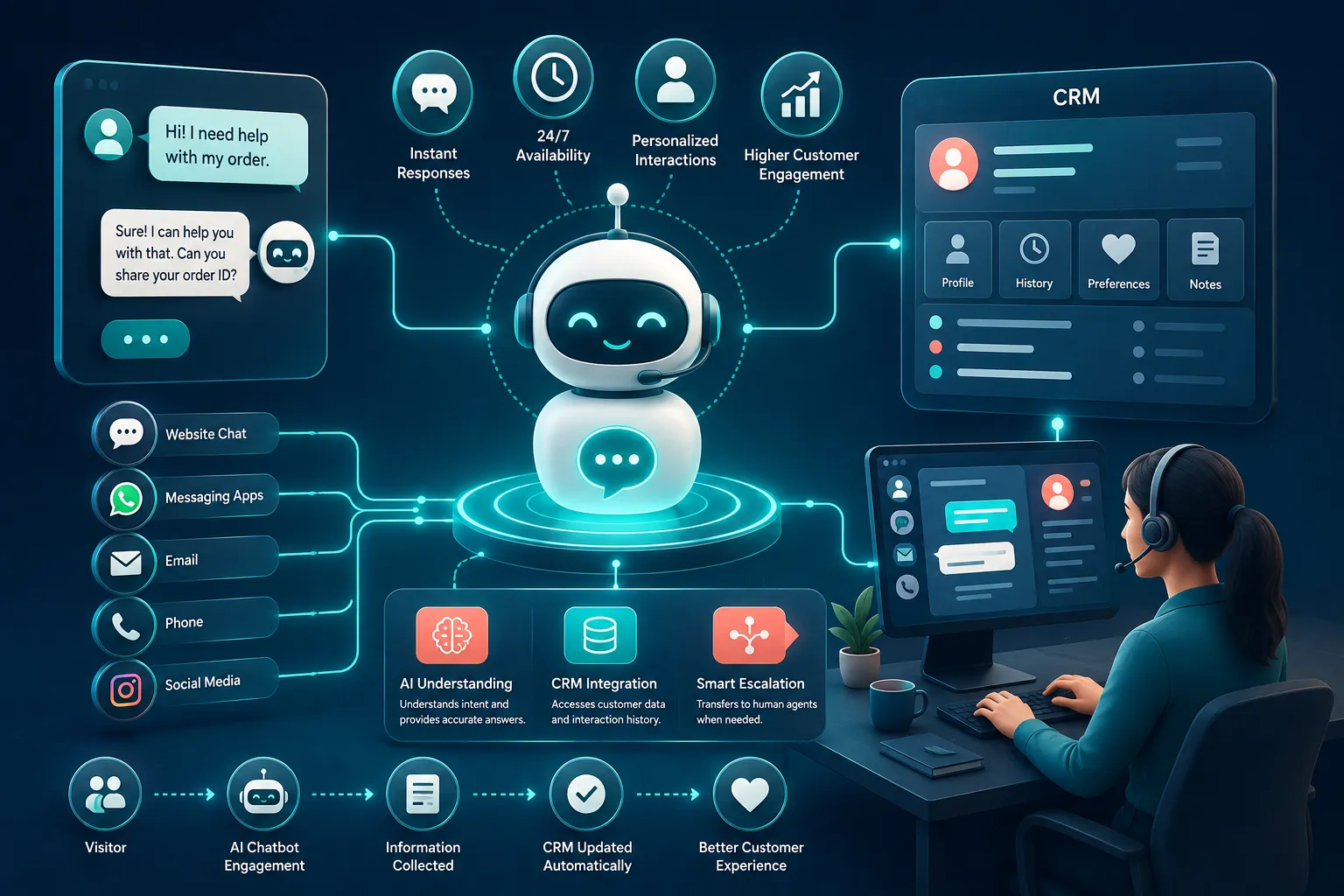
This creates a hybrid service model. The chatbot may handle the initial conversation, identify the general purpose of the request, collect relevant information, and provide basic assistance. When the situation becomes more complicated, the conversation can be transferred to a human employee with the available context attached.
This approach can reduce the amount of repetitive work employees perform while preserving human involvement where it matters most. It also reflects the broader principle behind AI automation in customer service: automation is most useful when it supports employees rather than simply replacing every human interaction.
How AI Chatbots Can Support Customer Service Workflows
Chatbots can contribute to customer service workflows before, during, and after human interactions. Before an employee becomes involved, a chatbot can collect information about the issue and identify its general category. During the handoff, that information can be passed to the employee to reduce repetition. After the conversation, AI can potentially help summarize the interaction or organize relevant details.
These capabilities can make service workflows more efficient because employees receive more context when they begin working on a case. Instead of spending the first part of the interaction asking basic questions, they may be able to focus on diagnosis, problem-solving, or relationship management.
However, workflow design matters. If a chatbot asks too many unnecessary questions or makes it difficult for customers to reach a human, the experience can become frustrating. Automation should reduce friction, not create additional barriers.
The Role of Customer Data in AI Chatbots
AI chatbots depend on information to provide useful responses, and CRM can provide some of the structured context required for customer interactions. This makes data quality particularly important. Outdated or incorrect information can lead to responses that sound reasonable but are wrong for the customer’s situation.
Organizations need processes for maintaining customer records, controlling access, and determining which information should be available to automated systems. Data should be relevant to the purpose of the interaction, and access should follow appropriate security and privacy controls.
The connection between AI, CRM, and customer data is also why predictive analytics in CRM is becoming relevant. Structured customer information can support not only conversations but also broader analysis of customer behavior and potential needs.
Challenges of AI Chatbots and CRM Integration
Connecting an AI chatbot with CRM can provide useful capabilities, but it also introduces challenges. Integration quality is important because the systems need to exchange relevant information reliably. Poorly synchronized data can create inconsistent customer experiences or cause employees to work with outdated information.
Privacy is another consideration. Customer conversations can contain personal or sensitive information, so organizations need clear rules for what data can be stored, processed, and exposed to automated systems. Customers should also have reasonable expectations about when they are interacting with AI and when a human employee is involved.
Accuracy is equally important. AI-generated responses can sometimes misunderstand questions or produce information that requires verification. Organizations should establish appropriate escalation processes and review mechanisms, especially for high-impact or sensitive customer interactions.
What Makes an AI Chatbot Useful?
A successful AI chatbot is not necessarily the one that handles the largest number of conversations. Its value depends on whether it solves real customer problems while keeping the experience clear and efficient.
Useful chatbots generally have access to reliable information, understand when they should answer directly, and recognize when a conversation needs human assistance. They should also make it easy for customers to move to the appropriate support channel when automation is no longer helpful.
The best measure of chatbot usefulness is therefore not simply automation volume. It is whether customers can achieve their goals with less friction and whether employees receive better information when human involvement becomes necessary.
Conclusion
AI chatbots and CRM can work together to improve customer engagement by combining conversational AI with structured customer information. Chatbots can provide faster responses, support routine requests, operate beyond traditional service hours, and help organize customer interactions before they reach human employees.
CRM adds another layer of value by providing relationship context, interaction history, customer records, and workflow information. Together, these capabilities can support more relevant and connected conversations without requiring every interaction to be handled manually.
The strongest approach is not to automate customer service indiscriminately. It is to use AI where it genuinely improves convenience and efficiency while preserving human judgment for situations that require empathy, context, or accountability. When designed around those principles, AI chatbots can become a useful part of modern customer engagement and CRM strategies.