AI Explainability in CRM: What Business Teams Need to Understand Before Trusting a Prediction
When a CRM says an account is at risk or a deal has a low probability of closing, the obvious question is ‘why?’ A bare score asks users to trust a system they cannot inspect. An overly technical explanation can be equally unhelpful if it describes model mechanics without telling the employee which evidence matters to the customer decision.
AI explainability in CRM should be designed around the person who must act. The explanation needs to reveal relevant signals, limitations, uncertainty, and the difference between correlation and business reason. It should help a user investigate rather than create a story that makes the model sound more certain than it is.
Key Takeaways
Explainability is useful when it supports verification and action, not when it simply decorates a score.
Different audiences need different levels of explanation.
Feature importance is not automatically a causal explanation of customer behavior.
Good explanations include evidence, uncertainty, and known limitations.
Users should be able to challenge or override AI-supported decisions when context justifies it.
Explain the Decision, Not the Algorithm First
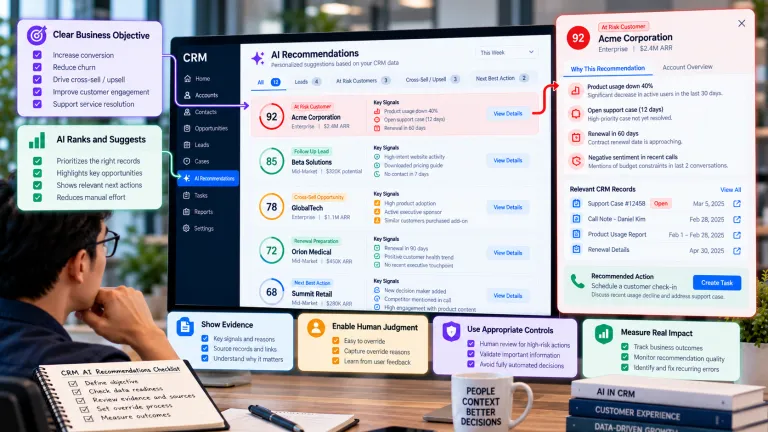
A customer success manager may need to know that risk increased because product usage declined, two critical cases remain open, and the renewal date is approaching. The manager does not necessarily need the internal architecture of the predictive model during daily work.
Model developers, risk owners, and auditors may need deeper technical information. Design explanation layers for the audience rather than assuming one explanation can serve everyone.
Distinguish Signal From Cause
A model may find that a behavior is associated with an outcome without proving that the behavior causes it. For example, reduced meeting activity can correlate with lost opportunities because disengaged customers attend fewer meetings. Scheduling more meetings may not fix the underlying problem.
Use language such as ‘the score is influenced by’ or ‘the account differs from successful cases in these ways’ rather than presenting statistical patterns as definitive causes.
Show the Evidence Behind the Explanation
Explanations are stronger when users can open the CRM fields, activities, or records behind them. If the system says engagement declined, show the time period and signal used. If it says a stakeholder change matters, identify the recorded change.
Evidence also helps diagnose errors. A model can appear unreasonable because the underlying CRM value is wrong. The user then knows to correct the data rather than merely distrust the model.
Represent Uncertainty Honestly
Predictions describe likelihood, not certainty. A 70 percent probability should not be translated into language such as ‘this customer will churn.’ Where calibration is reliable, show ranges or categories that users can interpret. Where uncertainty is substantial, make that visible.
Uncertainty is especially important when the customer falls outside the model’s familiar data, such as a new product, region, or unusual contract type.
Explain What the Model Does Not Know
A useful explanation can include missing context: no recent product-usage data, sparse activity history, or a segment with limited training examples. This tells users when human judgment deserves more weight.
Limitations should not be hidden in technical documentation that frontline users never see. Surface the limitation at the point of decision when it materially affects trust.
Use Explanations to Improve the System
When users disagree with a prediction, ask whether the evidence is wrong, incomplete, irrelevant, or outweighed by context. Those distinctions help improve data and model design.
Over time, explanation feedback can reveal that the business needs new fields, better outcome definitions, separate models for different segments, or simpler rules for certain decisions.
A Practical Explainability Example
An opportunity receives a low AI win score. The sales representative insists the deal is strong because an executive sponsor has verbally committed to the project, but that information exists only in a recent meeting note the scoring model does not use.
Instead of forcing the rep to accept the score, the CRM shows the factors lowering it: long stage age, no recorded decision date, and no recent multi-threaded engagement. The representative records the executive commitment in the appropriate field and updates the decision process. The model output and human context become a structured conversation about evidence rather than a contest over authority.
What Makes an Explanation Useful?
Question Useful Explanation Weak Explanation
What influenced the output? Names a few relevant, understandable signals. Shows only a score or technical coefficient.
Can I verify it? Links to the underlying CRM evidence. Provides a narrative with no source path.
How certain is it? Communicates probability, confidence, or limitations. Uses deterministic language for probabilistic output.
What should I do? Supports investigation or a decision without dictating it blindly. Turns explanation into an automatic command.
What is missing? Surfaces important unavailable or sparse context. Implies the model sees the whole customer situation.
Common Mistakes to Avoid
Calling correlation a cause
A feature that influences prediction is not necessarily the reason the customer behaves that way. Use explanations to guide investigation, not to invent causal stories.
Showing technical detail without decision context
Complex charts can look transparent while still failing to help the employee understand what to do. Match explanation depth to the user.
Using explainability to make poor models acceptable
An understandable model that performs badly is still not useful. Explanation complements validation; it does not replace it.
What to Do Next
Identify who needs to understand each AI output and what decision they make from it.
Define a small set of evidence signals that can be presented in business language.
Make important signals traceable to the underlying CRM records.
Communicate uncertainty and important data limitations at the point of use.
Allow users to record disagreement and the context the model missed.
Review explanation feedback alongside model performance and outcome monitoring.
Continue Reading on Clientira
Related Clientira guides provide additional context:
AI Recommendation Systems in CRM: When Suggestions Help and When Humans Should Override Them
AI Model Monitoring in CRM: How to Detect When Automated Decisions Start Losing Accuracy
Frequently Asked Questions
What does AI explainability mean in CRM?
It means providing enough understandable information about an AI output for users and responsible teams to assess the evidence, limitations, uncertainty, and relevance to the customer decision.
Do business users need to understand how the model is built?
They need enough understanding to use the output responsibly, but not necessarily the full mathematical implementation. Technical owners may require deeper documentation than frontline users.
Is feature importance the same as an explanation?
It is one type of model information, but it does not automatically explain why a specific customer outcome will occur or prove causality. Explanations should connect signals to the actual decision context.
Can explanations reduce automation risk?
They can help users verify outputs and identify errors, but explanations are not a substitute for validation, permissions, monitoring, human review, or appropriate limits on automated actions.
Final Thoughts
Explainability should make AI-supported CRM decisions easier to question, not merely easier to accept. A useful explanation exposes the evidence, uncertainty, and blind spots that matter to the person responsible for acting.
When users can understand why a prediction deserves attention and what the model may be missing, trust becomes more disciplined. The result is not blind confidence in AI, but a clearer partnership between model patterns and human customer judgment.