How AI Is Transforming Customer Relationship Management
Artificial Intelligence (AI) is changing how organizations understand, manage, and communicate with their customers. In the past, Customer Relationship Management (CRM) mainly focused on storing customer information, tracking interactions, and organizing sales or service activities. Today, AI can help organizations make greater use of that information by identifying patterns, assisting employees, automating repetitive work, and supporting more personalized customer interactions.
The connection between AI and CRM is becoming increasingly important because customer relationships generate large amounts of information. Emails, conversations, service requests, purchase activity, website interactions, and other customer signals can create more data than employees can realistically review manually. AI provides methods for analyzing this information and turning it into useful context. The result is a shift from CRM as a system of record toward CRM as a more intelligent tool for understanding and responding to customer needs.
What Does AI Mean in CRM?
AI in CRM refers to the use of artificial intelligence techniques to analyze customer data, recognize patterns, generate useful recommendations, automate selected tasks, and support customer-facing activities. Depending on the system and its implementation, AI may work with structured customer records, communication history, behavioral information, or text from conversations and service interactions.
The purpose is not simply to add AI to an existing CRM interface. The larger objective is to help organizations use customer information more effectively. AI can assist employees with tasks that require reviewing large amounts of information, identifying recurring patterns, preparing responses, or predicting what may happen next in a customer relationship. Human judgment remains important, but AI can help reduce the amount of repetitive analysis that employees need to perform manually.
From Data Storage to Intelligent Customer Insights
Traditional CRM systems are useful because they organize customer information in one place. However, storing data and understanding data are two different challenges. A CRM may contain thousands of customer records, but the information only becomes valuable when employees can interpret it and use it to support better decisions.
AI can help bridge this gap by examining customer information and identifying relationships that may not be immediately obvious. For example, an organization may want to understand which customers are most engaged, which types of interactions frequently lead to follow-up requests, or which patterns appear before a customer reduces activity. Instead of manually reviewing large numbers of records, AI can help surface potentially useful signals for further investigation.
This changes the role of CRM from a place where information is stored into a system that can help people make sense of information. The quality of the resulting insight still depends on the quality, completeness, and context of the underlying data, but AI can make large datasets easier to work with.
How AI Is Changing Customer Interactions
One of the most visible effects of AI in CRM is the way organizations manage customer interactions. Customer conversations can happen across email, chat, voice, social channels, websites, and support systems. Handling each interaction separately can make it difficult to maintain a consistent view of the customer.
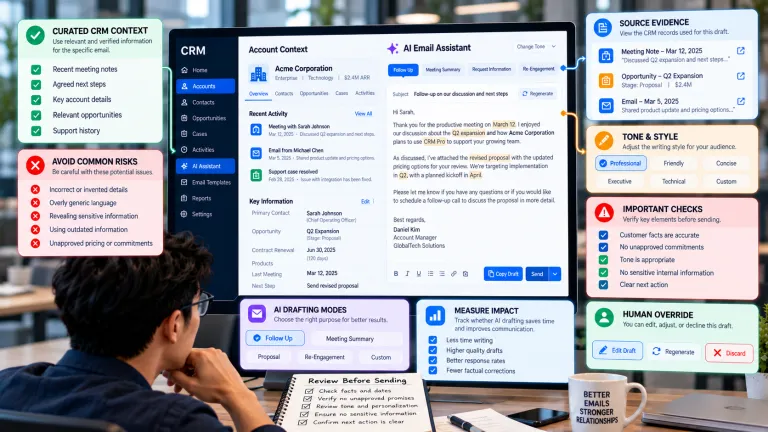
AI can help summarize conversations, identify important topics, assist with response drafting, and organize relevant information around an interaction. This can reduce the time employees spend reviewing long conversation histories and allow them to focus more directly on the customer’s issue or request.
Conversation Summarization
Long customer conversations can contain a significant amount of useful information. AI can help condense those conversations into summaries that highlight important requests, decisions, problems, or next steps. This is particularly useful when a case is transferred between employees or when someone needs to understand previous interactions quickly.
Response Assistance
Generative AI can also help employees draft emails or chat responses based on the context of a customer interaction. Instead of starting from an empty message, an employee can review an AI-generated draft, adjust the wording, verify the information, and then decide whether the response is appropriate to send. This approach can improve efficiency while keeping humans involved in the final decision.
AI and Customer Personalization
Personalization has always been an important part of customer relationship management, but creating relevant experiences can become difficult when organizations have large numbers of customers. AI can help analyze customer behavior and identify patterns that may support more relevant communication or recommendations.
For example, different customers may interact with the same organization in very different ways. One customer may frequently request product information, another may need technical support, while another may respond primarily to educational content. AI can help identify these behavioral differences and provide context that organizations can use when planning customer interactions.
However, personalization should not simply mean sending more automated messages. Effective personalization depends on relevance, timing, context, and responsible use of customer information. Poorly implemented automation can easily become intrusive. AI should therefore support a better understanding of customers rather than encourage organizations to communicate with customers more frequently without a clear purpose.
AI-Powered Automation in CRM
Automation is another area where AI can change CRM workflows. Traditional automation generally follows predefined rules. For example, a system might send an email whenever a particular field changes or create a task when a new customer record is added. These rule-based workflows can be useful, but they may not adapt well to complex situations.
AI can introduce a more flexible layer of automation by interpreting information, identifying patterns, and helping determine what action may be appropriate. For instance, AI may help classify customer requests, summarize cases, recommend follow-up activities, or identify conversations that require additional attention.
The distinction between automation and intelligent automation is important. Automation follows instructions, while AI can help interpret information and support decisions within a workflow. Even so, organizations need appropriate controls because not every customer interaction should be handled automatically.
Predictive Insights and Customer Behavior
Another important application of AI in CRM is predictive analysis. Instead of focusing only on what has already happened, organizations can use historical and current information to identify patterns that may indicate what could happen next.
For example, AI-supported analysis may help organizations identify customers whose engagement is changing, recognize patterns associated with successful interactions, or prioritize accounts that may require additional attention. These predictions are not guaranteed outcomes. They are signals that can help employees investigate situations and make more informed decisions.
The usefulness of predictive insights depends heavily on the quality of the data being analyzed. Incomplete records, inconsistent information, biased historical data, or poorly designed workflows can lead to misleading results. AI should therefore be treated as a decision-support capability rather than an unquestionable source of truth.
The Role of AI in Customer Service
Customer service is one of the areas where the combination of AI and CRM can be particularly useful. Service teams often need to review customer history, understand previous cases, find relevant information, and respond quickly. AI can assist by helping employees retrieve context, summarize cases, identify customer intent, or draft responses.
AI can also support self-service experiences through conversational interfaces. When customers can obtain answers to common questions without waiting for an employee, organizations may be able to handle routine requests more efficiently. However, complex or sensitive situations still require human involvement, especially when empathy, judgment, or detailed problem-solving is necessary.
Challenges of Using AI in CRM
Despite its potential, AI does not automatically improve customer relationships. One major challenge is data quality. AI systems depend on the information available to them, so inaccurate or incomplete customer records can affect the usefulness of AI-generated insights.
Privacy and security are also important considerations. Customer information may contain sensitive or personally identifiable data, and organizations need appropriate controls over how that information is accessed, processed, and used. Clear policies and responsible data practices are essential when introducing AI into customer-facing workflows.
Another challenge is maintaining human oversight. AI can produce useful recommendations and generated content, but it can also make mistakes or misunderstand context. Organizations should establish processes for reviewing important outputs and deciding when human intervention is required.
What Does the Future of AI and CRM Look Like?
The relationship between AI and CRM is likely to continue evolving as organizations move beyond simple automation toward systems that can assist with more complex customer-related workflows. CRM environments are increasingly becoming places where customer data, AI assistants, automated processes, and employee decision-making can work together.
The most important development may not be the replacement of human employees, but the redesign of how employees work with customer information. AI can reduce repetitive tasks, surface relevant context, and help employees spend more time on activities that depend on judgment, communication, creativity, and empathy.
This means the future of CRM will likely depend on finding the right balance between intelligent technology and human responsibility. Organizations that treat AI as a tool for enhancing customer understanding, rather than simply increasing automation, may be better positioned to create more useful and meaningful customer experiences.
Conclusion
AI is transforming Customer Relationship Management by changing how organizations analyze customer information, manage interactions, automate processes, and support decision-making. Instead of using CRM only as a system for storing customer records, organizations can increasingly use AI to extract context from those records and make customer-related work more efficient.
At the same time, AI should not be viewed as a replacement for human judgment. Effective customer relationships still depend on trust, empathy, communication, and responsible decision-making. The strongest CRM strategies are likely to combine the analytical and automation capabilities of AI with the human qualities that make customer relationships meaningful.
Understanding how AI is transforming CRM provides an important foundation for exploring related topics such as AI automation, personalization, predictive analytics, and the future of customer engagement.