
AI Agents in CRM: What Should They Be Allowed to Do Without Human Approval?
AI agents extend CRM assistance beyond generating text. An agent may search records, update fields, create tasks, route cases, schedule meetings, draft or send messages, trigger workflows, or coordinate steps across connected systems. That capability can remove repetitive work, but it also changes the risk model because the AI is no longer only advising a person; it can alter the operating environment.
The safest way to design agent autonomy is to classify actions by consequence and reversibility. Low-risk, easily reversible work can often be automated with monitoring. Actions involving customers, money, permissions, commitments, deletion, or sensitive data deserve stronger controls and frequently explicit human approval.
Key Takeaways
Agent autonomy should be granted per action, not as one broad permission to ‘use the CRM.’
Reversibility, customer impact, financial impact, and data sensitivity are useful risk dimensions.
Agents should operate through dedicated permissions and identities with audit trails.
High-impact actions need deterministic checks and often human approval even when the model is highly capable.
Start with narrow tasks, measure exception patterns, and expand authority only when controls work in production.
Separate Reading, Recommending, and Acting
An agent that reads CRM records and produces a summary has different authority from one that changes a renewal date or sends a customer email. Design permissions in layers: read, propose, draft, execute reversible internal actions, and execute consequential external actions.
This layered approach allows the organization to gain value before granting broad autonomy. It also makes failure easier to contain because the agent cannot exceed the permissions required for the current use case.
Assess Consequence and Reversibility
Creating an internal task can usually be corrected with limited impact. Deleting records, changing permissions, issuing credits, or sending legally meaningful communication may be difficult or impossible to reverse. Consequence should determine the level of control.
Use additional dimensions such as customer visibility, financial value, sensitivity of the data, regulatory significance, and uncertainty of the evidence. A reversible action can still be harmful if it exposes confidential information.
Use Dedicated Identity and Least Privilege
An agent should not inherit an employee’s unrestricted session simply because that is convenient. Give the agent a dedicated identity or service context where the platform supports it, and grant only the actions and data access required for its task.
This improves auditability and limits blast radius. It also makes it easier to suspend the agent without affecting human users when behavior needs investigation.
Put Deterministic Rules Around Generative Judgment
Language models are useful for interpreting unstructured context, but certain constraints should be explicit. An agent may suggest a refund amount, but a rule can prohibit execution above a threshold. It may draft an email, but a policy check can block sensitive terms or unverified commitments.
Combining flexible reasoning with deterministic boundaries creates a safer operating model than asking the model to remember every business rule in its prompt.
Design Approval for the Decision, Not Every Click
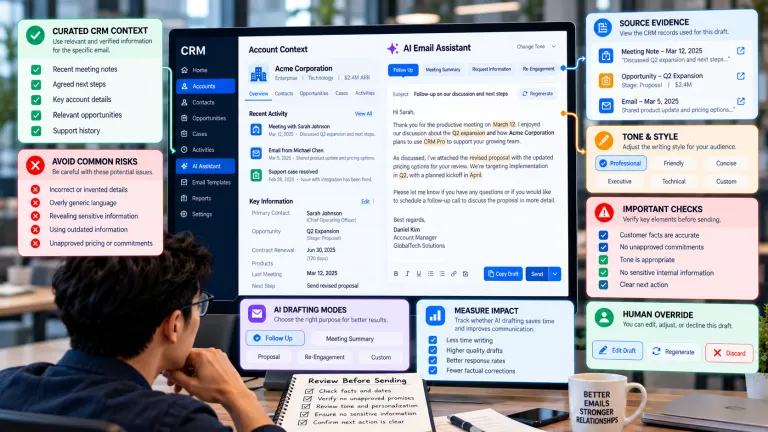
Human approval can become a bottleneck if every tiny step requires confirmation. Group low-risk steps into an approval unit that reflects the real decision. For example, an agent can gather account context, draft a message, and propose a task automatically, while the user approves the outbound communication and any pricing commitment.
Approval screens should show the intended action, key evidence, affected records, and important changes. A generic ‘approve’ button without context encourages rubber-stamping.
Plan for Exceptions, Failure, and Rollback
Agents will encounter missing fields, contradictory records, unavailable systems, unusual customers, and unexpected tool responses. Define when the agent should stop and ask for help instead of improvising.
Keep audit logs of requested actions, evidence, approvals, and resulting changes. Where feasible, design rollback for reversible actions and a rapid disable mechanism for the agent or specific tool permissions.
A Practical CRM Agent Autonomy Example
A service organization wants an AI agent to handle routine refund requests. The initial proposal lets the agent read cases, decide eligibility, issue refunds, and send confirmation. The team recognizes that incorrect refunds have financial and customer consequences, while collecting evidence is relatively low risk.
The agent is redesigned to read the case, check purchase history, summarize the evidence, and recommend an outcome. A deterministic rule validates policy eligibility. Refunds below a small threshold with unambiguous evidence can execute automatically; larger or exceptional refunds require approval. Every action is logged, and the agent cannot change refund policy or customer permissions.
A CRM Agent Autonomy Ladder
Level Example Action Default Control
1 – Read Search records and summarize context. Permission boundaries and source traceability.
2 – Recommend Suggest next action or classification. Human decides; capture feedback.
3 – Prepare Draft email, task, or field update. Human reviews consequential output.
4 – Execute low-risk Create internal task or update a reversible low-risk field. Rules, audit trail, monitoring, rollback.
5 – Execute high-impact Send commitments, change money, delete data, alter access. Strong authorization, deterministic checks, and human approval by default.
Common Mistakes to Avoid
Giving the agent broad CRM administrator access
Capability should be granted action by action. Broad rights increase the impact of prompt errors, tool mistakes, or unexpected behavior.
Treating approval as a cosmetic step
If reviewers cannot see evidence and material changes, they may approve automatically. Approval design should support a real decision.
Letting the model interpret every policy rule
Use deterministic controls for hard limits, permissions, and eligibility where the rule can be expressed clearly. Reserve model judgment for ambiguous context.
What to Do Next
List each action the proposed agent needs to take and classify it by consequence, sensitivity, and reversibility.
Give the agent a dedicated identity and only the minimum tools and data needed for those actions.
Move hard business limits into deterministic rules rather than prompt instructions alone.
Define which actions can execute automatically, which need confirmation, and which are prohibited.
Design exception behavior that stops safely when evidence is missing or conflicting.
Log actions and approvals, monitor outcomes, and expand autonomy only after low-risk operation is proven.
Continue Reading on Clientira
Related Clientira guides provide additional context:
AI Hallucinations in CRM: Where Generated Answers Can Create Business Risk
AI Model Monitoring in CRM: How to Detect When Automated Decisions Start Losing Accuracy
AI Explainability in CRM: What Business Teams Need to Understand Before Trusting a Prediction
Frequently Asked Questions
What is an AI agent in CRM?
An AI agent is a system that can interpret context and use tools to perform one or more CRM-related actions, such as retrieving records, updating data, creating tasks, communicating, or coordinating workflows.
Which CRM actions are safest to automate first?
Start with low-impact, reversible internal actions where inputs and rules are clear, such as preparing summaries, creating draft tasks, or updating narrowly defined fields. Evaluate each case rather than assuming all internal actions are safe.
Should AI agents be allowed to send customer messages automatically?
Only after careful scoping and testing. Routine messages with verified facts may be candidates, but sensitive, commercial, complaint-related, legal, or commitment-creating communication generally deserves stronger review.
How should agent permissions be managed?
Use least privilege, dedicated identities where possible, explicit tool permissions, access reviews, logging, and a way to suspend the agent or revoke a capability quickly.
Final Thoughts
CRM agents can reduce repetitive work by moving from recommendation to execution, but autonomy should be earned through controls and evidence rather than granted because a model can technically complete the task.
Separate reading from acting, classify actions by consequence, use least privilege, keep hard limits deterministic, and design meaningful approval where risk is high. With those boundaries, organizations can expand agent capability gradually without giving up accountability for customer decisions.