AI Hallucinations in CRM: Where Generated Answers Can Create Business Risk
Generative AI makes CRM information easier to summarize and query. A user can ask for the latest account status, a draft follow-up, a case summary, or an explanation of why an opportunity is at risk. The convenience creates a new failure mode: a generated answer can sound complete even when part of it is unsupported.
In CRM, hallucination is not only a technical curiosity. An invented customer commitment, incorrect contract detail, fabricated reason for churn, or false statement about a prior conversation can affect real relationships. Managing that risk requires designing the task, evidence, interface, and human responsibility around the model rather than relying on confidence of tone.
Key Takeaways
Hallucinations matter most when generated content is treated as customer fact or used to trigger action.
Grounding an AI response in CRM records can reduce unsupported output but does not eliminate error.
Users should be able to inspect the source evidence for high-impact answers.
Different tasks require different levels of human review and automation authority.
Monitor correction patterns and unsupported claims, not only whether users like the assistant.
Where Hallucinations Enter CRM Work
A model can invent a detail because the source information is missing, ambiguous, contradictory, or poorly retrieved. It may also blend two records, infer an unstated reason, or transform a tentative note into a confident statement. These errors are especially difficult to notice when the language is plausible.
Risk varies by task. Brainstorming subject lines has a different consequence from summarizing a complaint for escalation or answering a question about contractual obligations. Classify use cases by what would happen if the output were wrong.
Distinguish Generation From Retrieval
A CRM assistant often combines retrieval and generation. Retrieval finds relevant records or passages; generation turns them into an answer. If retrieval misses the latest note, the generated summary may be coherent but outdated. If retrieval returns the wrong account, the model can summarize the wrong context perfectly.
This means quality testing should inspect both stages. Teams need to ask whether the right evidence was retrieved and whether the generated response stayed faithful to that evidence.
Make Important Answers Traceable
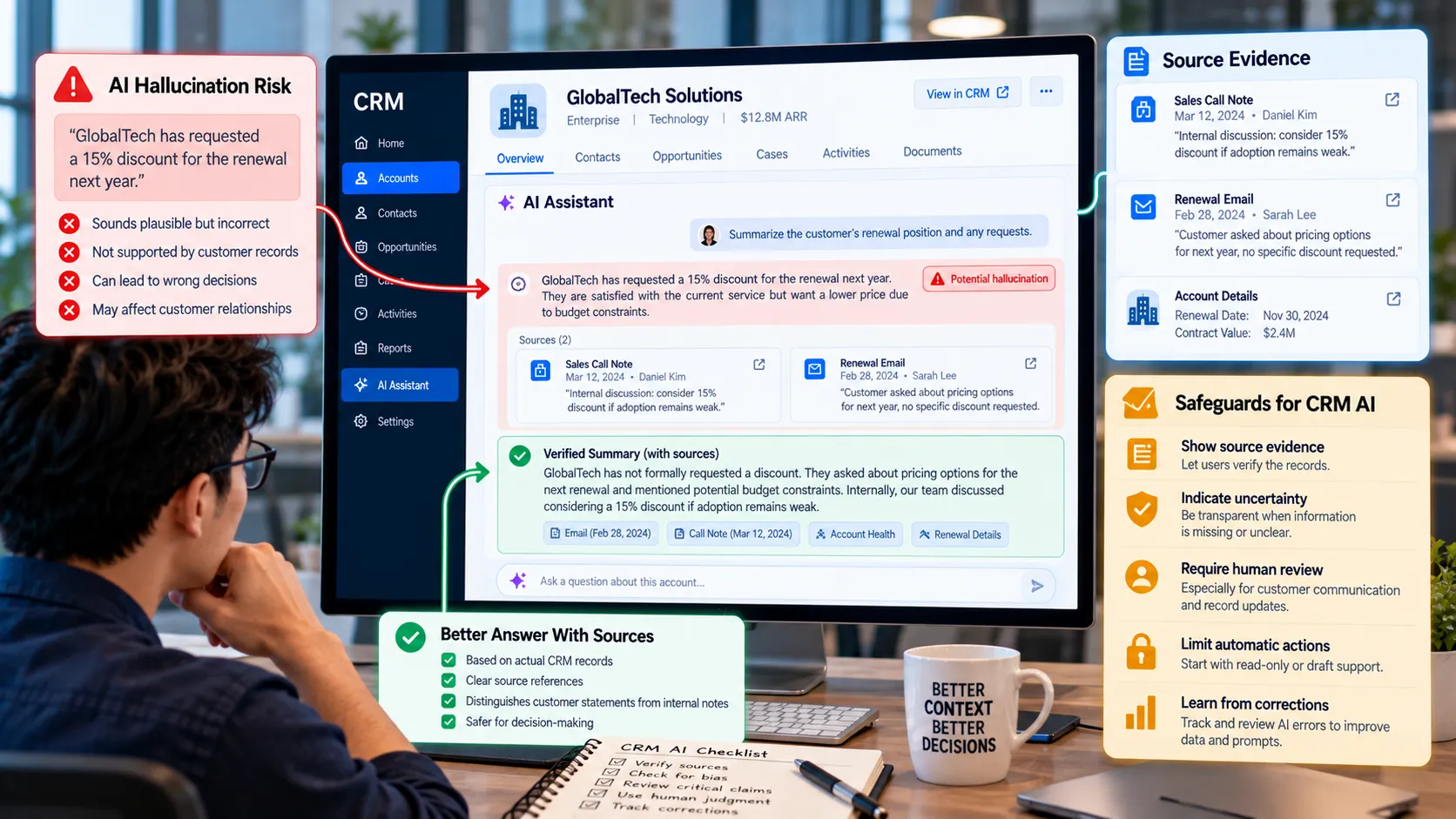
For higher-risk tasks, show the user which CRM records, activities, cases, or documents support the answer. Source visibility changes the user experience from ‘trust this summary’ to ‘use this summary as a fast interpretation of these records.’
Citations do not guarantee truth because the source itself can be wrong, but they make verification faster and expose when the assistant has produced claims with no obvious support.
Use Uncertainty as a Product Feature
Many AI interfaces are designed to sound helpful even when evidence is incomplete. In CRM, it can be safer for the assistant to state that the information is unavailable, contradictory, or uncertain. The system should not pressure the model to produce a confident answer to every question.
Design explicit fallback behavior: request clarification, return the available evidence without inference, route the task to a human, or decline to answer when required information is missing.
Set Boundaries on Automatic Action
The same hallucination has different consequences depending on whether the AI merely drafts text or directly changes a record, sends a message, adjusts a forecast, or offers a concession. The more consequential the action, the more important confirmation and validation become.
A practical pattern is to begin with read-only or draft assistance. Expand to action only after the team has measured error modes and created safeguards for reversal, approval, and exception handling.
Learn From Corrections
Users often notice AI errors before formal monitoring systems do. Provide a quick way to flag incorrect summaries, missing evidence, or inappropriate suggestions. Capture the reason for correction rather than only a thumbs-down score.
Review recurring patterns. If errors cluster around stale account notes, the issue may be data freshness. If the assistant confuses parent and subsidiary accounts, the underlying relationship model may need work. AI error analysis can reveal CRM design problems as well as model limitations.
A Practical Hallucination-Risk Scenario
An account manager asks an AI assistant to summarize a customer’s renewal position before a meeting. The assistant states that the customer requested a 15 percent discount. The source record actually says that an internal employee suggested considering a discount if adoption remained weak. The generated sentence converts an internal possibility into a customer request.
The company changes the assistant so important commercial statements include source links and speaker attribution. Renewal summaries distinguish customer statements, internal assessments, and model inferences. The team also prohibits the assistant from automatically updating negotiation fields based on generated summaries. The feature remains useful, but its output is treated as an interpretation rather than a new source of truth.
Match Safeguards to CRM AI Risk
Use Case Typical Risk if Wrong Practical Safeguard
Drafting an internal meeting agenda Low User review before use.
Summarizing account history Medium Source links, freshness checks, and easy correction.
Drafting customer communication Medium to high Human approval and protected facts or templates.
Updating commercial or service fields High Validation against source data and explicit confirmation.
Sending offers or taking irreversible action Very high Strict authorization, deterministic checks, and human approval.
Common Mistakes to Avoid
Treating fluent language as evidence
Models are optimized to generate useful language, not to signal truth perfectly. Verify important claims against underlying records.
Using one safeguard for every use case
A brainstorming assistant and an autonomous action agent should not share the same approval model. Controls should follow consequence.
Blaming only the model
Incorrect CRM data, weak account relationships, stale notes, and poor retrieval can all produce misleading output. Investigate the full system.
What to Do Next
List CRM AI use cases and rank them by consequence if the output is wrong.
For each high-impact task, identify the evidence the AI should use and make that evidence visible where practical.
Define what the assistant should do when evidence is missing or contradictory.
Start with drafting or read-only support before enabling direct record changes or external actions.
Create a correction channel that records why users rejected or changed important output.
Review error patterns by data source, task, customer segment, and action type before expanding autonomy.
Continue Reading on Clientira
Related Clientira guides provide additional context:
AI Data Readiness for CRM: How to Know Whether Your Customer Data Is Ready
CRM Activity Tracking: What Teams Should Record and What They Should Ignore
Frequently Asked Questions
What is an AI hallucination in CRM?
It is generated content that presents unsupported, invented, or incorrectly combined information as if it were grounded in the customer record or available evidence.
Does retrieval-augmented generation eliminate hallucinations?
No. Retrieval can improve grounding, but the system can retrieve incomplete or wrong context, and the model can still misinterpret the evidence. Evaluation should cover both retrieval and generation.
Should AI-generated CRM summaries be stored as customer data?
Be cautious. Generated summaries can be useful working aids, but they should be distinguishable from verified source facts and reviewed before they become authoritative inputs to automation or reporting.
How can users verify an AI answer quickly?
Show the source records or passages, timestamps, speaker attribution, and important data used in the response. Verification should require less effort than manually reconstructing the answer from the entire account history.
Final Thoughts
Hallucination risk does not mean generative AI has no place in CRM. It means the value of fast synthesis should be paired with evidence, uncertainty handling, and appropriate human responsibility.
The most trustworthy CRM assistants help users move quickly while preserving the ability to ask, ‘Where did this come from?’ Design for that question from the beginning, especially when generated language can influence customers, money, access, or irreversible decisions.