AI CRM Assistants: What They Can Do, Where They Fail, and How to Deploy Them
Many businesses adopt CRM platforms expecting technology to solve customer management problems. However, software alone cannot fix unclear processes, unreliable data, or disconnected teams. The most effective approach starts with understanding customer needs, defining important decisions, and using technology to support better workflows.
AI CRM assistants are becoming an important part of modern customer operations. They help teams organize information, identify opportunities, automate repetitive tasks, and support faster decisions. However, successful implementation depends on more than enabling an AI feature. Businesses need reliable data, clear ownership, appropriate permissions, and human oversight.
This article explains what AI CRM assistants can do, where they fail, and how organizations can deploy them responsibly to create better customer experiences.
What Are AI CRM Assistants?
AI CRM assistants are intelligent tools integrated into customer relationship management systems to help employees understand customer information and take better actions. Instead of replacing human decisions, they support daily activities by analyzing data, generating recommendations, and reducing repetitive work.
In practice, AI CRM assistants combine customer data, workflows, automation rules, and machine learning capabilities to improve how teams manage relationships. They can summarize conversations, highlight important changes, suggest next steps, and help employees focus on higher-value interactions.
The value of an AI CRM assistant depends on the quality of the information it receives. Poor data, unclear processes, and excessive automation can reduce reliability. For this reason, businesses should treat AI implementation as an operational improvement rather than simply a software upgrade.
What AI CRM Assistants Can Actually Do
AI CRM assistants are useful because they help employees process large amounts of customer information more efficiently. Several practical applications include:
1. Summarizing Customer Interactions
Sales and service teams often manage many conversations across emails, calls, and meetings. AI CRM assistants can summarize previous interactions, identify important details, and provide context before employees communicate with customers.
2. Supporting Sales Decisions
AI can analyze customer activity patterns and help sales teams identify potential opportunities. For example, an assistant may highlight inactive leads, suggest follow-up actions, or organize accounts based on engagement signals.
3. Improving Customer Support Workflows
Customer service teams can use AI CRM assistants to quickly access customer history, identify common issues, and prepare response suggestions. This reduces repetitive searching and allows employees to spend more time solving complex problems.
4. Automating Routine CRM Tasks
Many CRM activities require manual updates, such as recording notes, categorizing interactions, or updating customer information. AI assistants can reduce administrative workload while helping maintain more consistent records.
How AI CRM Assistants Improve CRM Operations
A CRM becomes valuable when employees can trust the information inside it. AI CRM assistants support this goal by connecting customer data with practical actions.
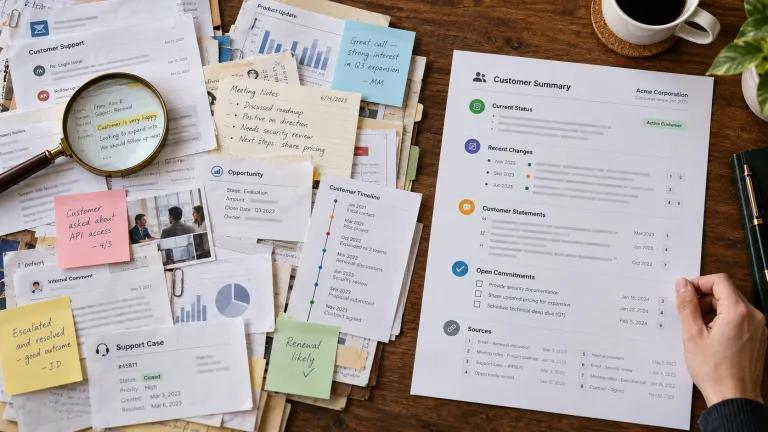
For example, a sales representative preparing for a customer meeting may need information from multiple sources. Instead of manually reviewing previous emails, notes, and activities, an AI assistant can provide a structured summary and highlight relevant changes.
This improves efficiency, but the greatest benefit comes from better decision-making. When teams understand customer context more clearly, they can provide more relevant communication and avoid unnecessary interactions.
However, businesses should avoid measuring success only through feature usage. A frequently used AI tool does not automatically create better outcomes. Organizations should evaluate whether the assistant improves customer experiences, reduces errors, and supports business goals.
Where AI CRM Assistants Fail
Although AI CRM assistants provide valuable support, they are not perfect. Several challenges can reduce their effectiveness.
Poor Data Quality
AI systems depend on the information available in the CRM. Duplicate records, incomplete customer profiles, and outdated information can produce inaccurate recommendations.
Before implementing AI, businesses should improve data hygiene by defining required fields, removing unnecessary information, and establishing clear ownership of customer records.
Excessive Permissions
AI CRM assistants often require access to customer information. Without proper controls, excessive permissions may create privacy and security risks.
Organizations should apply least-privilege access, review permissions regularly, and ensure employees understand how customer information is used.
Lack of Human Oversight
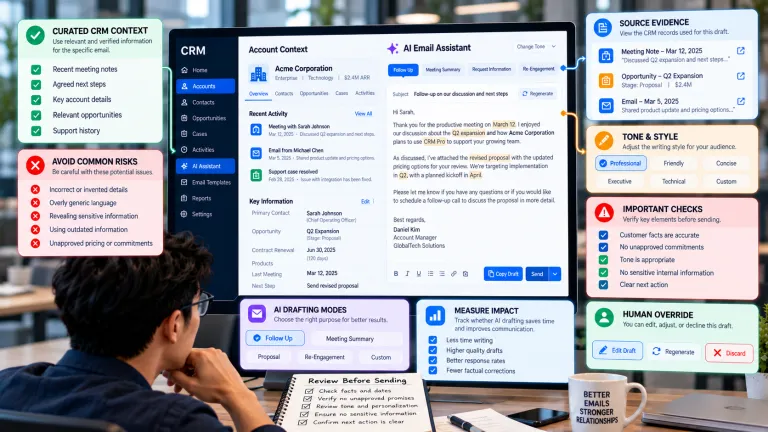
AI recommendations should support human judgment, not replace it completely. Important decisions involving pricing, contracts, eligibility, or sensitive customer situations require human review.
A responsible AI workflow includes monitoring, feedback, and escalation paths when the system produces uncertain results.
How to Deploy AI CRM Assistants Step by Step
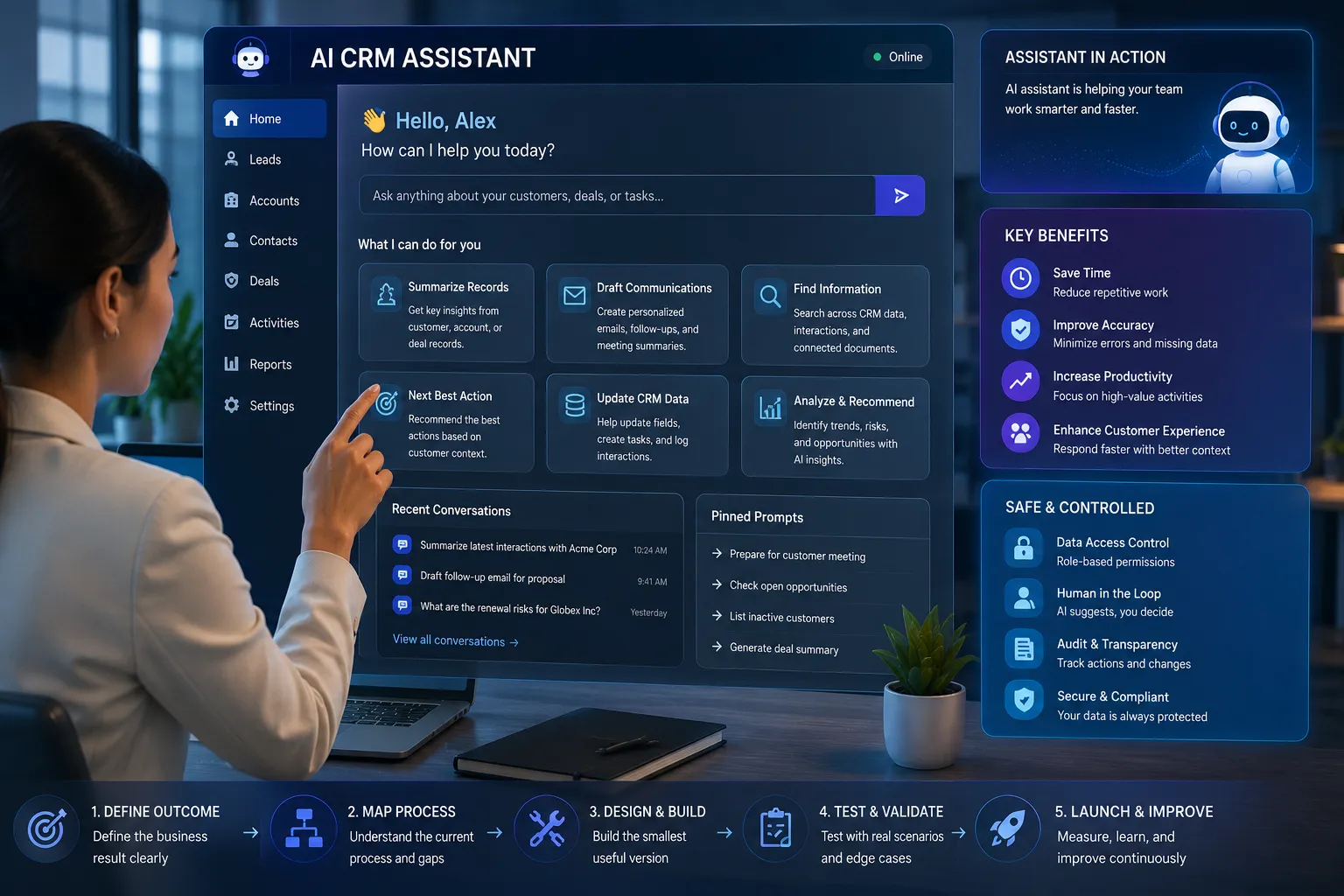
1. Define the Business Outcome
Start by identifying the problem the organization wants to solve. Avoid beginning with technology features. A clear outcome helps determine whether an AI assistant provides real value.
2. Review CRM Data Quality
Before deployment, evaluate whether customer records are accurate, complete, and consistent. AI cannot create reliable recommendations from unreliable data.
3. Define Roles and Responsibilities
Determine who manages the system, who reviews recommendations, and who handles exceptions. Clear ownership prevents confusion after implementation.
4. Start With a Small Use Case
Instead of enabling every available AI capability, businesses should begin with one practical workflow. A focused implementation makes it easier to test performance, collect feedback, and identify improvements.
For example, a company may start by using an AI CRM assistant to summarize customer conversations before expanding into sales recommendations or automated customer support.
5. Test and Improve Continuously
AI CRM assistants should be evaluated after deployment. Teams should review accuracy, employee feedback, customer impact, and operational improvements before expanding usage.
Continuous improvement ensures that AI remains aligned with business needs instead of becoming another unused feature inside the CRM system.
Measuring AI CRM Assistant Success
A successful AI CRM implementation should be measured through business outcomes, not only technical activity. The number of users or interactions alone does not show whether the system creates value.
Useful measurement areas include:
- Task Completion: Measure whether employees complete customer-related activities faster and more consistently.
- Human Acceptance: Evaluate whether employees trust AI recommendations and find them useful in daily workflows.
- Error Rate: Monitor incorrect recommendations, missing information, or decisions that require correction.
- Escalation Volume: Track situations where AI requires additional human review or intervention.
The best measurement approach combines quantitative data with employee feedback and customer outcomes. A system that reduces manual work but creates poor customer experiences is not a successful implementation.
Common Mistakes When Using AI CRM Assistants
1. Treating AI as a Replacement for Employees
AI CRM assistants are designed to support human decisions, not remove human responsibility. Customer relationships often require empathy, context, and judgment that technology cannot fully replace.
2. Automating Before Fixing Data Problems
Many organizations introduce AI while their CRM data is still inconsistent. Automation built on inaccurate information can increase mistakes instead of reducing them.
Businesses should establish reliable data practices before depending heavily on AI recommendations.
3. Ignoring User Adoption
Even a technically advanced AI assistant will fail if employees do not understand how to use it. Training, clear guidelines, and feedback channels are essential for successful adoption.
4. Measuring Features Instead of Results
A CRM assistant should not be judged only by how many times it is used. The important question is whether it improves customer decisions, workflow efficiency, and business performance.
How AI CRM Assistants Fit Into a Broader CRM Strategy
AI CRM assistants work best when they are part of a larger CRM strategy. They depend on accurate customer data, effective workflows, and clear business objectives.
Organizations should first understand the fundamentals of CRM management before introducing advanced automation. A strong CRM foundation makes AI capabilities more reliable and easier to scale.
Related topics such as
Predictive Analytics in CRM
and
AI for Customer Retention
can help businesses explore how artificial intelligence supports customer decision-making.
Frequently Asked Questions
What can AI CRM assistants do?
AI CRM assistants can summarize customer information, support sales decisions, automate repetitive tasks, improve customer service workflows, and provide recommendations based on CRM data.
Can AI CRM assistants replace CRM employees?
No. AI CRM assistants are designed to support employees by reducing repetitive work and improving access to information. Human judgment remains important for complex customer decisions.
What is the biggest challenge when implementing AI CRM assistants?
The biggest challenges are usually poor data quality, unclear processes, excessive permissions, and limited employee adoption. Successful implementation requires both technology and organizational preparation.
How should businesses measure AI CRM assistant performance?
Businesses should measure task completion, employee acceptance, error rates, escalation needs, and customer outcomes instead of focusing only on feature usage.
Final Thoughts
AI CRM assistants can help businesses create more efficient and personalized customer experiences, but their success depends on more than artificial intelligence. Reliable data, clear workflows, responsible access, and human oversight determine whether these tools create meaningful value.
The strongest implementations begin with a clear business problem, start with a focused use case, and improve through continuous evaluation. When AI supports better decisions instead of simply adding automation, CRM systems become more useful for both employees and customers.
For businesses exploring AI CRM assistants, the goal should not be replacing human interaction. The goal is creating a smarter customer management system where technology helps people work with better context, accuracy, and confidence.