What Are the Benefits of CRM for Customer Relationships?
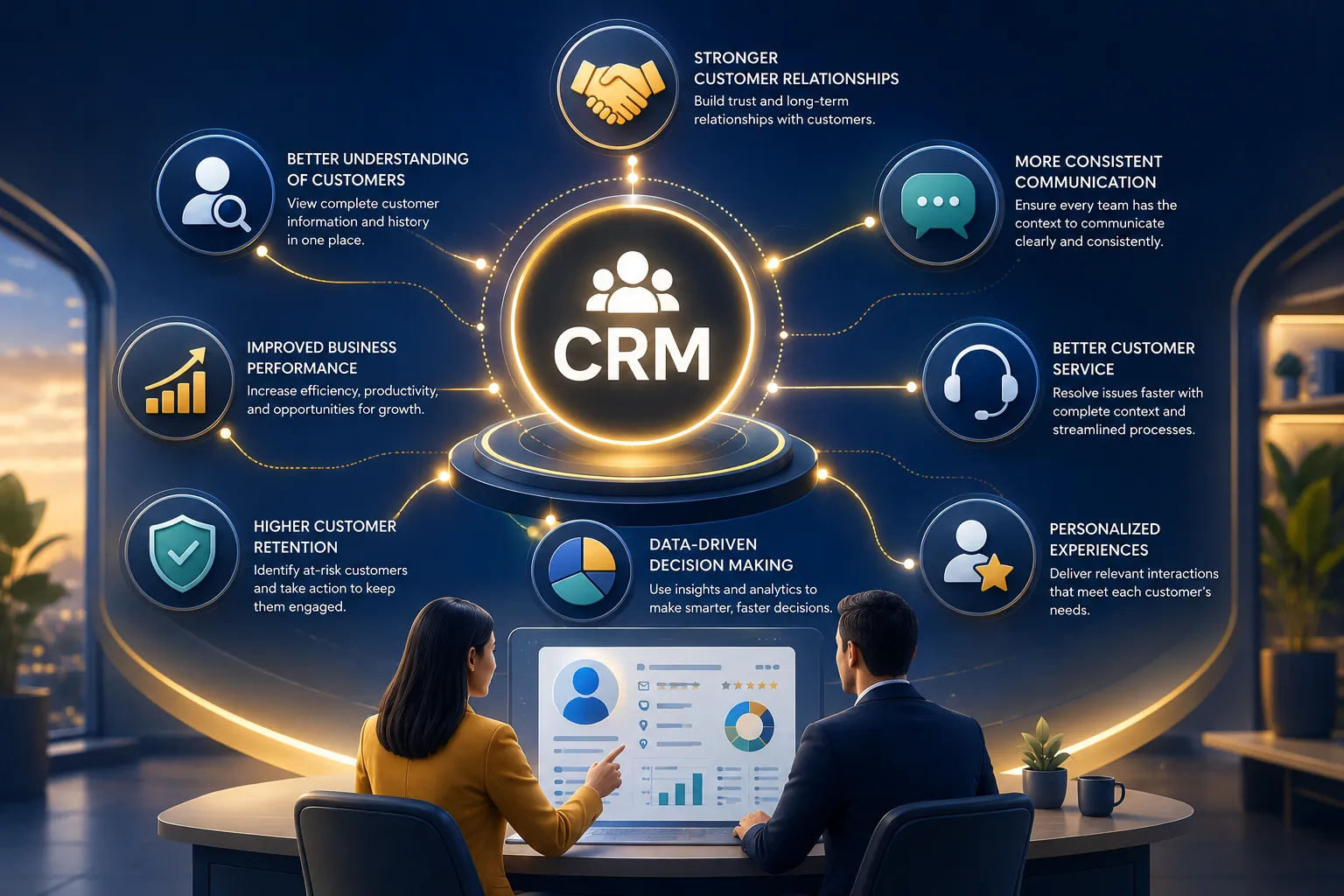
Customer Relationship Management (CRM) can provide several benefits for organizations that want to understand customers, manage interactions, and build stronger relationships over time. A CRM system brings customer information and relationship activities into a more structured environment, making it easier for employees to access relevant context and coordinate their work. The benefits are not limited to sales. CRM can also support customer service, communication, decision-making, retention, and the overall customer experience.
The value of CRM becomes clearer when customer relationships grow more complex. Customers may interact with an organization through websites, email, phone calls, messaging platforms, social media, and service channels. Without a consistent way to organize these interactions, important information can become fragmented. CRM helps connect customer records, communication history, activities, and workflows so organizations can manage relationships with greater consistency.
1. Better Understanding of Customers
One of the most important benefits of CRM is the ability to create a more complete understanding of customers. Instead of relying on isolated conversations or individual employee knowledge, organizations can maintain structured records that include customer details, previous interactions, preferences, activities, and other relevant information.
This broader context can help employees understand what customers need and how their relationships with the organization have developed. A customer who has contacted support several times, interacted with educational content, or previously discussed a specific issue can be viewed through that history rather than as a completely new interaction.
This is closely connected to the basic purpose of CRM. As explained in this beginner’s guide to CRM, customer relationship management is more than storing contact details. It is an organized approach to understanding and managing customer relationships over time.
2. More Consistent Customer Communication
Customer communication often involves multiple employees and departments. When information is stored in separate places, different employees may have different understandings of the same customer. This can lead to repeated questions, inconsistent messages, or missed follow-up activities.
CRM can help create a shared view of relevant customer information. Authorized employees can review interaction history and understand what has already been discussed before starting a new conversation. This makes communication more consistent because employees are working with the same available context.
Consistency does not mean that every customer should receive exactly the same message. Instead, it means that employees have enough information to respond appropriately to the customer’s situation. This can make interactions feel more connected and reduce unnecessary repetition.
3. Improved Customer Experience
Customer experience is influenced by many individual interactions. A customer may remember whether a business responded quickly, whether previous concerns were understood, and whether communication felt relevant to the situation. CRM can support these experiences by making useful customer context easier for employees to access.
For example, a customer who contacts a service team about an ongoing issue should not necessarily have to explain the entire history again. When previous cases, communications, and activities are available in a connected record, the employee can begin with more context and focus on resolving the current problem.
CRM does not automatically create a better customer experience. Its value depends on how well the system is implemented, how accurately information is maintained, and how employees use that information. Still, a structured customer history can provide a stronger foundation for more consistent interactions.
4. Stronger Coordination Between Teams
Customer relationships often involve several teams. Marketing may introduce a customer to an organization, sales may develop the relationship, customer service may handle questions, and account teams may manage ongoing interactions. If these functions operate in isolation, important information can become disconnected.
CRM provides a shared environment where relevant information can be connected across these activities. This can help teams understand what happened before and what needs to happen next. When responsibilities change, the next employee can review the available history instead of relying entirely on informal communication or personal notes.
This is one reason CRM becomes especially valuable as organizations grow. More customers and more employees create more opportunities for information to become fragmented. A structured system can help reduce these gaps and create a more continuous customer journey.
5. Better Access to Customer Information
Another benefit of CRM is easier access to organized customer information. Employees often need information quickly when responding to a customer, preparing a follow-up, or reviewing an ongoing case. Searching through different spreadsheets, inboxes, documents, and applications can take time and create uncertainty about which information is current.
CRM brings relevant information into a more structured environment. Customer profiles, interactions, tasks, opportunities, and service activities can be connected so employees can find important context more efficiently.
The value of this organization becomes even clearer when different CRM functions work together. The key components of a CRM system provide the underlying structure that allows customer records, communication, service, analytics, automation, and other activities to support the same relationship.
6. More Efficient Customer Service
Customer service teams often handle repetitive requests while also dealing with complicated issues that require investigation. CRM can help by organizing customer history, service cases, communication, assignments, and follow-up activities in one environment.
An employee can review a customer’s previous interactions before responding to a new request. This reduces the need to ask for information that may already be available and can make case handling more efficient. CRM can also help teams assign requests, monitor case status, and maintain continuity when more than one employee becomes involved.
Modern CRM environments can also connect with AI and automation. For example, AI can help summarize conversations or classify requests, while automation can trigger routine tasks. Our article on AI automation in customer service explores how these capabilities are changing service workflows.
7. Improved Sales and Follow-Up Management
CRM can also help organizations manage potential and existing customer relationships through more structured follow-up processes. Sales teams can track opportunities, record interactions, organize next steps, and monitor where potential customers are within a defined process.
This can reduce the risk of missed follow-up activities. Instead of depending entirely on memory, employees can use CRM tasks, reminders, and workflow stages to organize their activities. Managers can also gain a broader view of ongoing opportunities and identify areas where progress may have slowed.
The benefit is not simply better visibility into sales activity. A well-organized CRM can also preserve relationship context. Employees can review previous conversations and understand what information has already been shared before continuing a customer conversation.
8. Better Decision-Making Through Customer Data
CRM can support decision-making by organizing customer-related information into a form that can be analyzed. Reports and dashboards may help organizations understand activity across sales, customer service, engagement, or other relationship processes.
When patterns become visible, managers can investigate what may be causing them. For example, recurring customer issues may indicate a process that needs improvement, while changes in engagement may suggest that a particular customer segment requires more attention.
Advanced CRM environments can take this further through predictive analytics. Predictive analytics in CRM can help organizations examine customer behavior patterns and consider what may happen next rather than focusing only on historical activity.
9. Greater Customer Retention Potential
Customer retention depends on many factors, including satisfaction, communication, service quality, and the overall value customers experience. CRM can support retention efforts by helping organizations maintain a clearer history of customer relationships and identify situations that may require attention.
For example, a customer who has become less engaged or has experienced repeated service problems may need a different type of follow-up from an actively engaged customer. CRM can help employees recognize these differences and review relevant information before deciding how to respond.
Retention should not be reduced to a simple automated process. Customer relationships involve changing circumstances, and employees need to understand the broader context rather than relying only on a system alert. CRM provides information and organization, while the quality of the resulting relationship still depends on human decisions and actions.
10. More Opportunities for Personalization
CRM can support personalization because it gives organizations access to structured information about customer interactions and preferences. Instead of treating every customer as identical, employees and systems can use available context to make communication more relevant.
For example, a customer who frequently engages with information about a particular topic may be more interested in related resources than someone who has never shown that interest. CRM can provide the historical context needed to recognize these differences.
AI can extend this capability by analyzing customer behavior and identifying patterns that may support more relevant communication. AI-powered personalization in customer relationships explains how AI can help organizations move from broad customer segments toward more context-aware experiences.
11. Reduced Repetitive Administrative Work
Managing customer relationships involves many repetitive tasks, including updating records, assigning activities, scheduling reminders, documenting interactions, and preparing routine follow-ups. CRM can organize these activities and, in some cases, automate parts of the workflow.
Reducing repetitive administration can give employees more time to focus on customer conversations, problem-solving, and decisions that require human judgment. The benefit is strongest when automation is carefully designed around real business processes rather than added simply because a system makes automation possible.
Organizations should therefore consider which tasks genuinely benefit from automation and which activities are better handled manually. The goal should be to make customer-related work clearer and more efficient without creating unnecessary complexity.
12. A Stronger Foundation for AI and Analytics
A well-structured CRM environment can also create a foundation for more advanced technologies. AI and analytics depend on access to useful customer information, and CRM can provide an organized source of relationship data.
This is one reason CRM and AI are becoming increasingly connected. As discussed in how AI is transforming CRM, AI can help organizations analyze customer information, support automation, summarize interactions, and identify patterns that may be difficult to see manually.
However, more advanced technology does not remove the need for accurate data and sound processes. Poor information can limit the usefulness of even sophisticated analytics or AI tools. CRM therefore serves as both a customer management environment and a foundation for future digital capabilities.
What Determines Whether CRM Delivers These Benefits?
Having a CRM system does not automatically create all of these benefits. Results depend on how well the system fits the organization’s processes, how accurately customer information is maintained, and whether employees use the system consistently.
Organizations also need to avoid making the CRM more complicated than necessary. A system with excessive fields, unclear workflows, or unnecessary automation can create frustration rather than improve productivity. The most effective CRM environments tend to focus on relevant information, practical workflows, clear responsibilities, and useful customer context.
Training and ongoing review are also important. Customer relationships change, business processes evolve, and CRM systems may need to be adjusted over time. Successful CRM is therefore not only a technology project but an ongoing approach to managing customer information and relationships.
Conclusion
The benefits of CRM for customer relationships come from creating a more organized and connected way to manage customer information, interactions, communication, service, and decision-making. CRM can help organizations understand customers better, coordinate teams, improve service, support personalization, reduce repetitive work, and make better use of customer data.
The technology itself is only part of the equation. The strongest results come when CRM supports clear processes, accurate information, thoughtful communication, and employees who understand how to use customer context responsibly.
As CRM continues to evolve alongside artificial intelligence, automation, and analytics, its role is expanding beyond record keeping. CRM can become a foundation for understanding customer relationships more deeply and creating experiences that are more consistent, relevant, and useful.