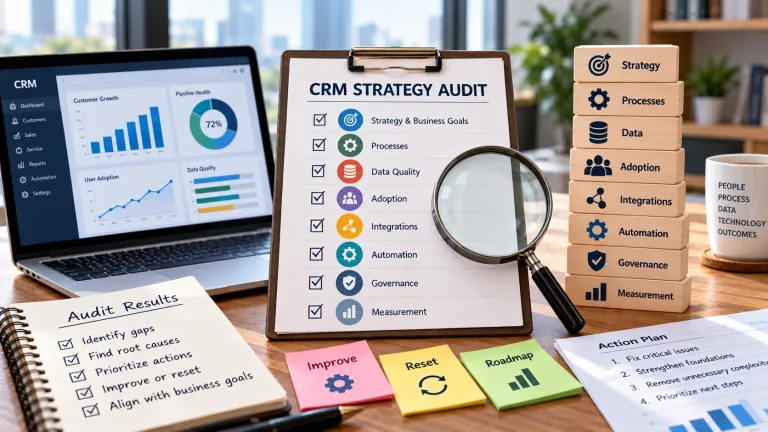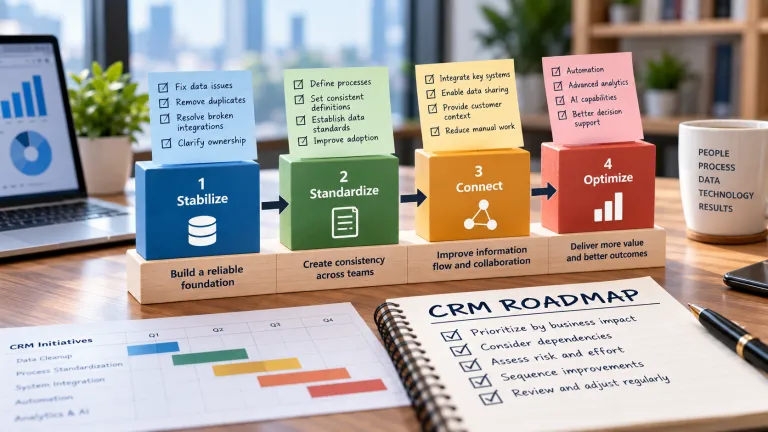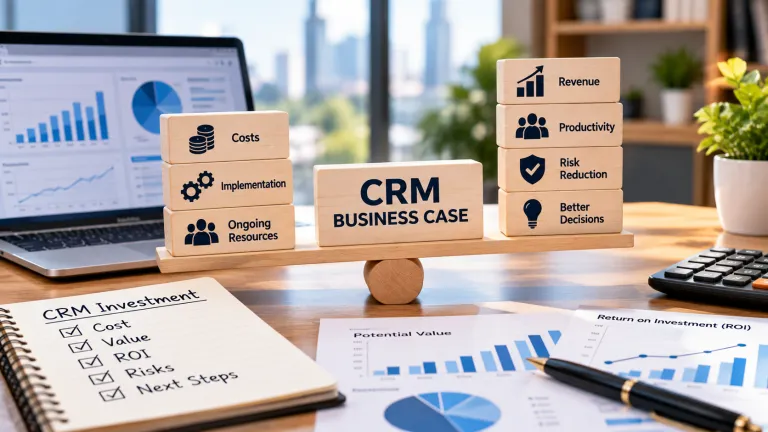
CRM Maturity Model: How to Assess Where Your Organization Really Stands
Organizations rarely have a simple “good CRM” or “bad CRM” problem. More often, different parts of the CRM environment develop at different speeds. The technology may be modern while customer data remains inconsistent. Reporting may be sophisticated while employees still maintain private spreadsheets. Automation may increase while ownership and governance remain unclear.
This is why CRM maturity is more useful than asking whether a company has implemented CRM successfully.
A CRM maturity model helps an organization evaluate how consistently its customer strategy, processes, data, people, governance, and technology work together. The objective is not to earn a maturity score for its own sake. It is to identify which weaknesses are limiting the value of the overall CRM environment and determine what should be improved next.
For organizations still defining the strategic foundations, Clientira’s CRM strategy framework provides a useful starting point. A maturity assessment serves a different purpose: it examines how well those principles are actually operating in practice.
What Is a CRM Maturity Model?
A CRM maturity model is a structured way to evaluate how developed an organization’s customer relationship management capabilities have become.
It looks beyond software installation. A company may own an advanced CRM platform and still have low maturity if data is unreliable, processes are inconsistent, ownership is unclear, or employees do not use the system as part of their normal work.
Likewise, a smaller organization using a relatively simple CRM can demonstrate stronger maturity if its customer processes are clear, information is maintained consistently, responsibilities are understood, and management uses reliable CRM data to make decisions.
The model therefore evaluates CRM as an operating capability rather than as a technology purchase.
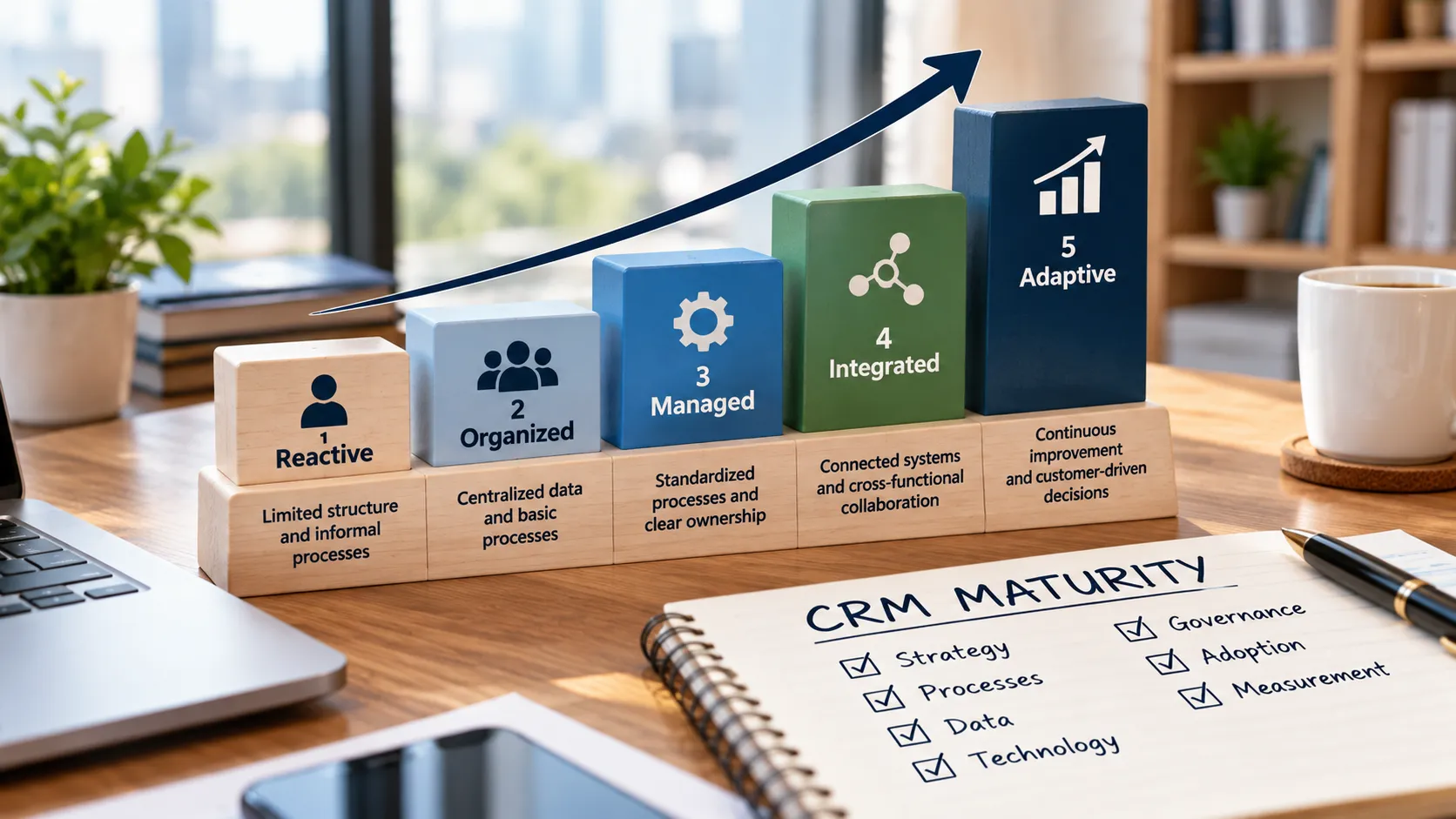
A Five-Level CRM Maturity Model
A practical maturity model can be divided into five levels. Organizations do not need to fit perfectly into one level. It is common for one capability to be more mature than another.
Level 1: Reactive
At the reactive level, customer information and processes depend heavily on individuals.
Important details may live in email inboxes, spreadsheets, notes, messaging applications, or employee memory. Customer records are often incomplete, duplicated, or updated inconsistently.
Processes tend to be informal. Employees may know what they personally need to do, but the organization has limited visibility into how customer relationships are managed across teams.
Reporting is difficult because definitions are inconsistent. Managers may spend significant time assembling information manually before they can answer basic questions.
The priority at this stage is not advanced automation. It is establishing a dependable operational foundation.
Level 2: Organized
At the organized level, the company has begun centralizing customer information and defining repeatable processes.
CRM becomes a recognized system of record for important customer information. Teams may have standard fields, sales stages, service categories, ownership rules, or basic reporting.
However, consistency may still depend heavily on individual managers.
Some users follow the standard process while others work around it. Data quality may be improving but still requires regular manual cleanup. Integrations may exist, although teams may not fully understand which system owns particular information.
The main goal at this stage is consistency.
Level 3: Managed
A managed CRM environment has clearer ownership and stronger operational discipline.
Customer processes are documented. Important fields have defined meanings. Teams understand who owns records and what is expected during handoffs. Managers rely on CRM reporting regularly rather than using the system only as an administrative database.
Governance also begins to matter more at this stage.
As the CRM environment expands, uncontrolled requests for new fields, dashboards, workflows, and integrations can create unnecessary complexity. Organizations need a process for deciding which changes deserve implementation and who is responsible for maintaining standards.
Clientira’s guide to CRM governance, roles, rules, and responsibilities examines this issue in greater detail.
Level 4: Integrated
At the integrated level, CRM is no longer functioning as an isolated application.
Important customer information flows between relevant systems, and teams can understand a relationship without manually reconstructing information from multiple sources.
Sales, marketing, service, operations, and other functions may share customer context while maintaining clear boundaries regarding data ownership.
Integration, however, should not be confused with connecting every available application.
A mature integration strategy focuses on information that supports a real customer process or business decision. The organization understands which system is authoritative for each important data element, how information is synchronized, and how failures or exceptions are handled.
This is closely related to the principles discussed in Clientira’s CRM integration strategy.
Level 5: Adaptive
At the adaptive level, CRM becomes part of how the organization continuously learns and improves.
Customer data is not merely recorded. It is used to identify patterns, test assumptions, evaluate customer outcomes, and adjust processes.
Teams can introduce new capabilities without losing control because governance, ownership, measurement, and review mechanisms are already established.
Automation and AI may play a larger role, but technology is introduced selectively. The organization can distinguish between a useful innovation and a feature that adds complexity without improving a meaningful decision.
An adaptive CRM organization also recognizes that maturity is temporary. New products, channels, regulations, organizational changes, or customer expectations can create new weaknesses. Continuous review is therefore part of the operating model.
Do Not Assess CRM Maturity With a Single Score
One of the biggest mistakes in maturity assessments is reducing the entire CRM environment to a single number.
A company might be highly mature in reporting but weak in employee adoption. It might have excellent customer data but poor cross-functional processes. It may have strong automation while governance remains informal.
A better approach is to evaluate CRM across several dimensions separately.
- Strategy: Is there a clear connection between CRM priorities and business outcomes?
- Customer process: Are important customer journeys and operational handoffs consistently defined?
- Data: Is customer information accurate, useful, owned, and maintained?
- Technology: Does the CRM environment support actual business requirements without unnecessary complexity?
- Integration: Does information move between systems with clear ownership and controls?
- Governance: Are changes, permissions, standards, and responsibilities managed deliberately?
- Adoption: Do employees use CRM as part of normal work rather than as an additional reporting obligation?
- Measurement: Can management determine whether CRM activities are improving business and customer outcomes?
This multidimensional view is more useful because improvement priorities become visible.
Assess Strategy Maturity First
CRM maturity should begin with strategy because improvements in other areas need direction.
Ask whether the organization can clearly explain what CRM is expected to improve.
A low-maturity answer usually focuses on software capabilities: centralize data, automate tasks, create dashboards, or implement AI.
A stronger answer connects CRM to outcomes such as improving retention, increasing qualified conversion, creating more consistent service, improving forecasting, or reducing friction during customer onboarding.
The distinction matters because technology investments are easier to prioritize when the intended outcome is clear.
Examine Whether Customer Processes Are Actually Standardized
Organizations sometimes assume a process is standardized because it has been configured inside the CRM.
The real test is whether teams interpret and use the process consistently.
Consider a sales pipeline. If different employees interpret opportunity stages differently, the CRM may technically contain a pipeline while management still cannot rely on it.
The same problem can occur in customer service, onboarding, renewal, or account management.
Process maturity means employees understand what each stage or status represents, what information is required, who owns the next step, and what conditions justify moving forward.
For broader context on how these stages change throughout a relationship, see Clientira’s guide to customer lifecycle management in CRM.
Evaluate Data by Usability, Not Volume
A CRM database can contain millions of records and still have low data maturity.
The important question is whether employees and systems can reliably use the information.
Look for signs such as duplicated accounts, incomplete fields, inconsistent formats, outdated ownership, unexplained custom fields, conflicting customer statuses, or records that employees routinely distrust.
Another useful question is whether each important field has a purpose.
Organizations often accumulate data because someone once requested it. Years later, the field remains even though nobody knows who maintains it or which decision it supports.
A mature CRM environment is often more selective. It collects enough information to support customer decisions, workflows, reporting, compliance, and measurement without making every record unnecessarily difficult to maintain.
Look for Technology That Supports the Process Instead of Controlling It
Technology maturity is not measured by the number of features enabled.
It is measured by how effectively the CRM supports the operating model.
A complicated system may actually indicate lower maturity if employees need extensive workarounds to complete basic tasks.
Warning signs include duplicate tools performing the same function, excessive custom fields, automation that users frequently override, reports that require manual correction, or integrations that nobody fully understands.
A mature technology environment should make important work easier to perform correctly.
Measure Governance Before Complexity Increases
Governance often appears unnecessary when a CRM implementation is small.
As more teams, data sources, workflows, and automation are added, the absence of governance becomes increasingly expensive.
A maturity assessment should therefore ask who can request CRM changes, who approves them, who owns definitions, who controls access, and how changes are documented.
If every team can independently add requirements without considering the broader CRM environment, complexity tends to accumulate quickly.
Strong governance does not mean every change requires a committee. It means important decisions have visible ownership and proportionate controls.
Assess Adoption Through Behavior, Not Login Counts
CRM adoption is frequently measured using the number of active users.
That can be useful, but it is not enough.
An employee can log in every day while still maintaining incomplete records or managing important customer work outside the system.
A better maturity assessment examines whether employees perform critical behaviors consistently.
Are opportunities updated before reviews? Are customer interactions recorded? Are accounts assigned correctly? Are follow-up activities visible? Are service cases completed using the defined process?
These behaviors reveal whether CRM has become part of the operating system of the organization.
Check Whether Measurement Leads to Decisions
Dashboard maturity is not determined by the number of charts available.
The important question is whether measurement changes what managers and teams do.
A mature CRM environment connects metrics to specific questions.
For example, a manager may need to understand why opportunities remain in one pipeline stage for too long, which customer segments experience repeated service issues, or whether intervention is improving retention.
Metrics should provide enough context to support action rather than merely summarize activity.
Choosing those measures carefully is important. Clientira’s article on CRM KPIs that match business goals explains how to connect measurement with the outcome the organization is actually trying to improve.
How to Run a Practical CRM Maturity Assessment
A maturity review does not need to become a large consulting exercise.
Start by selecting the major CRM dimensions and asking representatives from the teams that use or depend on the system to describe how each one currently works.
Evidence matters more than perception.
If a team says data quality is strong, review actual records. If managers say CRM adoption is high, examine whether important activities are consistently recorded. If integration is described as reliable, investigate how exceptions are handled when synchronization fails.
Different departments may provide different answers. That disagreement is itself useful information because it can reveal inconsistent definitions or hidden workflows.
The goal is not to prove that one team is right. The goal is to understand the operating reality.
Prioritize the Constraint, Not the Lowest Score
After completing the assessment, organizations often want to fix whichever maturity dimension received the lowest rating.
That is not always the best approach.
The more useful question is: which weakness is currently preventing the organization from achieving an important outcome?
For example, weak automation may not matter if customer data is still unreliable. Investing in more automation could actually increase the impact of data errors.
Similarly, advanced analytics may provide little value if teams do not consistently follow the customer process that generates the underlying data.
Improvement should therefore focus on the constraint that limits the next stage of CRM performance.
Example: A Company With Uneven CRM Maturity
Imagine an organization that has invested heavily in dashboards and automation.
Management can see pipeline reports in real time, automated reminders are active, and several systems are connected to CRM.
At first glance, the organization appears mature.
However, a closer assessment reveals several problems. Sales representatives interpret opportunity stages differently. Account ownership is sometimes outdated. Service history is not consistently available to sales. Managers regularly correct reports outside CRM before presenting them.
The technology is relatively mature, but process, data, and governance are not.
Adding predictive analytics or more automation would not solve the underlying problem. The better next step would be to standardize definitions, clarify ownership, improve data controls, and verify that reporting can be trusted.
This is the main value of a maturity model: it prevents visible technology from hiding less visible operational weaknesses.
CRM Maturity Is About Balance
The strongest CRM environments are not necessarily the ones with the most advanced technology.
They are the ones where strategy, customer processes, data, people, governance, technology, and measurement have developed at compatible levels.
If one dimension moves far ahead of the others, the organization often experiences friction.
Advanced automation built on weak data produces unreliable automation. Sophisticated dashboards built on inconsistent processes create misleading reports. Powerful technology with low employee adoption becomes expensive shelfware.
Maturity comes from strengthening the system as a whole.
Final Thoughts
A CRM maturity model gives organizations a more useful question than “Do we have a good CRM?”
It asks how consistently the organization can turn customer strategy into repeatable decisions, reliable data, coordinated processes, responsible technology, and measurable outcomes.
The assessment should not be treated as a competition to reach the highest maturity level as quickly as possible. Different organizations require different levels of sophistication.
The objective is to identify what the business needs next.
If customer processes are unclear, standardize them before adding advanced automation. If information is unreliable, strengthen data practices before investing heavily in analytics. If technology is expanding quickly, make governance and ownership explicit before complexity becomes difficult to control.
CRM maturity is therefore less about how many capabilities an organization has and more about whether those capabilities work together reliably.
When organizations understand where they actually stand, they can make CRM investments based on evidence rather than assumptions—and move toward the next stage with a clearer reason for every improvement.