Building a Business Case for CRM: Costs, Value, and ROI Explained
A CRM investment can sound convincing long before anyone has demonstrated that it is worth making. A team may want better reporting, cleaner customer data, more automation, stronger integrations, or a modern platform. Each request may be reasonable, but together they can create a significant investment without a clear explanation of what the organization expects to gain.
This is where a CRM business case becomes useful.
A strong business case does not try to prove that CRM is valuable in general. It explains why a specific CRM investment makes sense for a specific organization, which business problems it is expected to address, what it will cost, what value could realistically be created, and which assumptions must be true for that value to appear.
The purpose is not to make every benefit look financial. The purpose is to give decision-makers a credible way to compare investment, expected improvement, risk, and alternative uses of resources.
What Is a CRM Business Case?
A CRM business case is a structured argument for investing resources in a CRM initiative.
That initiative could involve implementing a new platform, improving an existing CRM, integrating additional systems, redesigning customer processes, strengthening data quality, expanding automation, or introducing new reporting capabilities.
A useful business case connects four questions:
- What problem are we trying to solve?
- What will it cost to solve it?
- What measurable value could the organization receive?
- What could prevent that value from being realized?
These questions sound simple, but CRM projects frequently become difficult because organizations start with the proposed solution rather than the business problem.
Before calculating ROI, the organization should be able to explain why the initiative exists. The CRM strategy framework provides a useful foundation for connecting CRM initiatives with business goals, customer priorities, processes, and ownership.
Start With the Cost of the Current Problem
A business case becomes much stronger when it begins with the current state rather than the proposed technology.
Consider an organization where sales representatives maintain separate spreadsheets because CRM data is unreliable. Managers spend several hours each week reconciling pipeline information. Customer service cannot easily see recent sales conversations. Duplicate account records create inconsistent reporting.
The problem is not simply that the organization needs a “better CRM.”
The current operating model already has a cost.
That cost may appear as wasted employee time, slower decisions, missed follow-ups, duplicated work, inconsistent customer experiences, reporting errors, or additional manual controls.
A useful business case makes those costs visible.
Instead of writing:
Our CRM needs to be modernized.
the organization might define the issue more precisely:
Sales managers spend approximately 12 hours each week reconciling pipeline data from CRM and spreadsheets because opportunity information is incomplete and stage definitions are inconsistent.
The second statement creates a baseline that can later be measured.
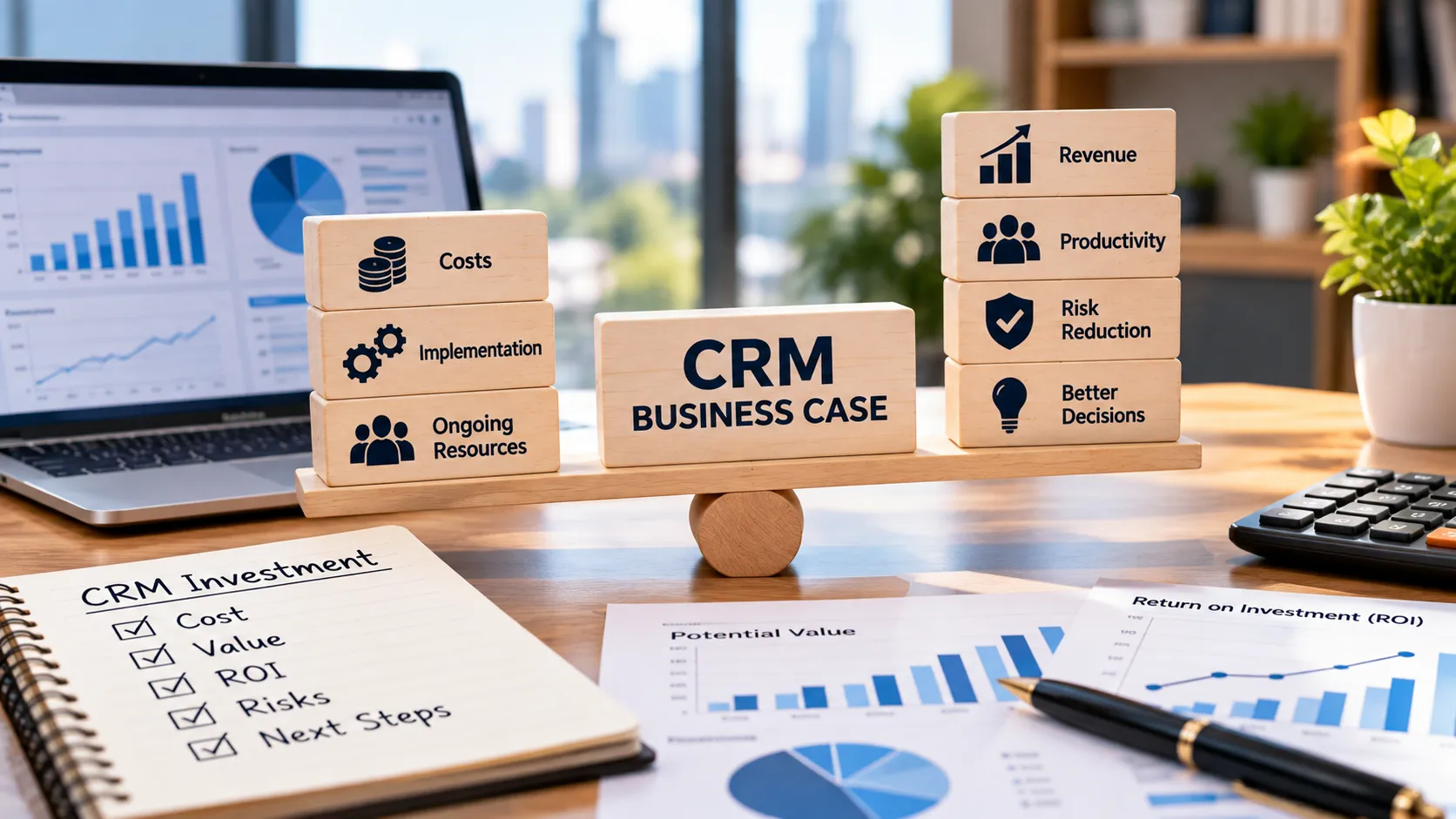
Separate CRM Costs Into Meaningful Categories
CRM cost is more than a software subscription.
A business case that considers only licensing can significantly underestimate the resources required to create a usable system.
It is more useful to organize costs into several categories.
1. Technology costs
These are the most visible costs and may include CRM subscriptions, additional modules, storage, integration services, analytics tools, security capabilities, or other supporting software.
2. Implementation costs
Implementation may require process design, configuration, data migration, testing, integration development, consulting, project management, and technical support.
The cost can vary substantially depending on how much the organization changes the standard platform.
3. Data costs
Customer data often requires more work than expected.
Duplicate records may need to be merged. Fields must be mapped. Historical information may require cleaning. Ownership may need to be corrected. Data standards may need to be created before migration begins.
If the organization already knows that data quality is a weakness, the business case should not treat cleanup as a minor implementation detail.
4. Integration costs
CRM rarely operates alone.
It may need to exchange information with marketing systems, customer service tools, financial applications, product platforms, identity systems, or data warehouses.
Integration can also create ongoing maintenance obligations. A connection that works at launch may require monitoring and adjustment when either system changes.
For organizations evaluating these dependencies, Clientira’s guide to CRM integration strategy explains why system ownership and data boundaries matter as much as technical connectivity.
5. People and adoption costs
Employees need time to learn new processes, attend training, test workflows, provide feedback, and adjust existing habits.
Managers may also need to change how they conduct pipeline reviews, customer meetings, or performance discussions.
These activities have a cost even when no external invoice is created.
6. Ongoing operating costs
A CRM environment requires maintenance after launch.
Administration, user support, governance, data quality reviews, integration monitoring, reporting changes, permissions, training for new employees, and platform updates should all be considered.
This is why the total cost of ownership is usually more useful than the initial purchase price.
Do Not Count Every CRM Benefit as Revenue
The value side of a CRM business case requires equal discipline.
CRM initiatives can create different forms of value, and not all of them should be converted into revenue.
A practical business case can separate value into four groups.
Revenue-related value
Some CRM improvements may contribute to higher conversion, better retention, more effective account expansion, or faster progression through a sales process.
These benefits can potentially be connected to revenue, but assumptions should remain conservative.
If a CRM change is only one of several factors influencing conversion, the business case should not claim that the entire increase belongs to CRM.
Productivity value
CRM may reduce time spent searching for customer information, preparing reports, entering duplicate data, coordinating handoffs, or performing repetitive tasks.
Time savings can be useful, but they should be interpreted carefully.
Saving 1,000 employee hours does not automatically mean the organization reduces payroll by the equivalent amount. The more realistic value may be that employees can redirect those hours toward customer-facing or higher-value activities.
Risk reduction
Better permissions, data controls, process consistency, ownership, and auditability may reduce operational or compliance risk.
These improvements can be highly valuable even when the organization cannot attach a precise revenue figure to them.
Decision-quality value
A trustworthy CRM environment may allow managers to make decisions sooner and with greater confidence.
Improved forecasting, clearer customer histories, consistent pipeline definitions, and more reliable dashboards can reduce uncertainty.
This type of value is difficult to express as a single financial number, but it should not be ignored.
Build the Business Case Around a Baseline
Claims such as “CRM will increase productivity” are difficult to evaluate without knowing the current level of productivity.
Before the investment begins, measure the existing condition wherever possible.
Depending on the project, useful baseline measures might include:
- time required to prepare recurring management reports;
- percentage of customer records with missing critical fields;
- number of duplicate accounts;
- average duration of a defined sales stage;
- percentage of opportunities updated before review meetings;
- average customer service response or resolution time;
- number of manual handoffs between teams;
- forecast accuracy;
- renewal or retention performance; or
- employee time spent moving information between systems.
The correct measures depend on the purpose of the investment.
If choosing appropriate indicators is difficult, Clientira’s guide on CRM KPIs that match business goals can help connect measurement to the underlying objective instead of measuring activity simply because data is available.
Estimate Value With Scenarios, Not One Perfect Forecast
A CRM business case involves uncertainty.
Adoption may be slower than expected. Integration may require more work. Data cleanup may uncover additional problems. Employees may save less time than initially estimated.
Trying to hide this uncertainty behind one precise ROI figure can make the business case less credible.
A better approach is to model several scenarios.
| Scenario | Assumption | Purpose |
|---|---|---|
| Conservative | Lower adoption, modest efficiency gains, higher implementation effort | Shows whether the investment still makes sense if results are weaker than expected |
| Expected | Reasonable adoption and benefits based on available evidence | Represents the planning case |
| Upside | Strong adoption and higher improvement in targeted processes | Illustrates additional potential without treating it as guaranteed |
This structure makes assumptions visible.
Decision-makers can then ask which variables have the greatest effect on the result rather than debating whether one forecast is “correct.”
How to Think About CRM ROI
At its simplest, ROI can be expressed as:
ROI = (Value Created − Cost of Investment) ÷ Cost of Investment × 100
The calculation itself is straightforward. The difficult part is deciding what legitimately belongs in “value created” and “cost of investment.”
For example, suppose a CRM initiative costs $100,000 over the period being evaluated and the organization estimates $140,000 in measurable benefits.
The simplified ROI would be:
($140,000 − $100,000) ÷ $100,000 × 100 = 40%
But the percentage alone tells an incomplete story.
Decision-makers should also understand how long benefits take to appear, how confident the organization is in the assumptions, whether important non-financial benefits exist, and what ongoing costs remain after the initial period.
ROI should therefore support the business case rather than become the entire business case.
Add Payback Period and Total Cost of Ownership
Two investments can produce similar ROI while having very different financial characteristics.
One project may require a large initial investment and take several years to recover its cost. Another may deliver smaller total benefits but generate them much sooner.
This is why the business case can benefit from additional views.
Payback period
The payback period asks how long it takes for accumulated benefits to recover the investment.
This can be especially useful when the organization has several competing projects and limited capital.
Total cost of ownership
Total cost of ownership considers the continuing cost of operating the CRM environment rather than stopping the analysis at implementation.
Subscriptions, administration, integrations, support, training, data maintenance, and future changes can materially affect the economics of a CRM program.
A system that appears inexpensive at purchase may become expensive to maintain if it requires extensive customization or manual support.
Make Adoption an Explicit Business-Case Assumption
Many CRM benefits depend on employee behavior.
A new pipeline design creates little value if opportunities remain outdated. Better customer profiles provide limited benefit if employees continue using separate spreadsheets. Automation cannot operate reliably when the required information is missing.
For this reason, adoption should not appear as a vague implementation risk at the bottom of the document.
It should be part of the value model.
For example, if a productivity estimate assumes that 100 sales employees will use a new workflow consistently, the business case should show what happens if only 60 employees adopt it during the first year.
That makes the relationship between behavior and ROI visible.
Clientira’s article on building a CRM adoption plan employees will actually follow provides additional context for turning implementation requirements into everyday user behavior.
Evaluate the Organization’s CRM Maturity Before Assuming Advanced Benefits
The same CRM investment can produce very different results in different organizations.
An organization with consistent processes, reliable data, clear ownership, and strong adoption may be ready to benefit from advanced automation or analytics.
Another organization may purchase the same capability and struggle because the underlying operating model is unstable.
This is why maturity should influence the business case.
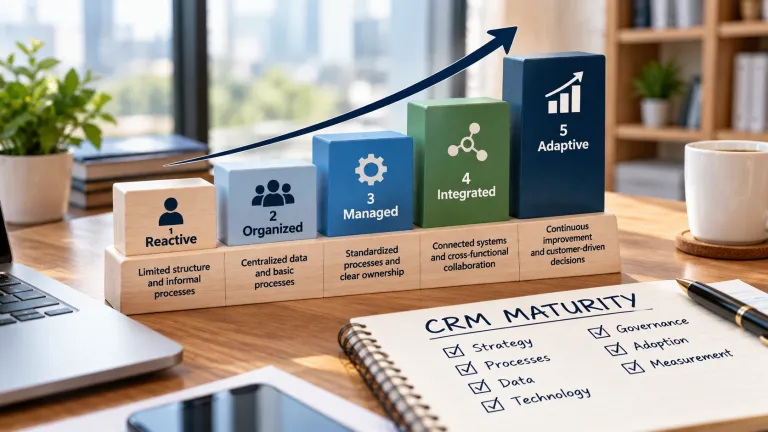
Before forecasting sophisticated benefits, assess whether the organization has the foundations required to support them. Clientira’s CRM maturity model provides a practical way to examine strategy, processes, data, technology, governance, adoption, and measurement separately.
If the assessment reveals significant weaknesses, strengthening those foundations may be part of the investment rather than an activity that can be assumed away.
Include the Cost of Doing Nothing
A CRM business case should compare the proposed investment with a realistic alternative.
Sometimes the alternative is not “spend nothing.”
Keeping the current environment may continue to create costs through manual reporting, duplicate work, lost productivity, inconsistent customer handling, technical maintenance, or growing data problems.
If the number of customers, users, or systems is increasing, those costs may also grow over time.
The relevant comparison is therefore:
What happens if we make this investment, and what happens if we continue operating as we do today?
This prevents the proposed project from being compared with an unrealistic zero-cost status quo.
Identify What Could Break the Business Case
A credible business case explains its weaknesses.
Decision-makers should know which assumptions matter most and what could prevent the projected value from appearing.
Common risks may include:
- low employee adoption;
- poor data quality;
- unclear process ownership;
- integration complexity;
- excessive customization;
- underestimated migration effort;
- weak executive sponsorship;
- changing business requirements; or
- benefits that depend on several unrelated initiatives succeeding at the same time.
The objective is not to make the investment appear risky. It is to determine whether the organization understands the conditions required for success.
A Simple CRM Business Case Structure
A practical business case does not need to become a 50-page document. For many CRM decisions, the core logic can be summarized in a relatively compact structure.
- Problem: Describe the current business or customer issue using evidence.
- Baseline: Show how the current process performs today.
- Proposed change: Explain what will change without turning the section into a feature list.
- Investment: Estimate technology, implementation, data, integration, people, and ongoing costs.
- Expected value: Separate revenue, productivity, risk, and decision-quality benefits.
- Assumptions: State what must happen for the expected benefits to appear.
- Scenarios: Model conservative, expected, and upside outcomes.
- Risks: Identify the conditions that could weaken the result.
- Measures: Define how benefits will be verified after implementation.
- Decision: Explain why the investment should proceed, change, wait, or be rejected.
Do Not Stop Measuring After the Investment Is Approved
The business case should survive implementation.
Too often, ROI is calculated to secure approval and then forgotten after the project begins.
A better approach turns the assumptions in the business case into a measurement plan.
If the investment was justified partly by reducing reporting time, measure reporting time after implementation. If the case assumed better pipeline accuracy, compare the new results with the baseline. If employee adoption was necessary for the projected benefits, measure the behaviors that demonstrate adoption.
Dashboards can help, but only when they are designed around decisions rather than visual activity. Clientira’s guide on creating CRM dashboards that drive better decisions explains how reporting can remain connected to action.
Post-implementation measurement also improves future CRM decisions. The organization learns which assumptions were accurate, which costs were underestimated, and which benefits appeared more slowly than expected.
Questions Leaders Should Be Able to Answer
Before approving a CRM investment, decision-makers should be able to answer a small number of questions clearly:
- What business problem justifies this investment?
- What evidence shows that the problem is significant?
- Which customer or employee outcomes should improve?
- What is the full cost rather than only the software price?
- Which benefits are measurable and which are strategic but difficult to monetize?
- Which assumptions have the greatest effect on the financial case?
- What level of employee adoption is required?
- What happens if the organization does nothing?
- How will management know whether the expected value was actually created?
If these questions cannot yet be answered, the organization may need more discovery before making a large commitment.
Final Thoughts
A CRM business case should make an investment easier to understand, not easier to sell.
That means beginning with the current business problem, measuring the baseline, estimating the full cost of change, and distinguishing credible benefits from optimistic assumptions.
ROI can be useful, but it should sit alongside total cost of ownership, payback, risk, adoption, customer impact, and the cost of maintaining the current environment.
The strongest business cases also remain useful after approval. Their assumptions become targets to test, their baselines become points of comparison, and their promised benefits become outcomes that management can verify.
When CRM investment decisions are made this way, organizations are less likely to fund technology simply because it appears modern or feature-rich. They can invest because they understand the problem, the expected value, the conditions required for success, and the evidence that will eventually show whether the decision was worthwhile.