CRM Roadmap Prioritization: What to Fix First and What Can Wait
CRM improvement rarely fails because an organization has too few ideas. More often, the problem is the opposite: there are too many.
Sales wants a better pipeline. Service wants more customer context. Management wants dashboards. Operations wants integrations. Users want fewer required fields. Data teams want cleaner records. Leadership may also want automation, AI, forecasting, and new reporting capabilities.
Every request can sound important when considered independently.
The strategic challenge is deciding what should happen first.
CRM roadmap prioritization is the process of determining which improvements should receive attention now, which depend on other work, which can wait, and which should not be pursued at all.
A strong roadmap does not simply rank features. It sequences improvements so that each stage creates a stronger foundation for the next one.
Why CRM Roadmaps Become Overloaded
CRM roadmaps often begin as a list of reasonable requests.
A new field is needed for reporting. An integration would reduce duplicate entry. A workflow could automate follow-up. A dashboard might help management. A new AI feature promises faster decisions.
Individually, these requests may make sense. The problem appears when the organization tries to implement them without understanding their dependencies.
For example, building advanced dashboards before fixing inconsistent pipeline definitions can produce polished reports that nobody trusts.
Automating customer follow-up before correcting account ownership can make the wrong employee responsible more efficiently.
Adding AI recommendations before improving CRM data quality may create more sophisticated outputs without improving reliability.
This is why roadmap prioritization should begin with the operating problem rather than the feature request.
If the broader direction is still unclear, Clientira’s CRM strategy framework provides a useful starting point for connecting CRM decisions with business goals and customer priorities.
Start by Identifying the Constraint
The first question should not be:
Which CRM feature should we implement next?
A better question is:
What is currently preventing the CRM environment from producing better outcomes?
This difference is important.
An organization may believe it needs better forecasting. But the real constraint may be that opportunity stages are interpreted differently across the sales team.
Another organization may believe it needs more automation. The real constraint may be incomplete customer records.
A company may want a customer 360-degree view, while the actual problem is that no one has defined which system owns important customer information.
The constraint is the condition that limits the usefulness of everything built around it.
Prioritizing that constraint often creates more value than adding another visible feature.
Assess CRM Maturity Before Choosing Priorities
Prioritization should reflect the organization’s current capability.
A company with reliable data, standardized processes, strong adoption, and clear governance can reasonably consider advanced analytics or automation.
An organization still struggling with duplicated records, unclear ownership, inconsistent workflows, and low user trust needs a different roadmap.
The same feature can therefore be a good investment for one organization and a poor priority for another.
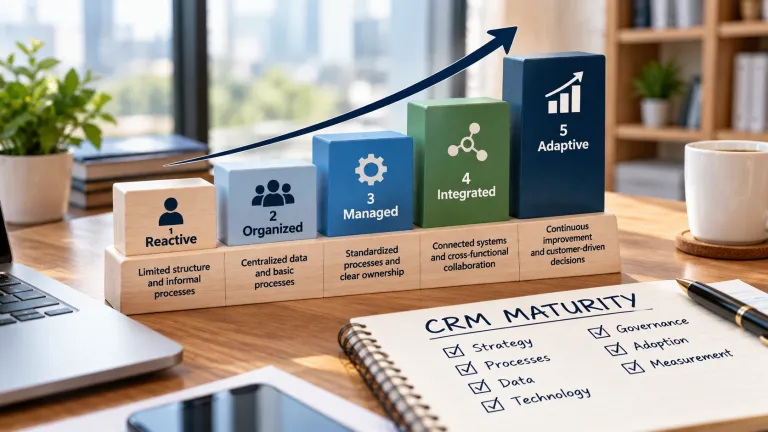
Clientira’s CRM maturity model can help evaluate strategy, processes, data, technology, governance, adoption, and measurement separately before major roadmap decisions are made.
The purpose of the assessment is not to delay improvement until everything is perfect.
It is to understand which capabilities are strong enough to support the next investment.
Separate Problems From Proposed Solutions
Roadmap discussions become clearer when teams separate the problem from the solution they are requesting.
Consider these examples:
| Requested Solution | Underlying Problem |
|---|---|
| Build a new dashboard | Managers cannot identify where opportunities are stalling |
| Add more automation | Employees repeatedly miss the same follow-up activity |
| Integrate another platform | Teams manually re-enter the same information |
| Add AI lead scoring | Sales teams struggle to distinguish useful leads from low-priority ones |
| Create more required fields | Important information is missing when records move between teams |
Once the problem is visible, alternative solutions become possible.
A new dashboard may not be necessary if the existing pipeline definitions are corrected. An integration may not be necessary if the duplicated process can be removed. Additional required fields may not help if users do not understand why the information matters.
This prevents the CRM roadmap from becoming a queue of feature requests.
Use Five Criteria to Prioritize CRM Work
A practical prioritization framework can evaluate each proposed CRM improvement across five dimensions.
1. Business impact
What meaningful outcome could improve if the initiative succeeds?
Examples may include reduced customer churn, better conversion, faster service resolution, improved forecasting, lower administrative effort, stronger data quality, or reduced operational risk.
The stronger the connection to an important business outcome, the stronger the case for prioritization.
2. Customer impact
Does the improvement make an important customer interaction easier, faster, clearer, or more consistent?
Some CRM improvements may appear operational but have direct customer consequences.
For example, better service history can reduce the need for customers to repeat information. Clearer account ownership can reduce delayed responses. Better lifecycle visibility can help teams intervene before important customer issues become urgent.
3. Dependency
What needs to be true before the improvement can work reliably?
This is one of the most important prioritization questions.
Advanced analytics may depend on reliable data. Automation may depend on stable process definitions. Integration may depend on clear system ownership. AI may depend on appropriate permissions and review processes.
An initiative with unresolved foundational dependencies may need to move later in the roadmap even if its potential value is high.
4. Risk
What happens if the organization does not address this issue?
Some CRM problems create inconvenience. Others create serious operational, security, privacy, compliance, or customer risks.
Risk can justify moving work earlier even when the financial return is difficult to quantify.
5. Effort and complexity
How much time, technical effort, organizational change, and ongoing maintenance will the initiative require?
Effort should not automatically push large projects to the bottom of the roadmap.
Instead, it helps determine whether the expected value justifies the resources required.
Do Not Prioritize Only by Impact and Effort
A simple impact-versus-effort matrix can be useful, but it is incomplete for CRM planning.
A high-impact, low-effort project may still be the wrong first move if it depends on unresolved data or process problems.
For example, suppose an organization identifies AI-powered recommendations as a high-impact initiative with relatively simple technical activation.
If customer records are incomplete and lifecycle definitions are inconsistent, the apparent quick win may create unreliable recommendations.
The roadmap therefore needs a third consideration:
readiness.
The question is not only whether something is valuable and affordable. It is whether the organization is prepared for it to work.
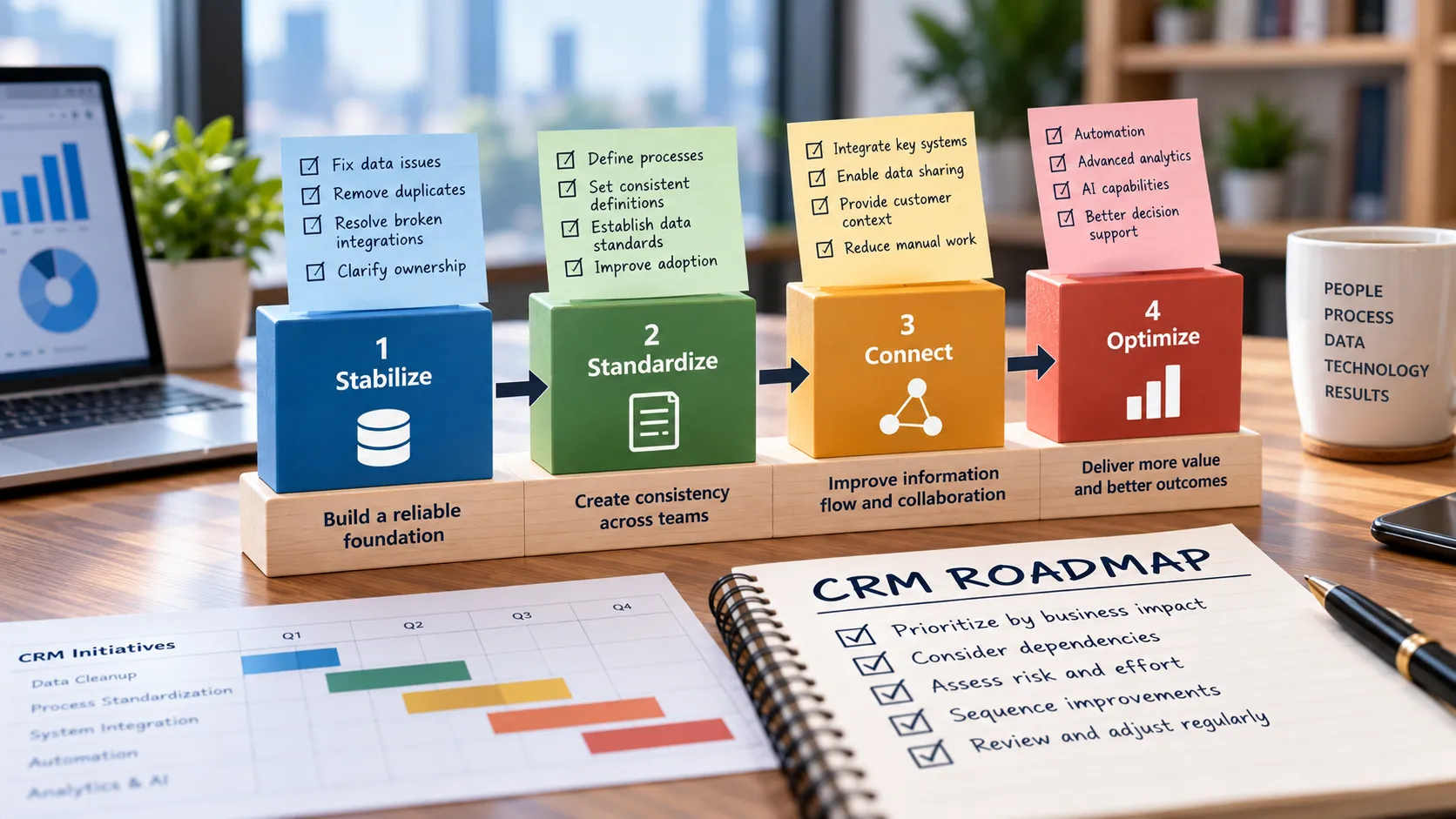
A Useful Priority Sequence: Stabilize, Standardize, Connect, Optimize
Although every CRM environment is different, many improvement roadmaps benefit from a sequence like this:
Stage 1: Stabilize
Address problems that prevent employees from trusting or using the CRM reliably.
This may include:
- critical data errors;
- duplicate customer records;
- broken integrations;
- incorrect permissions;
- unclear account ownership;
- unreliable required fields; or
- workflows that regularly fail.
The objective is not perfection. It is to create a dependable baseline.
Stage 2: Standardize
Once the system is stable, define the processes and terms that teams need to use consistently.
This can include lifecycle stages, pipeline definitions, handoff requirements, customer statuses, service classifications, ownership rules, and measurement standards.
Standardization is often less visible than new technology, but it makes future reporting and automation much more reliable.
Stage 3: Connect
After important processes and data definitions are reasonably stable, the organization can improve the movement of information between teams and systems.
Integration should focus on reducing real operational friction rather than connecting every available platform.
The priority is to make useful customer context available where decisions are made.
Stage 4: Optimize
Only after the environment is stable, standardized, and connected should the organization aggressively expand optimization.
This may include more sophisticated automation, advanced dashboards, predictive models, AI assistants, next-best-action recommendations, or other decision-support capabilities.
These tools become more useful because the foundation underneath them is stronger.
Prioritize Foundations Without Letting Them Become Endless Projects
There is also a danger in focusing too heavily on foundational work.
An organization can spend years trying to make data perfect before delivering anything useful to employees or customers.
That is not the goal.
Foundational improvement should be proportional to the next capability being introduced.
If a team wants to automate renewal reminders, it may not need perfect customer data across the entire CRM. It may only need reliable renewal dates, ownership, customer status, and communication rules for the relevant accounts.
The better question is:
What is the minimum reliable foundation required for this improvement to work safely and consistently?
This creates progress without accepting unnecessary risk.
Distinguish Quick Wins From Strategic Priorities
Quick wins can be valuable, especially when a CRM program needs to rebuild user confidence.
A small improvement that removes a recurring frustration may demonstrate progress quickly.
However, quick wins should not replace strategic priorities.
For example, simplifying an unnecessary form may improve usability immediately. That is worthwhile.
But if inconsistent customer ownership is causing major service failures, the larger ownership problem still deserves attention even if it requires more effort.
A healthy roadmap includes both:
- quick wins that remove visible friction; and
- structural improvements that strengthen the CRM operating model.
Build Dependencies Into the Roadmap
A roadmap should show more than dates.
It should show why one initiative comes before another.
For example:
- standardize opportunity stages;
- improve completion of critical opportunity fields;
- validate historical pipeline data;
- rebuild forecasting reports;
- introduce advanced forecasting capabilities.
Each stage increases the reliability of the next.
Compare that with launching advanced forecasting first and trying to repair definitions afterward.
The second path may appear faster initially but can create additional rework and lower trust.
Connect Priorities to the Business Case
Larger CRM initiatives should also be evaluated economically.
A priority may be strategically attractive but difficult to justify once implementation effort, ongoing maintenance, adoption requirements, and alternative investments are considered.
This is where the roadmap and business case should connect.
Clientira’s guide to building a CRM business case explains how to evaluate total cost, expected value, ROI, risk, adoption, and the cost of doing nothing.
The roadmap determines sequence. The business case helps determine whether the investment is worth making at all.
Use a Simple Prioritization Table
Organizations do not need a complicated scoring model to make better decisions.
A practical roadmap discussion can use a table like this:
| Initiative | Impact | Dependency | Risk if Delayed | Effort | Readiness |
|---|---|---|---|---|---|
| Standardize customer ownership | High | Low | High | Medium | High |
| Improve CRM data quality | High | Low | Medium | Medium | High |
| Build advanced dashboards | Medium | Data and process standards | Low | Medium | Medium |
| Add predictive recommendations | Potentially high | Reliable data and measurement | Low | High | Low |
The table does not make the decision automatically.
Its purpose is to make the trade-offs visible.
Example: Why the Most Exciting Initiative May Need to Wait
Imagine a company that wants to introduce an AI assistant that recommends the next action for sales representatives.
The potential value appears high. Salespeople could receive suggestions about which opportunities deserve attention and what follow-up should happen next.
However, the roadmap review reveals several issues.
Opportunity stages are inconsistent. Many expected close dates are outdated. Important customer interactions are not always recorded. Account ownership is sometimes incorrect.
Technically, the AI capability could still be activated.
Strategically, it should wait.
The higher-priority roadmap might be:
- standardize opportunity stage definitions;
- clarify account ownership;
- improve completion of critical sales data;
- monitor adoption for a defined period;
- establish baseline sales metrics; and
- then test AI recommendations with a limited group.
This sequence does not reject AI. It increases the likelihood that AI will eventually operate on information employees can trust.
For organizations considering these tools, Clientira’s guide to AI CRM assistants also explains why reliable data, clear ownership, and human oversight matter before wider deployment.
Know What Can Wait
A disciplined CRM roadmap also identifies work that does not need immediate attention.
An initiative can usually wait when:
- it has no clear connection to an important business or customer outcome;
- its required data or process foundation is not ready;
- another initiative removes the same problem more simply;
- the expected value is small relative to implementation effort;
- few users need the capability;
- the organization cannot identify who will own it after launch; or
- success cannot yet be measured meaningfully.
“Not now” does not necessarily mean “never.”
It means the initiative should not consume resources before more important constraints are addressed.
A Roadmap Should Include Things You Will Stop Doing
CRM strategy is not only about adding capabilities.
Mature roadmaps also remove unnecessary complexity.
This can mean retiring unused fields, simplifying workflows, deleting redundant reports, removing outdated automation, consolidating duplicate tools, or stopping manual processes that no longer serve a purpose.
Removing complexity can sometimes create more value than introducing another feature.
It also makes future improvements easier because employees have fewer conflicting rules and systems to navigate.
Review Priorities Regularly
A CRM roadmap should not become a fixed multi-year promise.
Priorities can change as customer behavior, organizational structure, technology, regulation, budgets, or business strategy changes.
A useful review cycle asks:
- Did the last improvement produce the expected result?
- Has the main CRM constraint changed?
- Are previously planned initiatives still necessary?
- Have new dependencies or risks appeared?
- Is the organization ready for the next capability?
This creates a roadmap that responds to evidence rather than continuing work simply because it was approved months earlier.
Final Thoughts
CRM roadmap prioritization is ultimately an exercise in sequencing.
The question is not which technology is most impressive or which department has the longest request list. The question is which improvement will remove an important constraint and create a stronger foundation for the next decision.
Start with the business and customer outcome. Identify the current constraint. Examine maturity and dependencies. Evaluate impact, risk, effort, and readiness. Then sequence improvements so that foundational work supports more advanced capabilities rather than competing with them.
Some initiatives should happen now. Others should wait. A few may not deserve implementation at all.
That discipline is what turns a CRM roadmap from a feature backlog into a strategy.