CRM Integration Strategy: Connecting Sales, Marketing, and Service Systems
Many organizations buy a CRM expecting the software to solve a process problem. The better approach is to begin with the customer outcome, define the decisions employees must make, and then configure technology around that operating model. This article explains how to approach CRM integration strategy in a practical, measurable way. The focus is reliable system integration, with enough structure to support growth without creating unnecessary administrative work.
The topic matters because customers experience the combined effect of sales, marketing, service, data, and technology. When those elements are disconnected, employees spend time searching for information, customers repeat themselves, and reports become difficult to trust. A well-designed approach creates a shared language and a repeatable way to act.
What CRM Integration Strategy Means in Practice
In practice, CRM integration strategy is the combination of definitions, data, workflow, ownership, and measurement required to support customer operations. It is not a single setting or dashboard. It is an operating capability that determines what information is captured, how it is interpreted, who acts on it, and how the result is evaluated.
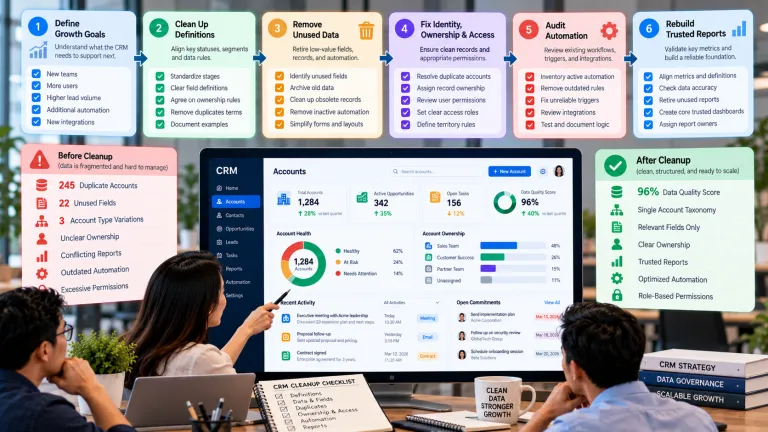
The first design principle is purpose. Every field, rule, score, automation, or report should support a decision. If a team cannot explain what action a piece of information enables, the information may be unnecessary. This discipline keeps the CRM usable and reduces the hidden cost of maintaining low-value data.
Why Businesses Struggle With This Area
Most problems begin before configuration. Teams may use different definitions, follow informal processes, or measure activity without connecting it to an outcome. Software then makes those inconsistencies more visible but does not resolve them automatically.
Common risks include two-way syncing everything, duplicate identifiers, unclear ownership, and undocumented mappings. These issues can produce inaccurate reporting, weak adoption, duplicated effort, or customer communication that feels irrelevant. They also make later automation more difficult because automation depends on stable rules and reliable inputs.
How to Implement CRM integration strategy Step by Step
- Define the outcome. Write one sentence describing the customer or business result. Avoid starting with a feature list. A clear outcome helps the team decide what belongs in scope.
- Map the current process. Document how work happens today, including exceptions, spreadsheets, manual handoffs, and decisions made outside the CRM.
- Agree on definitions and ownership. Define important terms, record owners, required evidence, and escalation responsibilities. Use language that frontline employees understand.
- Build the smallest useful version. Configure only the fields, stages, rules, and views required for the first working process. Simplicity makes testing and adoption easier.
- Test with real scenarios. Include complete records, incomplete records, edge cases, and unusual customer situations. Test both the normal path and the exception path.
- Measure and improve. Compare results with a baseline, collect user feedback, and review errors. Expansion should follow evidence rather than enthusiasm.
Designing the Data and Workflow
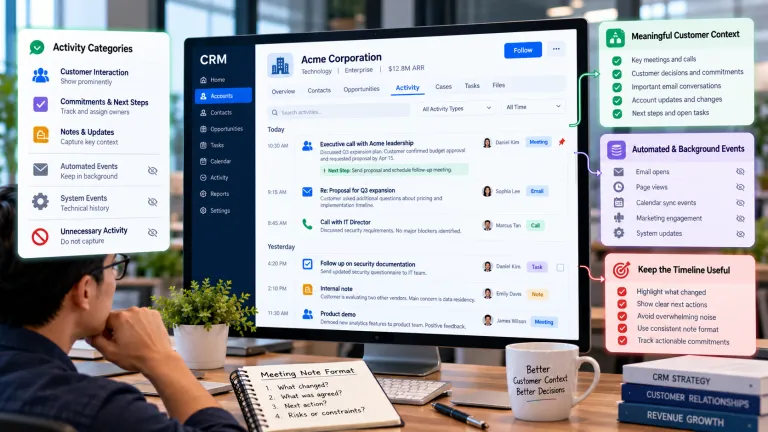
Good CRM design separates essential information from optional context. Required fields should support qualification, handoff, service, compliance, or measurement. Too many requirements encourage shortcuts; too few create ambiguity. Dropdowns, defaults, validation, and guided steps can improve consistency without forcing employees to complete a long form.
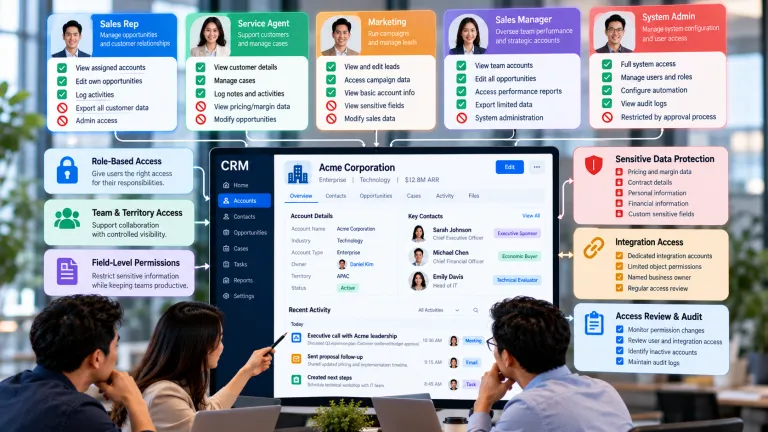
Workflow design should also make ownership visible. Every important record needs a responsible person or team, a clear next step, and a time expectation. When a process crosses departments, define the evidence required for a handoff. A handoff should not depend on one employee remembering to send a message.
A Practical Example
Consider a growing company introducing CRM integration strategy. Instead of enabling every available feature, the team selects one decision that currently causes delay or inconsistency. It documents the existing workflow, checks whether the required data is reliable, names a business owner, and pilots the change with a small group of users who handle real customer cases.
During the pilot, the team tracks Sync Errors, Duplicate Rate, Data Latency and reviews cases involving two-way syncing everything and duplicate identifiers. Feedback leads to clearer rules, fewer unnecessary fields, and a defined escalation path. The company expands only after the new process produces a measurable improvement without creating unacceptable customer or operational risk.
Common Mistakes and Better Alternatives
- Two-way syncing everything: define a system of record, map fields explicitly, and test sync behavior and exceptions before launch.
- Duplicate identifiers: define matching rules, merge procedures, and a clear owner for resolving duplicate records before they affect reporting or outreach.
- Unclear ownership: assign named business ownership, routing rules, service levels, and backup responsibility.
- Undocumented mappings: define a system of record, map fields explicitly, and test sync behavior and exceptions before launch.
Repeated user errors should be treated as design feedback. If many people make the same mistake, the field label, workflow, training, or incentive may be unclear. Coaching matters, but the system should also make the right action easier.
How to Measure Success
A balanced measurement set should cover process quality, employee behavior, and business outcomes. Useful indicators for this topic include sync errors, duplicate rate, data latency, and manual re-entry. Establish a baseline before changing the process so improvements can be evaluated fairly.
- Sync Errors: use this as a primary signal of whether the process is becoming more effective.
- Duplicate Rate: compare teams, segments, or time periods to locate friction and inconsistency.
- Data Latency: connect operational behavior with a customer or commercial result.
- Manual Re-Entry: monitor sustainability and identify deterioration after the initial launch.
Do not judge success by logins or feature usage alone. A tool can be heavily used and still create poor outcomes. Combine quantitative metrics with employee feedback, customer comments, and examples of decisions that improved.
How IT Connects to a Broader CRM Strategy
This topic is stronger when connected to adjacent capabilities. Read about how to choose CRM KPIs that match your business goals for a related framework that supports the same data, workflow, and decision environment.
Then continue with customer retention strategies in CRM and how businesses can identify risk and act earlier. This related guide adds another perspective and helps readers continue through the Clientira topic cluster.
Implementation Checklist
- State the intended customer or business outcome.
- Identify the minimum reliable data needed.
- Define terms, owners, handoffs, and exceptions.
- Remove fields and steps that do not support a decision.
- Test with realistic and unusual scenarios.
- Provide role-based guidance and examples.
- Measure quality, adoption, and outcomes separately.
- Review the design monthly after launch and quarterly thereafter.
Frequently Asked Questions
What should a team prepare before implementing CRM integration strategy?
Start with a clearly defined decision or outcome, reliable minimum data, agreed definitions, a named business owner, and a documented workflow. Technology selection should follow those foundations rather than replace them.
Which metric is most useful for evaluating CRM integration strategy?
There is no single universal metric. A practical scorecard should combine sync errors, duplicate rate, data latency with user feedback and a baseline from before the change.
What is a common risk when using CRM integration strategy?
Common risks include two-way syncing everything, duplicate identifiers. Reduce them with realistic testing, explicit exceptions, accountable review, and monitoring after launch.
How often should CRM integration strategy be reviewed?
Review operational signals monthly during early adoption and after major changes. Conduct a deeper quarterly review of definitions, permissions, workflow logic, performance, customer impact, and whether the capability still serves its original purpose.
Final Thoughts
The most sustainable CRM practices make good decisions easier, not merely mandatory. When the information is trusted and the workflow reflects real customer behavior, adoption and performance improve together. Start with a clear purpose, build the smallest useful version, and expand only after the team can demonstrate reliable use and measurable value.
For CRM integration strategy, long-term success comes from the combination of sound design, clear ownership, trusted information, and continuous learning. That combination turns the CRM from a database into a practical system for better customer decisions.