CRM Ownership: Who Should Be Accountable for Strategy, Data, and Daily Operations?
When a CRM works poorly, teams often ask who owns it. The answer is rarely one person. A platform administrator can configure fields but should not decide the company’s sales qualification standard alone. A sales leader can own pipeline policy but should not manage integration credentials. A data team can improve consistency without owning the customer experience.
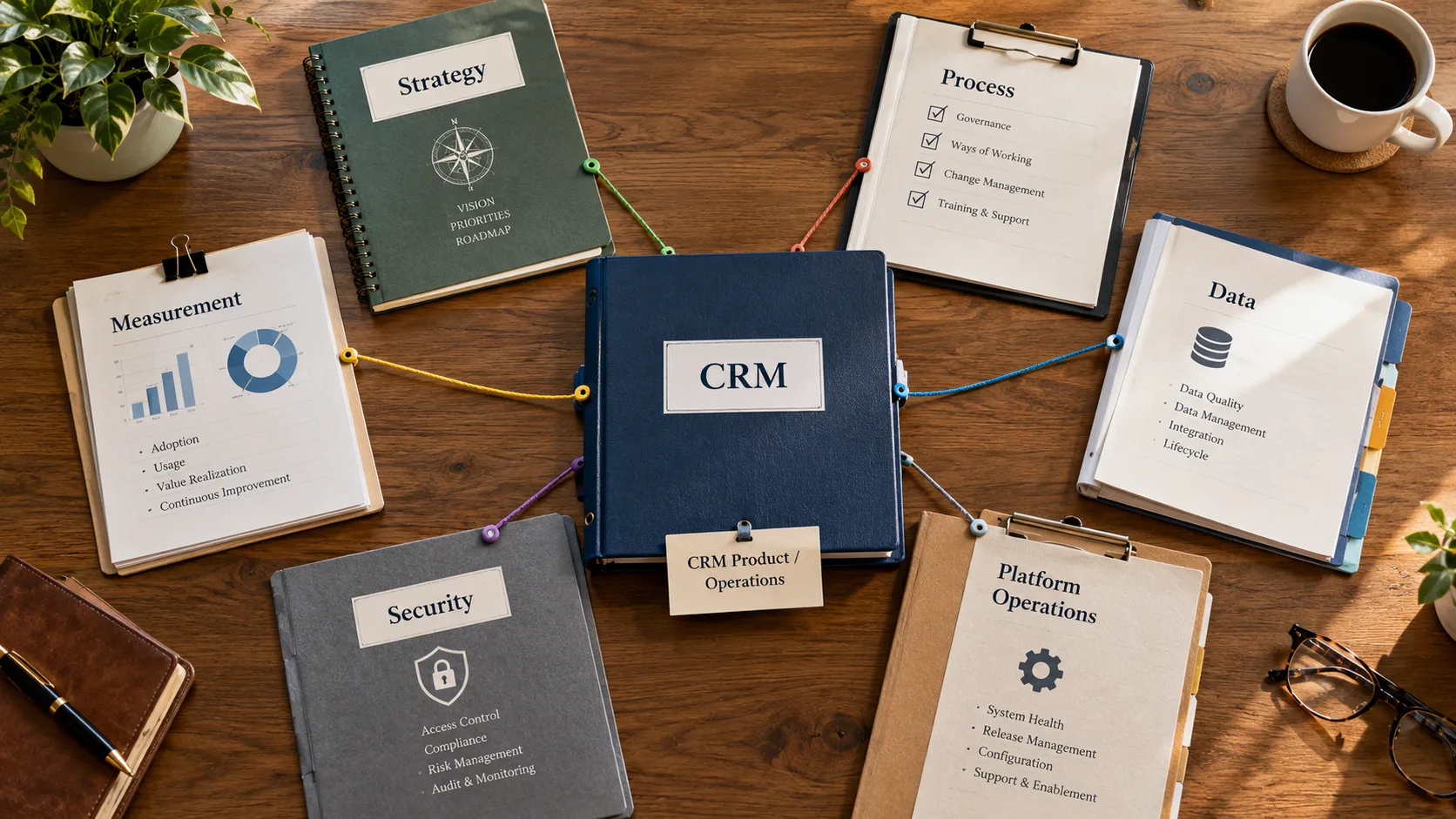
The useful approach is to separate types of ownership. Strategy, business process, data, platform operations, security, and measurement require different expertise, while a coordinating role keeps those decisions aligned. Clear ownership reduces both bottlenecks and the opposite problem: important issues that everyone assumes belong to someone else.
Key Takeaways
Separate business accountability from technical administration.
Every critical CRM process, definition, and integration should have a named owner.
One coordinating CRM product or operations role can manage priorities without owning every decision personally.
Decision rights should be explicit for changes that affect multiple teams.
Ownership should include maintenance and review after launch, not only project delivery.
Differentiate the Types of CRM Ownership
CRM strategy ownership defines why the organization invests in CRM and which outcomes matter. Process ownership defines how a workflow should operate. Data ownership covers definitions, quality expectations, and stewardship. Platform ownership covers configuration, reliability, release management, and vendor coordination.
Security, privacy, analytics, and integration responsibilities may sit elsewhere. Making these distinctions prevents one overloaded CRM administrator from becoming the default owner of every customer-related decision.
Name a Coordinating Owner
Even with distributed accountability, someone needs to manage the CRM as a coherent product or operating capability. This person or team maintains the roadmap, organizes change requests, resolves dependencies, and ensures that business and technical work remain connected.
The coordinating owner does not need executive authority over every department. The role needs a clear mandate, transparent prioritization, and access to the people who can make cross-functional decisions.
Assign Process Owners Where Work Crosses Teams
Processes such as lead handoff, onboarding, renewal, and service escalation cross organizational boundaries. A process owner should be accountable for the end-to-end outcome rather than optimizing only one department’s step.
That owner maintains definitions, reviews exceptions, and sponsors changes. Teams can still own their specific activities while the process owner protects the whole flow.
Give Data Definitions a Home
Fields such as customer status, revenue, source, lifecycle stage, health, and churn may be used by many teams. Without a named owner, definitions drift until reports disagree.
Assign business owners for critical data concepts and technical stewards for implementation. The business owner decides meaning; the steward ensures the CRM, integrations, and documentation reflect that meaning.
Control Change Without Creating Bureaucracy
Not every CRM change needs a committee. Low-risk layout improvements or typo corrections can follow delegated authority. Changes to lifecycle definitions, security, automation, integrations, or executive metrics deserve broader review because they affect multiple teams or outcomes.
Create change categories with clear approval paths. This makes governance proportional to impact rather than treating every field request as strategic.
Make Ownership Visible
An ownership model hidden in a project document will not help during an incident six months later. Publish a simple responsibility map showing who owns key processes, data domains, integrations, reporting, permissions, and platform operations.
Review it after reorganizations and staff changes. An outdated ownership map can be worse than none because it sends issues to people who no longer have authority.
What Good Ownership Looks Like During an Incident
Ownership is easiest to test when something breaks. If an integration begins creating duplicate accounts, the technical owner should be able to contain the issue, the data owner should define how affected records are corrected, the process owner should assess customer or workflow impact, and the CRM coordinating owner should organize the response and communication. No single person needs to perform every task, but the path from detection to decision should be clear.
This is why responsibility maps should include incidents as well as planned changes. A system may look well governed during roadmap meetings yet become chaotic when a high-impact error appears. Practicing a few realistic failure scenarios is a useful way to discover ownership gaps before customers encounter them.
A Practical CRM Ownership Example
A company relies on one CRM administrator for nearly every request. Sales asks the administrator to change pipeline stages, finance asks for revenue definitions, marketing asks for source attribution rules, and security asks about export access. The administrator becomes a bottleneck and is forced to make business decisions without authority.
The company creates a simple ownership map. Sales operations owns pipeline process, finance owns recognized revenue definitions, marketing operations owns campaign-source taxonomy, security owns access standards, and the CRM product owner coordinates changes and platform design. The administrator implements approved decisions and advises on feasibility. Work becomes faster because ownership is distributed rather than because the administrator works harder.
A Practical CRM Ownership Map
Area Accountable Owner Typical Responsibility
CRM strategy Executive/business sponsor Outcomes, investment priorities, major trade-offs.
CRM product/operations CRM product owner or operations lead Roadmap, backlog, coordination, release governance.
Business process Functional or end-to-end process owner Definitions, workflow, exceptions, performance.
Data Business data owner plus steward Meaning, quality, source, correction, lifecycle.
Platform/security Technical and security owners Configuration, reliability, access, integrations, controls.
Common Mistakes to Avoid
Making the CRM administrator the business owner
Administrators should advise and implement, but business leaders must own definitions and process choices that affect customers and performance.
Splitting ownership so widely that nobody can decide
Distributed ownership still needs single accountability for each important decision and a coordinating role for dependencies.
Defining ownership only during implementation
CRM ownership is an ongoing operating need. Include review, incidents, change requests, and lifecycle maintenance.
What to Do Next
List the CRM decisions that currently cause delay or disagreement.
Assign one accountable owner to each business process and critical shared definition.
Separate configuration responsibility from approval authority.
Name a coordinating CRM product or operations owner for roadmap and change management.
Publish a concise ownership map and escalation path.
Review ownership after organizational changes and at least annually.
Continue Reading on Clientira
Related Clientira guides provide additional context:
CRM Operating Model: How People, Process, Data, and Technology Fit Together
CRM Requirements Gathering: How to Define What Your Business Actually Needs
Frequently Asked Questions
Who should own a CRM?
No single role should own every aspect. A business sponsor owns strategic outcomes, process owners own workflows, data owners own definitions, and technical teams own platform operation. A CRM product or operations role coordinates the whole system.
Should sales own the CRM?
Sales may own key commercial processes, but the CRM often supports marketing, service, customer success, finance, and other teams. Enterprise ownership should reflect the system’s full scope.
What is the CRM administrator responsible for?
Typically configuration, user support, release execution, technical documentation, and platform maintenance within approved business and security rules. Exact responsibilities vary by organization.
How can small businesses handle CRM ownership?
Combine roles deliberately. One person may wear several hats, but still document which decisions they are making as business owner, data steward, or administrator so those responsibilities can separate as the company grows.
Final Thoughts
CRM ownership is clearer when the organization stops asking who owns the entire system and starts asking who owns each important decision. Strategy, process, data, technology, and security need distinct accountability even when one person temporarily fills multiple roles.
A simple ownership model reduces hidden dependencies and gives teams a path to resolve disagreements. That clarity becomes more important as CRM usage expands, because complexity grows faster when decision rights remain informal.