CRM Change Management: How to Introduce New Processes Without Losing Team Buy-In
CRM changes alter how people work: what they must record, how leads are assigned, which fields become required, how managers review performance, or which tasks are automated. Even technically sensible changes can fail when employees experience them as extra administration with no visible benefit.
Change management is not a communication campaign added at the end of configuration. It is the work of aligning purpose, design, training, incentives, leadership behavior, and feedback so the new process becomes easier to use than the old workaround.
Key Takeaways
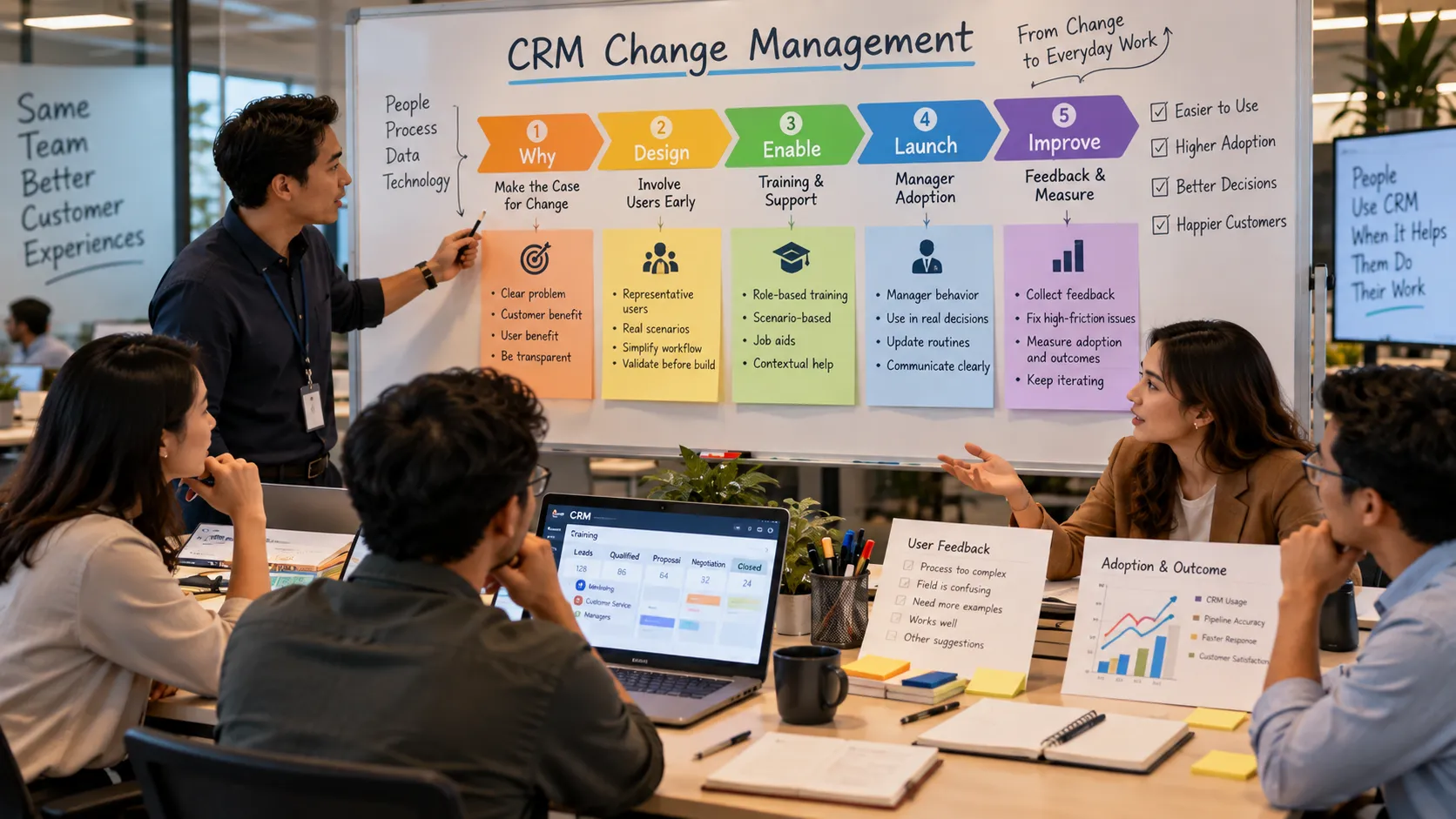
Explain the work problem being solved, not only the feature being launched.
Involve representative users early enough that feedback can still change the design.
Managers must use the new CRM process in real decisions or adoption messages lose credibility.
Training should be role-based and scenario-based rather than a tour of every feature.
Post-launch friction should be treated as operating feedback, not automatically as resistance.
Make the Case for Change Specific
Employees are more likely to engage when they can connect the change to a real problem: leads are lost during handoff, customers repeat information, forecasts are unreliable, or service escalations are slow. Generic claims about transformation or a modern platform do not explain why daily behavior must change.
State what will improve for customers, users, and managers, and be candid about any additional effort. If a new required field adds work but prevents repeated follow-up, explain the trade-off.
Design With Representative Users
User involvement should happen before the design is fixed. Select people who represent different roles, experience levels, regions, and common exceptions. Ask them to complete realistic scenarios and observe where the process becomes confusing.
Do not let the pilot become a vote on whether any change is allowed. The business can maintain non-negotiable requirements while still using user evidence to simplify the way those requirements are implemented.
Train Around Scenarios
Feature tours create familiarity but do not necessarily prepare people for work. Training should show how a user handles a new lead, updates a deal after a meeting, completes a handoff, resolves an exception, or corrects bad data.
Keep reference material close to the task: concise field guidance, examples, short videos, or contextual help. Employees should not need to remember an hour-long launch presentation to perform a routine action.
Align Manager Behavior
Users watch what managers actually use. If leaders ask for spreadsheet forecasts after telling employees the CRM is the source of truth, the organization has created competing systems. If managers ignore required evidence during reviews, users learn the field is administrative rather than useful.
Update management routines at the same time as the CRM. The new workflow should appear in pipeline reviews, service meetings, coaching, and handoffs where the relevant information is supposed to matter.
Create a Visible Feedback Loop
After launch, distinguish defects, confusing design, missing exceptions, training needs, and enhancement ideas. Give users one clear place to report friction and show what happens to their feedback.
Quickly fixing a few high-frequency irritants can build credibility. Equally important, explain why some requests are not accepted so the CRM does not become a collection of individual preferences.
Measure Behavior and Outcome Together
Adoption metrics such as login frequency or field completion can reveal basic usage, but they do not prove that the new process works. Combine them with the intended outcome: faster response, fewer handoff failures, more reliable forecasts, or reduced case aging.
If usage is high and outcomes are poor, the design may be wrong. If outcomes improve despite moderate feature usage, the organization may not need to push additional activity simply to increase an adoption score.
A Practical CRM Change-Management Example
A sales organization introduces stricter opportunity stage criteria. Representatives complain that the new CRM process is bureaucracy because deals can no longer be moved forward without recording decision process and next step. Management initially plans mandatory retraining.
A pilot reveals that the intent is sound but one field is required too early and another has confusing options. The company adjusts the design, trains managers to use stage evidence during weekly reviews, and publishes examples of what good evidence looks like. Users can report exceptions through a visible backlog. The change becomes part of sales management rather than a compliance exercise owned by the CRM team.
A CRM Change Readiness Check
Question Ready Signal Warning Signal
Purpose Users can explain the problem the change solves. Communication focuses on features or deadlines.
Design Representative users have tested real scenarios. Feedback begins after build completion.
Leadership Managers will use the new data or workflow in decisions. Leaders maintain parallel spreadsheets or old routines.
Learning Role-specific examples and support are available. Training is one generic product tour.
Feedback There is an owned path for issues and improvement. Users rely on private messages and workarounds.
Common Mistakes to Avoid
Calling every objection resistance
Some objections identify real design flaws or missing exceptions. Diagnose the reason before deciding whether the issue is motivation, knowledge, or system design.
Launching training before the process is stable
Training people on a moving design wastes attention. Pilot first, stabilize critical workflow, then train on the version users will actually receive.
Ignoring managers as users
Managers shape adoption through the questions they ask and the tools they use. Update management routines alongside frontline workflows.
What to Do Next
Write a one-paragraph explanation of the problem and expected outcome of the change.
Recruit representative users to test realistic scenarios before final configuration.
Identify which management routines must change at launch.
Create role-based training focused on high-frequency tasks and exceptions.
Publish one feedback path with clear ownership and prioritization.
Measure both usage quality and the business outcome the change was designed to improve.
Continue Reading on Clientira
Related Clientira guides provide additional context:
CRM Implementation Mistakes: Why Good Software Still Produces Poor Results
CRM Operating Model: How People, Process, Data, and Technology Fit Together
CRM Ownership: Who Should Be Accountable for Strategy, Data, and Daily Operations?
Frequently Asked Questions
Why do CRM users resist change?
Reasons vary: extra effort, unclear benefit, poor design, missing exceptions, weak training, conflicting incentives, or distrust from previous projects. Treat resistance as a diagnosis problem rather than a personality trait.
When should users be involved in CRM design?
Early enough that their observations can change the workflow and again during pilot testing with realistic records. Their role is to reveal operating reality, not to make every requirement optional.
What is the best CRM adoption metric?
There is no single metric. Measure reliable completion of important workflows alongside the customer or business outcome they are supposed to improve.
How long does CRM change management last?
It begins before design is finalized and continues after launch until behavior, support, and outcomes stabilize. Major process changes may require ongoing reinforcement and refinement for months.
Final Thoughts
CRM change management is successful when new behavior becomes part of normal work rather than something the project team continually reminds people to do. That requires a credible purpose, usable design, manager reinforcement, focused learning, and a feedback loop that continues after launch.
Treat adoption as evidence about the operating system. When many users struggle in the same place, investigate the workflow. When managers bypass the CRM, align leadership behavior. Change becomes durable when the system and the organization tell people the same story about how customer work should happen.