CRM Operating Model: How People, Process, Data, and Technology Fit Together
CRM strategy often sounds clear at a high level: know customers better, coordinate teams, improve conversion, and build stronger relationships. Execution becomes harder because those goals cross organizational boundaries. Sales, marketing, service, operations, data, and IT may each own part of the customer experience while using different definitions and priorities.
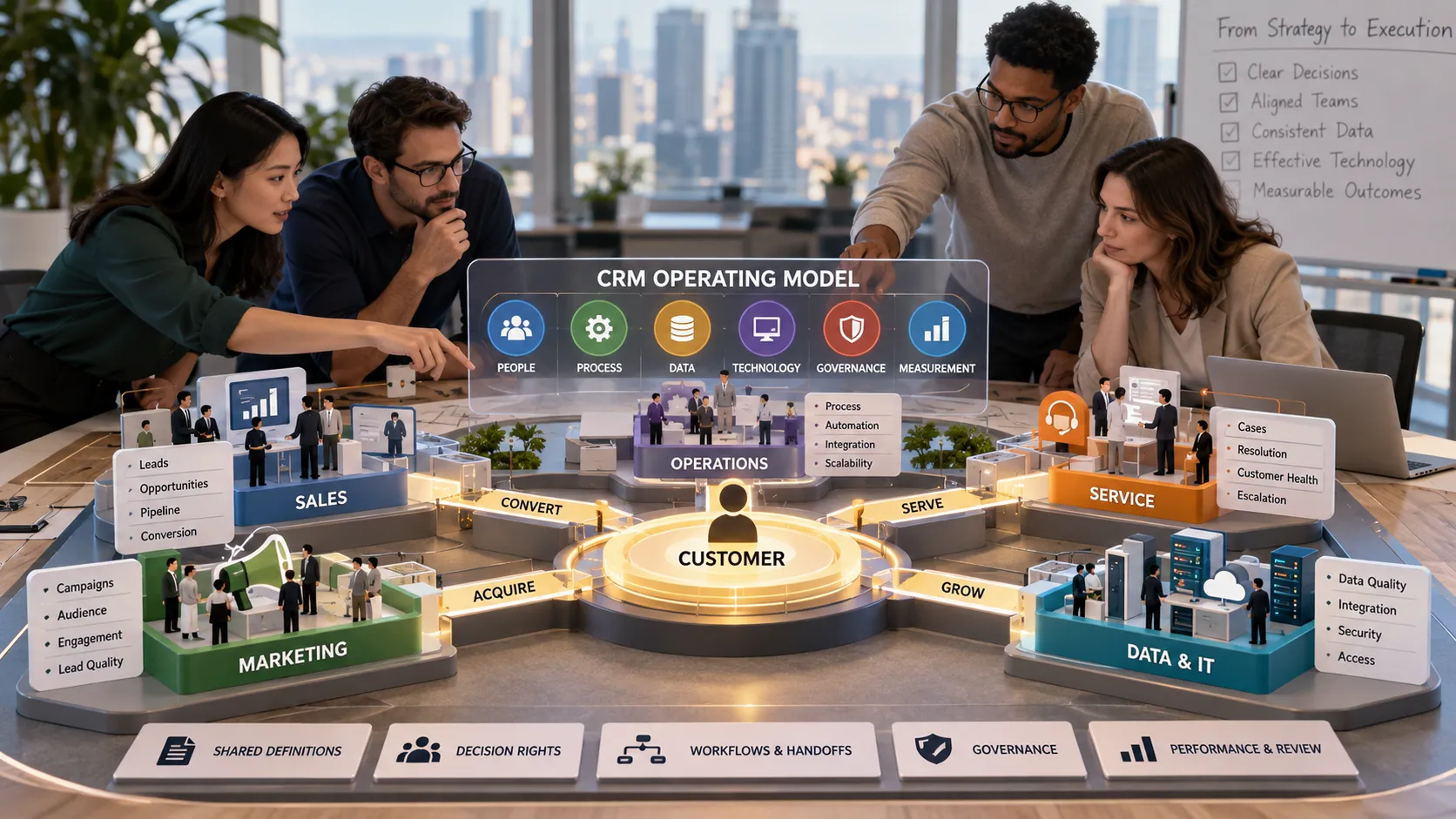
A CRM operating model turns strategy into a repeatable way of working. It describes how people, process, data, technology, governance, and measurement fit together. The purpose is not to create another organizational chart. It is to make important customer decisions understandable enough that teams can execute them consistently as the business changes.
Key Takeaways
A CRM operating model begins with customer and business decisions, not application ownership.
People, process, data, and technology should be designed as one system rather than separate projects.
Decision rights and escalation paths prevent cross-functional issues from becoming permanent ambiguity.
A small set of shared definitions creates more value than a large governance document nobody uses.
The operating model should evolve as the organization, products, and customer journeys change.
Start With the Decisions the Organization Must Make
An operating model becomes practical when it is anchored to decisions: which customers receive priority, when a lead becomes sales-ready, who owns a renewal risk, when a service issue needs escalation, and which data defines pipeline or customer health. These decisions reveal the people, inputs, workflow, and controls that must work together.
Avoid beginning with departments or platform features. Customer work often crosses those boundaries, and the operating model should make cross-functional responsibility clearer rather than preserving every existing silo.
Define Roles and Decision Rights
Accountability is different from participation. Many people may contribute to CRM work, but important definitions and changes need named owners. Decide who can approve lifecycle definitions, fields, automation, reports, access patterns, and major process changes.
Use escalation only where disagreement genuinely matters. A lightweight model might assign a business process owner, CRM product owner, data steward, technical owner, and executive sponsor without building a large governance committee.
Connect Process to Customer Context
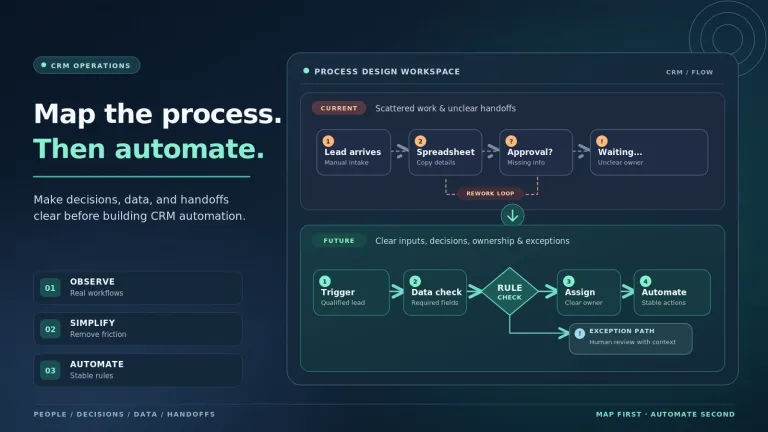
A process should describe the sequence of decisions and handoffs required to serve a customer outcome. It should include normal flow, important exceptions, ownership transitions, and evidence required before a record moves forward.
When process design is disconnected from customer context, CRM stages become administrative labels. Strong processes explain why the next step matters and what information should be available to the person taking it.
Make Data Part of the Operating Design
Data is not a separate cleanup workstream. Every process depends on definitions, identifiers, fields, sources, and quality expectations. If a sales stage requires information that is not reliably captured, the process is not truly designed.
Define which system is authoritative for critical data, who owns important definitions, and how exceptions are corrected. Keep the data model focused on information that supports active decisions, controls, or required history.
Use Technology to Reinforce the Model
CRM configuration should make the intended operating behavior easier. Views can surface priorities, validation can protect critical data, automation can route stable workflows, and dashboards can expose outcomes. Technology should reduce reliance on memory without turning every rule into a hard system constraint.
Preserve flexibility where customer situations vary. The best operating model uses technology to create consistency around essentials while allowing people to exercise judgment in legitimate exceptions.
Create a Review Rhythm
Operating models degrade when changes arrive one at a time. New products, acquisition, team restructuring, AI features, and integrations can all alter ownership and data requirements. Establish a cadence for reviewing performance, exceptions, change requests, and recurring user friction.
The review should ask whether the model still supports the intended decisions, not simply whether the CRM is technically stable.
Use the Operating Model to Resolve Cross-Functional Trade-Offs
The operating model becomes most valuable when teams want different things from the same CRM. Marketing may prefer detailed source tracking, sales may want fewer required fields, finance may need stronger revenue definitions, and security may want tighter export controls. These are not configuration disagreements; they are trade-offs between legitimate business needs.
A clear model provides a path for resolving them. The process owner explains the customer or operational need, the data owner defines the information standard, technical teams explain implementation consequences, and the coordinating owner makes dependencies visible. Decisions can then be based on impact rather than on which request arrived first or which department has the loudest sponsor.
A Practical CRM Operating-Model Example
A growing company has separate sales, onboarding, and support teams. Each team uses the same CRM but defines an ‘active customer’ differently. Sales marks an account active when a contract is signed, onboarding does so after implementation, and support uses the term for any account with an open case. Reports conflict and handoffs are inconsistent.
The company defines distinct lifecycle states, names an owner for each definition, and documents the evidence required for transitions. The CRM shows commercial status, onboarding status, and service status separately instead of forcing all three meanings into one field. Handoff responsibilities and review metrics are then built around those definitions. The operating model becomes clearer because the business no longer expects one label to serve unrelated decisions.
The Core Layers of a CRM Operating Model
Layer Key Question Output
People Who is accountable and who contributes? Roles, decision rights, escalation.
Process How does work move from signal to outcome? Stages, handoffs, exceptions, timing.
Data What information is needed and trusted? Definitions, sources, ownership, quality rules.
Technology How does the system support the work? Configuration, automation, integration, access.
Measurement How do we know the model works? Outcome, quality, adoption, and risk measures.
Common Mistakes to Avoid
Making the operating model an IT document
CRM operations cross business functions. Technical ownership matters, but customer decisions and process definitions require business accountability.
Creating a committee for every decision
Governance should make decisions faster and clearer. Assign single owners where possible and escalate only issues that genuinely require cross-functional agreement.
Freezing the model after launch
Products, teams, and customer behavior change. Review the model and retire rules that no longer support useful decisions.
What to Do Next
List the ten customer or commercial decisions the CRM most needs to support.
Assign an accountable owner to each major process and shared definition.
Map the people, data, systems, and handoffs involved in each high-value workflow.
Identify conflicts where one field or status is serving multiple meanings.
Align automation and reporting with the agreed operating rules.
Establish a monthly or quarterly review of exceptions, outcomes, and change requests.
Continue Reading on Clientira
Related Clientira guides provide additional context:
CRM Requirements Gathering: How to Define What Your Business Actually Needs
CRM Cleanup Before Growth: What to Fix Before Adding More Users, Data, or Automation
AI Agents in CRM: What Should They Be Allowed to Do Without Human Approval?
Frequently Asked Questions
What is a CRM operating model?
It is the practical design for how people, processes, data, technology, governance, and measurement work together to manage customer relationships and CRM-enabled decisions.
Is a CRM operating model the same as a CRM strategy?
No. Strategy explains priorities and desired outcomes; the operating model explains how the organization will repeatedly execute those priorities.
Who should own the CRM operating model?
Business and technology usually share responsibility, but individual decisions and processes need clear accountable owners. A CRM product or operations leader often coordinates the model across functions.
How detailed should the operating model be?
Detailed enough that teams can understand ownership, handoffs, data requirements, change authority, and measures of success. Avoid documenting rules that do not affect real work.
Final Thoughts
A CRM operating model is the bridge between a strategic ambition and daily behavior. It makes customer work more dependable by clarifying who decides, how information moves, and how technology reinforces the process.
Keep the model focused on decisions and outcomes. When people, process, data, and technology are designed together, CRM improvement stops being a sequence of isolated configuration projects and becomes an operating capability the organization can intentionally evolve.