
CRM Strategy for Growing Teams: When Informal Customer Management Stops Working
Informal customer management can work remarkably well in a small company. The founder remembers key accounts, salespeople message each other before contacting a lead, and customer issues are resolved through direct conversation. Those practices begin to fail when the number of customers, employees, products, and handoffs grows faster than shared memory.
CRM strategy for a growing team is not about replacing every informal behavior with process. It is about identifying where coordination now requires a shared system and adding structure in stages. The objective is to preserve speed and customer knowledge while reducing dependence on individual memory, private spreadsheets, and heroic employees.
Key Takeaways
The need for more CRM structure appears when ownership, context, definitions, or follow-through become unreliable at scale.
Start by stabilizing a few high-value workflows rather than building an enterprise-sized CRM for a future organization.
Shared definitions and accountable ownership are more important than a large feature set.
Permissions, data quality, and change governance should mature as team size and sensitivity increase.
Growth strategy should add structure when the cost of ambiguity becomes greater than the cost of process.
Recognize the Signals That Informal Management Is Breaking
Common signs include duplicate outreach, unowned leads, customers repeating their history, inconsistent pricing promises, managers unable to explain pipeline, important knowledge leaving with employees, and increasingly complex spreadsheets used to reconcile systems.
One incident does not require a transformation. Look for recurring coordination problems that affect customer experience, revenue, risk, or employee time.
Protect the Customer Record First
Growing teams need a shared way to identify customers and see essential relationship context. Start with account and contact rules, ownership, recent meaningful activity, and open commitments.
Avoid collecting every possible attribute. The first goal is continuity: a competent colleague should be able to understand the relationship well enough to take the next appropriate action.
Standardize a Few Critical Workflows
Choose processes where ambiguity becomes expensive: lead assignment, opportunity qualification, onboarding, service escalation, renewal, or another core journey. Define start, finish, owner, handoff, evidence, and exception.
Do not standardize every personal productivity habit. Let teams preserve flexibility in how they prepare or communicate as long as shared decisions and commitments remain visible.
Add Governance in Proportion to Risk
A five-person team does not need a large CRM committee. It does need someone who can decide what a field means and who can approve changes that affect everyone. As the company grows, separate process, data, security, and platform responsibilities gradually.
The principle is proportional governance: enough structure to keep shared systems coherent without making minor improvements unnecessarily slow.
Prepare for Automation and AI by Strengthening Foundations
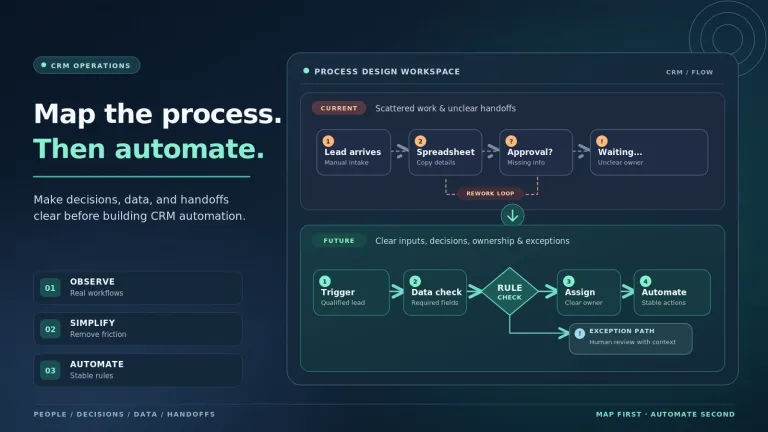
Automation becomes attractive as volume grows, but it depends on stable inputs and ownership. AI features depend on reliable context, understandable permissions, and clear decisions. Scaling technology on top of informal definitions magnifies inconsistency.
Use growth as a trigger to improve data and process before expanding automation. The foundation work creates value even if advanced features are delayed.
Measure Whether Structure Is Helping
Process should earn its cost. Track whether the new CRM approach reduces missed follow-up, duplicate work, handoff delay, forecast disagreement, service repetition, or other problems that justified the change.
If employees spend more time maintaining the CRM but coordination is not improving, simplify. Growth strategy is not successful because the system becomes more sophisticated; it is successful because the organization can serve more customers without losing reliability.
Know What Not to Formalize Yet
Growth can create pressure to document everything because leaders fear inconsistency. Some informal practices should remain informal until their value is clear. Personal note-taking style, meeting preparation habits, or the exact order of low-risk internal tasks may not need centralized rules if they do not affect customer commitments, data quality, security, or cross-team coordination.
A useful test is dependency. Formalize a behavior when other people or systems must rely on it being performed consistently. Leave room for individual judgment where variation does not create meaningful downstream cost. This keeps the CRM focused on shared coordination instead of becoming a rulebook for every aspect of work.
A Practical Growth-Stage CRM Example
A 12-person services company manages prospects in individual spreadsheets and customer history in email. This works until the sales team doubles and a new customer success function is added. Leads receive duplicate outreach, onboarding commitments are not visible to success managers, and the founder becomes the person everyone asks for account context.
The company introduces a shared CRM with a deliberately small scope: customer identity, lead ownership, opportunity stages, meeting outcomes, onboarding handoff, and open commitments. It assigns one operations owner and reviews definitions monthly. Only after those workflows stabilize does it add automated routing, dashboards, and AI-assisted summaries. The company adds structure in the order coordination requires it.
A Growth-Stage CRM Maturity Path
Stage Primary Need CRM Priority
Small team Shared visibility Customer identity, ownership, essential activity and commitments.
Growing functions Reliable handoffs Process definitions, role-based views, lifecycle states.
Increasing volume Consistency and scale Data quality, automation, integrations, reporting.
Complex organization Governance and control Permissions, operating model, standardized core, change management.
Advanced optimization Better prediction and assistance AI readiness, monitoring, explainability, controlled agents.
Common Mistakes to Avoid
Buying for the organization you might become in five years
Excess capability can create complexity before the team has processes to support it. Choose a platform with room to grow but implement the smallest useful operating model now.
Keeping informal ownership too long
As teams grow, customer work cannot depend on knowing who usually handles something. Make ownership visible before missed follow-up becomes normal.
Automating before definitions stabilize
High volume makes automation tempting, but unstable rules scale inconsistency. Standardize critical inputs and exceptions first.
What to Do Next
List recurring coordination failures that have appeared as the team has grown.
Choose the two or three customer workflows where those failures have the highest impact.
Define customer identity, ownership, handoffs, and the minimum data needed for those workflows.
Assign a CRM operations owner and a business owner for each critical process.
Add automation only after users can explain and follow the manual rule consistently.
Review every quarter whether CRM structure is reducing customer friction and employee coordination cost.
Continue Reading on Clientira
Related Clientira guides provide additional context:
CRM Operating Model: How People, Process, Data, and Technology Fit Together
CRM Change Management: How to Introduce New Processes Without Losing Team Buy-In
CRM Process Mapping: How to Find Workflow Problems Before Automating Them
Frequently Asked Questions
When does a small business need a more formal CRM strategy?
When customer context, ownership, follow-up, reporting, or handoffs repeatedly fail because the team can no longer coordinate through memory and informal communication.
Should a growing team implement every CRM feature at once?
No. Start with the workflows and data required for current coordination problems, then expand after the foundation is reliable.
What should a growing company standardize first?
Customer identity, accountable ownership, critical handoffs, core lifecycle definitions, and the small set of data required for important customer decisions are strong starting points.
When should a growing team add AI to CRM?
After the intended AI use case is clear and the underlying customer data, permissions, workflow, and monitoring are reliable enough to support that decision.
Final Thoughts
Informal customer management is not a failure; it is often the fastest way for a small team to operate. The need for CRM strategy appears when the organization can no longer depend on shared memory to maintain consistent customer context and ownership.
Add structure progressively. Protect identity and commitments, stabilize important handoffs, clarify ownership, and strengthen data before layering automation and AI. A growing team’s CRM should become more disciplined as complexity increases without becoming more bureaucratic than the customer work requires.